Establishing secure connection…Loading editor…Preparing document…

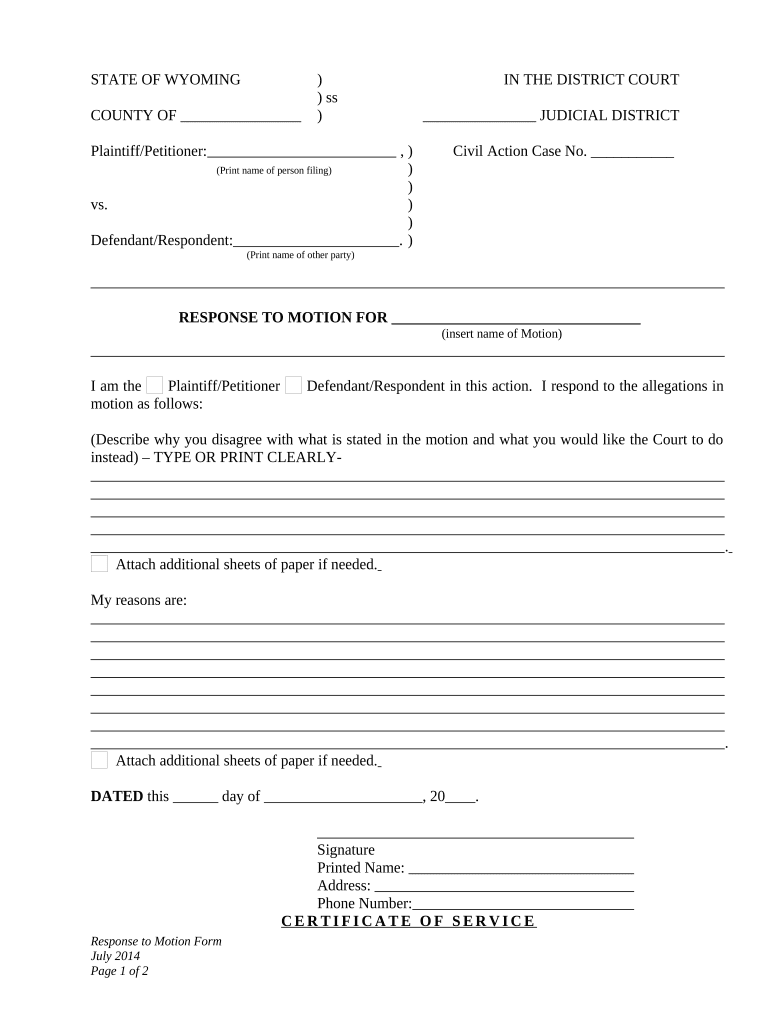
Wyoming Response to Motion

This template is fully customizable. Edit the text, fill out the fields, and send it for signature. Give it a try!
Wyoming Response to Motion

What the Wyoming Response to Motion Is and When it Applies

A Wyoming Response to Motion is a formal written submission filed by a party to oppose, explain, or request modification of a motion submitted to a Wyoming trial court. It typically includes a caption, procedural history, statement of facts, argument with supporting authorities, and a short conclusion stating the requested relief. Responses must comply with the applicable Wyoming Rules of Civil Procedure, local court rules, and federal rules when in federal court; timing and service requirements vary by rule and by judge.

Why a Clear, Rule‑Compliant Response Matters

A properly drafted response preserves rights, provides the court with the claimant’s legal and factual objections, and can prevent adverse default rulings or sanctions. It frames the issues for decision and documents service and compliance with procedural timeframes.

Why a Clear, Rule‑Compliant Response Matters

Who Typically Prepares and Files a Response

When in doubt, consult local rules or court help resources to confirm timing, format, and service methods before filing.

  • Represented parties — attorneys drafting legal arguments, citations, and procedural compliance for clients.
  • Pro se litigants — individuals filing their own response who must follow court formatting and service rules.
  • Clerks or paralegals — assist with filing, service, and docketing to meet court deadlines.

Core Components of a Professional Wyoming Response to Motion

A complete response is organized, legal‑authority driven, and compliant with formatting and service rules. The document must make the party’s position clear, cite controlling law, and request precise relief while preserving procedural defenses such as lack of jurisdiction or insufficient service.

Caption

Court name, case number, party names, and title identifying it as a Response to Motion; must match the original caption exactly.
Introduction

Short statement identifying the motion opposed, the responding party, and the requested disposition (deny, continue, limit, or grant in part).

Statement of Facts

Concise, relevant factual recitation with citations to the record, exhibits, or affidavits supporting the party’s position.

Argument

Legal analysis with headings, citations to statutes, rules, and case law; explain why the motion should be denied or modified.

Conclusion

Clear statement of the precise relief requested and any proposed alternative (e.g., oral argument or discovery schedule).

Signature Block

Name, bar number if attorney, address, telephone, email, and date; include certificate of service showing how and when opposing parties were served.

Step‑by‑Step: Prepare and File a Wyoming Response to Motion

Follow these sequential steps to prepare, verify, and file a compliant response in state or federal court.

  • 01
    Read the Motion: Identify relief requested, supporting exhibits, and cited authority.
  • 02
    Research Law: Confirm controlling statutes, rules, and on‑point cases applicable in Wyoming or federal court.
  • 03
    Draft Response: Assemble caption, facts, argument, and requested relief with proper citations.
  • 04
    Serve and File: Serve opposing counsel and file with the court according to local rules and e‑filing procedures.

Typical Electronic Workflow Settings for eFiling and eService

Configure your e‑filing and document workflow to match court requirements and ensure proof of service is preserved.

Field Configuration
Document Format PDF/A with searchable text for e‑filing systems
File Naming CaseNo_Party_Response.pdf for consistent docketing
Signature Type Typed or drawn e‑signature where allowed; include printed name and date
Service Method Court e‑service and e‑mail or CM/ECF as required

Technical and Integration Considerations for Electronic Submission

Ensure your chosen platform records timestamps and retains copies of served documents to satisfy court and appellate record needs.

  • File Types: PDF/A, DOCX
  • Authentication: Email or court SSO
  • Integrations: CM/ECF and document management

How Electronic Submission and Service Typically Works

Electronic workflows follow a predictable path from drafting to filing and recordation; ensure each step creates verifiable evidence of timing and service.

  • Draft: Prepare the response and supporting exhibits in editable format.
  • Sign: Apply signatures per court rules or attorney requirements.
  • File: Submit via court e‑file system or clerk’s office.
  • Serve: Simultaneously serve opposing counsel by court e‑service or certified methods.

Common Deadlines and Timing Considerations

Deadlines for filing responses depend on whether the case is in state or federal court and on local rules; compute time under Federal Rule of Civil Procedure 6 where applicable.

Federal court (typical):

14–21 days to respond to many motions; check local rules and judge’s standing order

Wyoming state courts:

Varies by county and judge — commonly 14–20 days; consult local rules or clerk

Reply deadlines:

If allowed, replies often due 7–14 days after response is filed

Emergency motions:

Accelerated schedules may require expedited responses within days

Time computation:

Use FRCP 6 or state equivalent to compute calendar vs. business days

Key Processing Milestones After Receiving a Motion

Track these milestones to meet procedural deadlines and preserve appellate rights.

01

Receive Motion

Determine service date and read relief requested and exhibits.

02

Assess Response Window

Calculate deadline using applicable rules and accounting for service method.

03

Draft and Review

Prepare factual and legal content; obtain client signoff if required.

04

File and Serve

File with court and serve opposing counsel with proof of service.

Common Pitfalls to Avoid When Preparing a Response

  • Missing the deadline for filing a response, which can result in the court treating the motion as unopposed or granting relief by default.
  • Failing to attach necessary exhibits or citations to the record, leaving arguments unsupported and subject to dismissal.
  • Improper service or filing method, such as emailing without court approval, which can invalidate the submission.
  • Overloading the response with irrelevant facts or extensive legal history that distracts from dispositive issues and wastes judicial time.

Recordkeeping, Security, and Compliance Essentials

Encryption: TLS 1.2/1.3 in transit
At‑Rest Security: AES‑256 encryption
Audit Trail: Comprehensive timestamp and IP logs
Legal Frameworks: ESIGN and UETA recognized
HIPAA: BAA required for PHI
Compliance Reports: SOC 2 Type II available

Consequences of Incorrect or Late Responses

Motion Granted: Court may grant relief requested by moving party
Sanctions: Monetary fines or attorney fee awards possible
Default Ruling: Failure to respond can be treated as consent
Appeal Issues: Preservation of issues may be lost
Evidence Excluded: Untimely exhibits may be excluded
Professional Risk: Attorney discipline for egregious violations

eSignature Vendor Comparison for Signing and Serving Legal Responses

Selected vendor features and starting prices to consider for executing and sharing court filings or supporting affidavits; signNow is listed first per comparison conventions.

signNow DocuSign Adobe Sign PandaDoc HelloSign
Starting Price $8/user/mo $15/user/mo $14/user/mo $19/user/mo $15/user/mo
Free Trial 7-day trial Varies Varies Varies Varies
Bulk Send Yes (premium tier) Yes Yes Yes No
Audit Trail Yes Yes Yes Yes Yes
HIPAA Compliant Yes Yes Yes No No
Envelope Cap No cap 100 envelopes/user/year Varies Varies Varies

Frequently Asked Questions About the Wyoming Response to Motion

Quick answers to common practical and procedural questions when preparing or filing a response in Wyoming courts.


Need help? Contact support

be ready to get more
Join over 28 million airSlate SignNow users