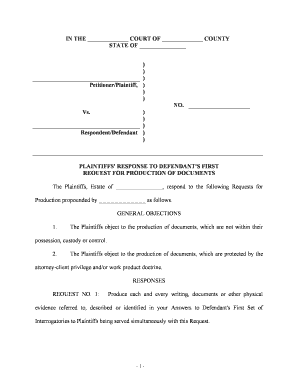
Plaintiffs' Response to Defendant's First Request for Production of Documents
What the Plaintiffs' Response to Defendant's First Request for Production of Documents Is
Why a Clear, Complete Response Matters
A complete response limits later disputes, documents your objections, and shows compliance with discovery rules so courts can focus on the merits rather than process. It creates a contemporaneous record of what was produced and what remains withheld.
Typical Teams That Prepare This Response
After production, counsel documents delivery and retains copies per retention policies to support any later motion or deposition follow-up.
- Plaintiff counsel and partners who approve objections and privilege claims
- Paralegals and litigation support teams who collect and assemble documents
- eDiscovery vendors and IT personnel who extract metadata and produce load files
Who Typically Signs and Submits It
Plaintiff Attorney
A licensed attorney of record signs and certifies the response under applicable rules; the signature affirms that counsel has conducted a reasonable inquiry into the asserted facts and is responsible for any certification statements.
Firm Paralegal
A supervising paralegal or litigation eDiscovery specialist often prepares and transmits the production package under counsel direction, ensuring metadata mapping, Bates numbering, and privilege logs are accurate.
Key Risks of Incomplete or Incorrect Responses
Common Preparation Pitfalls to Avoid
- Overbroad objections that fail to state specific factual or legal basis make responses vulnerable to challenge and motion practice.
- Producing files without native metadata or without a clear Bates scheme creates downstream disputes about completeness and authenticity.
- Failing to include a privilege log or providing an inadequate log leads to presumptions against privilege and possible court orders to produce.
- Late or rolling productions without clear communication increase motion risk and can be cited as discovery abuse.
Step-by-step: Prepare and Serve the Response
-
01Review Requests: Read each numbered request and note scope
-
02Collect Documents: Search custodians, systems, and backups
-
03Review & Redact: Privilege review, redact where justified
-
04Produce & Certify: Deliver files, Bates stamp, and serve response
Where to Send and How to Serve Your Production
-
Opposing Counsel: Serve the production package and response by agreed electronic method
-
Court Filings: File only if required by local rules or court order
-
Meet-and-Confer: Schedule conference to resolve disputes before motion practice
-
Certificate of Service: Document date, method, and recipients for the record
Configure Your Electronic Production Workflow
| Field | Configuration |
|---|---|
| Document repository | Centralized ESI store with timestamped exports |
| Search terms | Use validated keywords and date ranges |
| Redaction process | Dual-review redaction with audit trail |
| Production format | Searchable PDF with load file when required |
Technical Considerations for eProduction and eSignature
Confirm recipients can receive and load the chosen formats and provide access instructions for native files or load files as needed.
- File Formats: PDF, DOCX, XLSX supported
- Integrations: Salesforce, NetSuite, Google Workspace
- Security: AES-256 at rest, TLS 1.2/1.3
Typical Deadlines and Scheduling Expectations
Response Period:
Typically 30 days to respond (see FRCP 34; local rules may shorten/extend)
Extension by Agreement:
Parties may stipulate to extend the deadline by written agreement
Preservation Duty:
Preserve relevant ESI immediately upon notice of litigation or reasonably anticipated suit
Meet-and-Confer:
Engage opposing counsel early to narrow scope and resolve disputes
Motion Timing:
Allow required meet-and-confer time before filing a motion to compel
Key Milestones in Production (Sequential Overview)
Preservation Notice
Issue hold to custodians and IT promptly
Collection Complete
Finish ESI and paper collection for listed custodians
Review Complete
Complete privilege and responsiveness review
Production Delivered
Serve Bates-stamped files and certificate of service
Practical Examples of a Plaintiffs' Production
Document Production — Employment Case
A plaintiff's counsel identified five custodians and collected email and HR files
- Privilege review removed attorney-only drafts
- The production included searchable PDFs, a load file, Bates ranges, and a detailed privilege log to prevent later disputes.
Healthcare Records — Privacy Review
A plaintiff producing medical records coordinated with compliance to apply HIPAA authorizations
- Redacted PHI where necessary and documented redactions
- The production included signed patient authorizations and a chain-of-custody report for authenticity.
Best Practices for a Defensible, Efficient Response
eSignature and eProduction Vendor Pricing Comparison
| signNow | DocuSign | Adobe Sign | PandaDoc | HelloSign | |
|---|---|---|---|---|---|
| Starting Price | $8/user/mo | $15/user/mo | $14/user/mo | $19/user/mo | $15/user/mo |
| Free Trial | 7-day free trial | No | No | Yes, limited | Yes, limited |
| Bulk Send | Yes | Yes | Yes | Yes | No |
| Audit Trail | Yes | Yes | Yes | Yes | Yes |
| HIPAA Compliant | Yes | Yes | Yes | No | No |
| Envelope Cap | No cap | 100 envelopes/user/year | Varies by plan | Varies by plan | Varies by plan |
Frequently Asked Questions: Common Discovery Challenges
-
Can responses be electronically signed?
Yes. Electronic signatures are valid under the ESIGN Act (15 U.S.C. ch. 96) and state UETA statutes where adopted, provided intent, consent, attribution, and retention requirements are met and any consumer disclosures required by law are given.
-
How should privileged material be handled?
Identify privileged items on a privilege log listing document identifiers, date, author, recipients, and privilege basis. Withhold documents when privilege applies and provide sufficient log detail to allow meaningful review without disclosing privileged content.
-
What format should productions use?
Agree with opposing counsel on format—common choices are searchable PDF with load files, native for spreadsheets, and TIFF only when required. Consistency and metadata preservation are key to avoiding disputes.
-
How to produce metadata and attachments?
Produce metadata fields commonly requested (e.g., author, to/cc, sent/received dates, file path) and include native attachments or indicate attachment ranges in the load file to preserve document relationships.
-
What if the response is late?
Notify opposing counsel immediately, explain reasons, propose a remedy, and document meet-and-confer efforts. Courts may impose sanctions; prompt transparency can mitigate consequences.
-
Do state rules affect remote notarization?
Yes. Remote online notarization and witness requirements vary by state. Confirm local notary and RON rules before relying on digital notary services for any executed affidavits or declarations.