Establishing secure connection…Loading editor…Preparing document…

Revocation of License

This template is fully customizable. Edit the text, fill out the fields, and send it for signature. Give it a try!
Revocation of License

What a Revocation of License Is and When it Applies

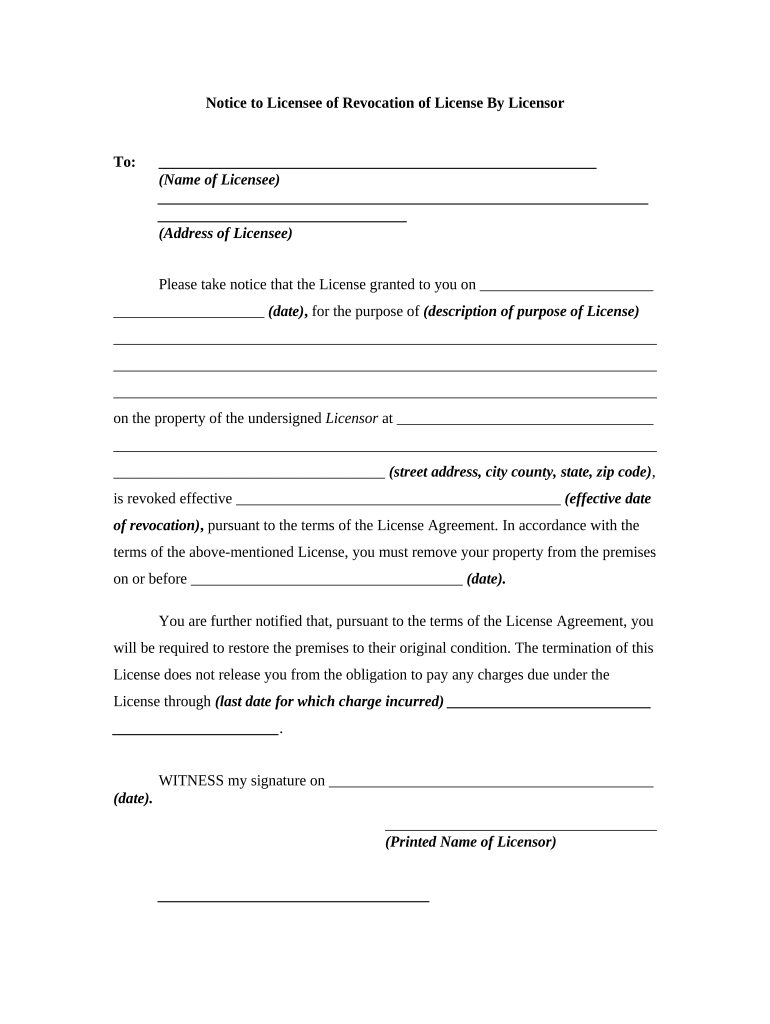
A Revocation of License is a written legal notice that terminates or withdraws previously granted permission for a party to use property, intellectual property, a business right, or a licensed activity. The document names the licensor and licensee, identifies the original license terms, states the grounds for revocation, sets an effective date, and explains required actions such as cessation of use, return of materials, and disposition of deposits or escrow. Properly drafted revocations create clear evidence for enforcement, reduce ambiguity, and establish remedies if the licensee continues use after termination.

Why a Clear Revocation Matters

A formal revocation creates an auditable record that preserves rights, stops unauthorized use, and documents compliance steps. It reduces litigation risk by giving licensees explicit notice, a defined effective date, and remediation instructions.

Why a Clear Revocation Matters

Who Typically Issues or Responds to a Revocation

Use role-specific templates and signatory rules so notices reach the correct decision-maker and meet service or filing requirements.

  • Licensors and rights holders such as IP owners, software vendors, landlords, and content owners who must stop licensed use quickly.
  • In-house counsel, compliance officers, and contract managers tasked with enforcing or documenting license termination and preserving remedies.
  • Licensees and their legal representatives who must confirm receipt, cease use, return materials, and negotiate any cure or reinstatement.

Essential Elements Every Professional Revocation Should Include

A complete document balances clarity, legal sufficiency, and enforceability by calling out specific facts, dates, and remedies.

Parties

Identify licensor and licensee by full legal name and entity type. Include addresses and contact details to ensure proper service and avoid mistaken identity.
License Details

Cite the original agreement, license number or reference, effective dates, scope of rights granted, and any key contractual provisions being revoked.

Revocation Clause

State the specific action taken (full or partial revocation), the factual or contractual grounds, and whether revocation is immediate or after a stated cure period.

Effective Date

Provide a clear effective date in MM/DD/YYYY format or state 'upon delivery' if immediate; specify time zone if time of day matters for compliance.

Return and Post-Revocation Duties

Describe required steps: return or destruction of materials, removal of licensed marks, cessation of distribution, and confirmation procedures with deadlines.

Remedies and Dispute Process

List remedies (injunctive relief, damages, indemnification) and any dispute-resolution path such as arbitration or litigation venue and governing law.

Required Information to Record in the Document

Legal Names: Full legal entity names
Contact Details: Street address and email
License Reference: Agreement title or ID
Effective Date: MM/DD/YYYY format
Grounds Cited: Breach or statutory reason
Signature Block: Signer name and capacity

Step-by-Step: Preparing and Delivering a Revocation of License

Follow a concise sequence to prepare, authenticate, deliver, and record the revocation to maximize enforceability.

  • 01
    Prepare: Verify original license details and attach the cited agreement.
  • 02
    Draft: State grounds, effective date, required actions, and remedies.
  • 03
    Authenticate: Have authorized signer sign and notarize if needed.
  • 04
    Deliver: Serve the notice per contract notice clause and retain delivery proof.

How to Configure an Online Revocation Workflow

Set up authentication, fields, and retention rules to ensure the electronic process meets legal and contractual requirements.

Field Configuration
Authentication Use email with SMS code or identity verification (KBA) depending on risk.
Signature Type Allow electronic signature; require digital certificate for high-assurance records.
Notarization Enable RON or schedule in-person notarization if state or contract requires it.
Storage Retain signed PDF and audit trail in encrypted archive with access logs.

Typical Routing and Filing Steps for the Notice

A simple routing process improves traceability: create, assign, authenticate, and file with proof of service.

  • Create Document: Draft and attach the original license excerpt.
  • Send Notice: Deliver via contract-specified method and record transmission.
  • Sign & Notarize: Obtain authorized signature and notarization if required.
  • Archive & Serve: Store the signed record and serve copies to stakeholders.

Technical Requirements for Digital Completion and eFiling

Confirm the provider offers audit logs, encrypted storage, and integrations with systems like Salesforce, NetSuite, Microsoft 365, or Box to maintain record continuity.

  • File Formats: PDF and DOCX support
  • Authentication: Email, SMS, or KBA
  • Integrations: CRM and cloud storage

Typical Timelines, Deadlines, and Processing Expectations

Timelines depend on contract terms and statutory notice requirements; confirm cure periods and service rules before issuing notice.

Effective Date:

The date specified in the notice when obligations cease.

Cure Period:

If the contract allows, provide the stated cure period (commonly 10–30 days).

Service Window:

Allow time for delivery verification if sending by certified mail or courier.

Notarization Timing:

Schedule notarization before or immediately after signing as contract requires.

Internal Review:

Allow legal and compliance teams 3–5 business days to review language.

Common Mistakes to Avoid

  • Using vague descriptions that fail to identify the specific license or agreement increases the risk of a successful challenge by the licensee.
  • Sending notice to an incorrect or old address; verify the recipient's registered agent and notice address before delivery.
  • Failing to follow contract-specified notice, cure, or escalation procedures can render the revocation procedurally invalid.
  • Omitting required authentication, notarization, or proof of authority for the signer can undermine enforceability in court.

Potential Consequences of an Incorrect or Improper Revocation

Breach Claims: Counterclaims or damages
Injunction Risk: Court-ordered reversal possible
Monetary Liability: Damages, fees, and indemnity costs
Regulatory Fines: Sector fines for noncompliance
Contractual Penalties: Liquidated damages or termination fees
Reputational Harm: Business relationships impacted

eSignature Providers to Consider for Revocations (signNow First)

Compare starting prices and core features relevant to executing and retaining a Revocation of License. Confirm HIPAA or industry compliance needs when selecting a provider.

signNow DocuSign Adobe Sign PandaDoc HelloSign
Starting Price $8/user/mo $15/user/mo $14/user/mo $19/user/mo $15/user/mo
Free Trial 7-day trial Varies Varies Varies Varies
Bulk Send Yes Yes Yes Yes No
Audit Trail Yes Yes Yes Yes Yes
HIPAA Compliant Yes Yes Yes No No

Real-World Examples of Signable Legal Notices

Organizations use e-signed legal notices where rapid, auditable delivery is essential; these examples show how signed records support operations.

Martin Properties

A regional property management firm needed fast, enforceable notices for lease and license terminations.

  • They required mobile signing and offline access for field agents.
  • "I can process and execute all of these documents online with 100% compliance and built-in security. Whether on mobile or working offline, I can get forms back to their necessary parties efficiently."

BIS

An enterprise legal team standardised notices and proof of service across jurisdictions.

  • They prioritized audit trails and compliance certifications.
  • "We felt most comfortable with airSlate SignNow given their SOC 2 certification and strict focus on ESIGN and UETA act compliance."

Frequently Asked Questions About Revocation of License

Answers to common questions about enforceability, electronic signatures, notarization, and retention for a Revocation of License.


Need help? Contact support

be ready to get more
Join over 28 million airSlate SignNow users