Establishing secure connection…Loading editor…Preparing document…

Revocation of Power of Attorney

This template is fully customizable. Edit the text, fill out the fields, and send it for signature. Give it a try!
Revocation of Power of Attorney

What a Revocation of Power of Attorney Is

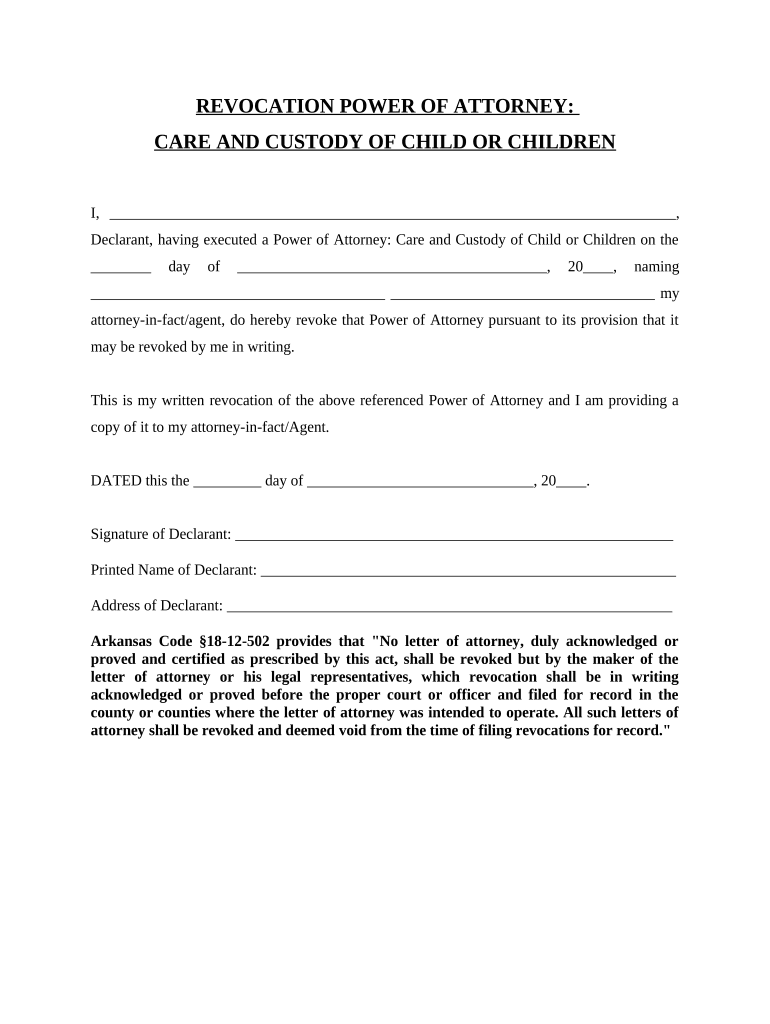
A Revocation of Power of Attorney is a written instrument that terminates previously granted authority from a principal to an agent (attorney-in-fact). It identifies the original POA, declares it revoked, and notifies relevant parties that the agent no longer has the authority to act. The document should include clear identification of the principal and agent, the effective date of revocation, signatures, and any required notarization or witness attestations to ensure enforceability.

Why and When Revoking an Existing Power of Attorney Matters

Revoking a POA restores decision-making control to the principal and prevents an agent from continuing to act after the principal’s wishes change. A formal written revocation provides clear notice to third parties, reduces fraud risk, and supports legal enforceability when the revocation is delivered properly.

Why and When Revoking an Existing Power of Attorney Matters

Who Typically Prepares or Receives a Revocation

Intended users include principals revoking authority, attorneys advising clients, and institutions receiving notice of termination.

  • Principals and grantors who want to terminate previously given powers and control future decision-making.
  • Agents / attorneys-in-fact who must be formally informed to stop acting under the revoked authority.
  • Banks, healthcare providers, and government agencies that must be notified to refuse future agent actions.

Proper preparation and timely distribution to the agent and relevant third parties are essential to make the revocation effective and defensible.

Representative Signers and Roles

Principal

The individual who originally granted the power of attorney. The principal must sign the revocation; if incapacitated, state incapacity rules and prior durable POA terms will affect who can revoke.

Agent

The named attorney-in-fact who held authority under the original POA. The agent should receive a copy and confirmation; failure to notify third parties can result in unintended agent actions.

Core Elements to Include in a Professional Revocation

A complete revocation contains specific references to the original document, unambiguous revocation language, identification of parties, and execution details. Including these elements reduces ambiguity and improves acceptance by banks, medical providers, and courts.

Revocation Statement

A clear declaration such as 'I hereby revoke all powers granted by the Power of Attorney dated [date].' This unambiguous language removes doubt about intent and scope.
Original POA Details

Reference the original POA by date, parties, and document type so third parties can match the revocation to the correct authorization.

Principal Identification

Full legal name, date of birth, and current address for the principal to avoid mistaken identity with similarly named persons.

Agent Identification

Full legal name and contact details for the agent whose authority is revoked; helps third parties confirm who is affected.

Execution Details

Principal signature, date, and notary/witness block as required by state law or institutional policy to validate the revocation.

Delivery Instructions

Statement describing how notice will be provided to the agent and relevant third parties, and the effective date of revocation.

Step-by-Step: Completing and Delivering a Revocation

Follow these sequential steps to ensure the revocation is valid, delivered, and recognized by relevant parties.

  • 01
    Prepare the Document: Reference the original POA and state the unambiguous revocation language.
  • 02
    Sign and Notarize: Sign in front of a notary or witnesses if required by state law or institution.
  • 03
    Notify the Agent: Deliver a signed copy directly to the agent with proof of delivery when possible.
  • 04
    Notify Third Parties: Send copies to banks, healthcare providers, and agencies that relied on the original POA.

Typical Delivery and Recognition Workflow

A standard workflow moves from preparation to signed execution, then to targeted delivery and confirmation of receipt.

  • Prepare: Draft revocation that references the original POA.
  • Execute: Sign and notarize or witness as required.
  • Deliver: Provide copies to agent and third parties.
  • Confirm: Obtain written acknowledgment when possible.

Digital Workflow Settings for Online Completion

When using an eSignature platform, configure fields and authentication to match legal and institutional requirements.

Field Configuration
Signature Field Required; date stamp enabled
Notary Field Optional; enable when notarization needed
Authentication Email + SMS code or ID verification
Delivery Method Email with read receipt or certified mail

Platform and Technical Considerations for eSigning

Choose an eSignature workflow that supports required authentication, audit logs, and optional notarization features.

  • Authentication: Email and SMS code options
  • Audit Trail: Capture IP, timestamp, and actions
  • Integrations: Connects with common CRMs

Confirm the platform supports the legal requirements (notary, witness, retention) for the states and institutions involved before finalizing e-execution.

Common Preparation and Delivery Mistakes to Avoid

  • Failing to reference the original POA by date and parties, which can cause third parties to ignore the revocation.
  • Not notifying banks and healthcare providers directly, allowing agents to continue unauthorized transactions.
  • Using vague revocation language that leaves room for interpretation by institutions or courts.
  • Relying solely on verbal revocation without a signed, dated, and delivered written document.

Risks and Legal Consequences of an Improper Revocation

Unauthorized Actions: Agent may continue to act if not properly notified
Financial Loss: Third parties may honor agent transactions causing monetary harm
Liability: Principal could face challenges proving timely revocation
Record Disputes: Unrecorded revocations complicate title and account histories
HIPAA Exposure: Improper notice may lead to unauthorized medical access
Court Intervention: Disputes can require probate or court adjudication

Practical Tips for a Smooth Revocation Process

Follow clear execution steps, deliver copies to all relying parties, and retain proof of delivery to strengthen enforceability.

Use Clear Language
State ‘I revoke’ and reference the exact date of the original POA to avoid ambiguity and rejection by institutions.
Get Notarized When Possible
Notarization reduces challenges and is required by some institutions; for remote cases, consider RON where available and accepted.
Deliver Directly
Send revocation to the agent and all third parties that previously relied on the POA and obtain acknowledgments when possible.
Keep Proof
Retain signed copies, delivery receipts, and any returned acknowledgments to defend against later claims.

Practical Examples of Revocation Scenarios

Two common scenarios show how revocations work in practice and what documentation helps resolve disputes.

Agent Removed

A principal decides to replace an agent after a falling-out and signs a revocation referencing the POA date

  • The principal delivers certified copies to the agent and bank
  • The bank updates account access after receiving the notarized revocation and delivery receipt, preventing further agent transactions.

Healthcare Access Withdrawn

A patient revokes medical access granted to a family member following a change in preference

  • The patient signs a dated revocation and provides copies to the provider and health plan
  • The provider flags the record and requires updated authorization forms before releasing records to the former agent.

eSignature Pricing and Feature Snapshot for Revocation Workflows

Compare entry pricing and key features relevant to executing and distributing revocations; signNow is listed first per vendor comparison conventions.

signNow DocuSign Adobe Sign PandaDoc HelloSign
Starting Price $8/user/mo $15/user/mo $14/user/mo $19/user/mo $15/user/mo
Free Trial 7-day free trial No No Yes, limited Yes, limited
Bulk Send Yes Yes Yes Yes No
Audit Trail Yes Yes Yes Yes Yes
HIPAA Compliant Yes Yes Yes No No

Frequently Asked Questions About Revoking a Power of Attorney

Answers to common procedural and acceptance questions when revoking a POA, focused on practical steps and acceptance concerns.


Need help? Contact support

be ready to get more
Join over 28 million airSlate SignNow users