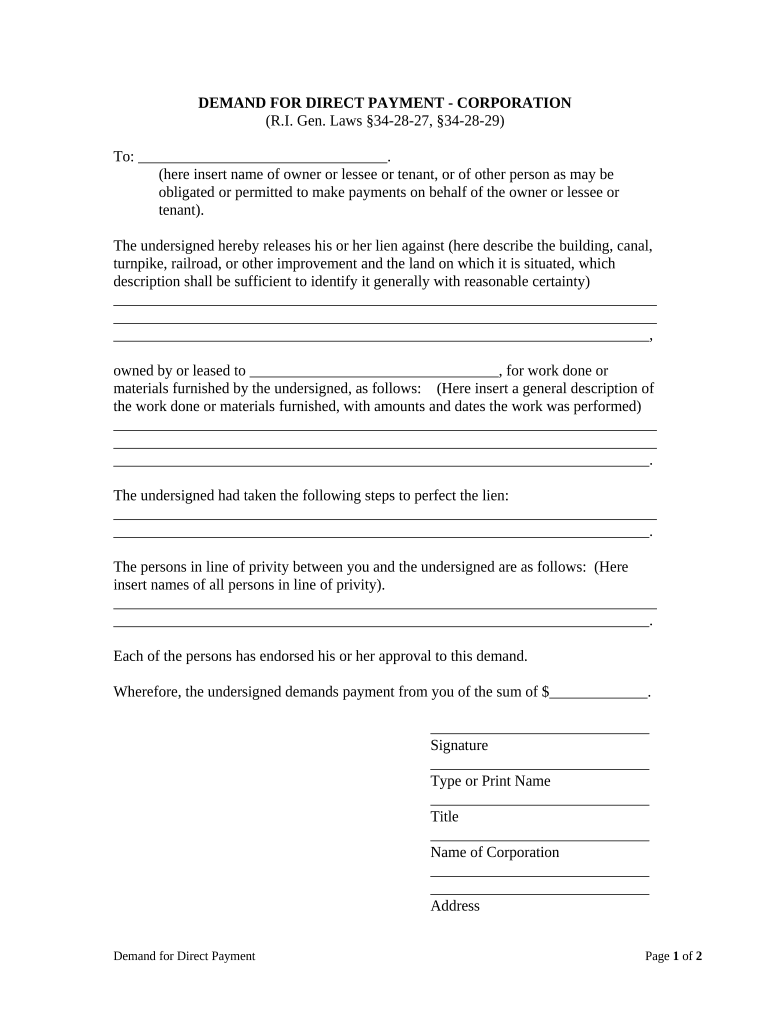
Demand for Direct Payment
What a Demand for Direct Payment Is and When It’s Used
Why a Clear Demand for Direct Payment Matters
A concise, well-documented demand reduces disputes, enables faster reconciliation, and creates an auditable record that supports collections or legal remedies if necessary. It also clarifies payment routing and tax-reporting obligations for both parties.
Who Typically Prepares or Receives This Demand
Relevant parties include payees seeking payment, accounts receivable teams, project managers, and payers' accounts payable personnel; each has distinct responsibilities when a demand is issued.
- Accounts receivable teams — prepare and track demands, attach invoice numbers and aging, and escalate unpaid items according to company policy.
- Project managers or contractors — issue demands on behalf of subcontractors or suppliers to ensure correct project accounting and lien rights preservation.
- Accounts payable staff — review demands, confirm invoice validity, route approvals, and execute the direct payment per contract or instruction.
Clear role allocation reduces processing delays and ensures the demand is acted on within internal control and payment-cycle timelines.
Stepwise Process to Prepare and Send the Demand
-
01Gather Documentation: Collect invoices, contracts, delivery receipts, and lien waivers if applicable.
-
02Populate the Demand: Enter payer/payee, invoice references, amounts, payment method, and deadline.
-
03Attach Supporting Files: Attach PDFs of invoices and agreements to the demand record.
-
04Send and Track: Deliver via the chosen channel and record the delivery method and timestamp.
Configuring an Online Workflow for Direct Payment Demands
| Field | Configuration |
|---|---|
| Payer Field | Dropdown linked to vendor master |
| Invoice Field | Auto-validate invoice numbers |
| Attachment Field | Require PDF upload |
| Approval Step | Sequential routing to approver |
Typical Flow from Draft to Payment
-
Draft Demand: Payee prepares demand with invoice and proof of delivery.
-
Internal Approval: Accounts receivable or project manager verifies amounts.
-
Send to Payer: Deliver by agreed channel and record timestamp.
-
Payment Execution: Payer processes payment and confirms remittance details.
Delivery Options and Platform Requirements
Choose a delivery method that provides proof of delivery and integrates with your records management system.
- Email: Simple and fast; use read receipts and attach PDFs for evidence.
- Certified Mail: Provides postal proof of delivery; useful for formal notice requirements.
- Secure Portal: Preferred for high-volume or sensitive transactions; preserves access logs.
Ensure the selected channel records timestamps and sender/recipient details; integrate delivery records with accounting systems for reconciliation.
Common Preparation Pitfalls to Avoid
- Incomplete invoice references that prevent matching in payer systems and delay payment.
- Mismatched payee name or bank details that cause returns or backup withholding triggers.
- Sending by an insecure channel without an auditable trail, increasing dispute risk.
- Failing to attach proof of delivery or acceptance, weakening later collection or lien claims.
Consequences of an Incorrect or Missing Demand
Typical Timelines and Processing Expectations
Immediate Acknowledgement:
Request confirmation within 2–3 business days
Standard Payment Window:
Commonly 7–30 calendar days from receipt
ACH Processing:
Typically 1–3 business days after initiation
Wire Transfers:
Often same-day or next-business-day
Escalation:
Begin collection steps after stated deadline passes
Key Milestones from Demand to Resolution
Issue Demand
Payee sends demand with invoices and remittance details.
Acknowledge Receipt
Payer confirms receipt and expected payment date.
Payment Processing
Payer executes ACH, wire, or check per instructions.
Reconciliation
Payee confirms funds received and applies to invoices.
eSignature Pricing and Feature Snapshot for Document Delivery
| signNow | DocuSign | Adobe Sign | PandaDoc | HelloSign | |
|---|---|---|---|---|---|
| Starting Price | $8/user/mo | $15/user/mo | $14/user/mo | $19/user/mo | $15/user/mo |
| Free Trial | 7-day free trial | Varies | Varies | Varies | Varies |
| Bulk Send | Yes | Yes | Yes | Yes | Varies |
| Audit Trail | Yes | Yes | Yes | Yes | Yes |
| Envelope Cap | No cap | 100 envelopes/user/year | Varies | Varies | Varies |
Frequently Asked Questions About the Demand for Direct Payment
-
Is an electronic demand legally binding?
Yes, electronic demands can be binding when they satisfy ESIGN and UETA factors: intent to sign, consent to conduct business electronically, attribution to the signer, and reliable record retention (15 U.S.C. §7001; UETA). Certain exceptions like wills or court orders remain unsuitable for e-signature.
-
What proof of delivery is acceptable?
Acceptable proof includes email delivery receipts, certified mail return receipts, portal access logs, or audit trails capturing recipient identity, timestamp, and document version. Use methods that preserve an auditable chain of custody.
-
When should I notarize the demand?
Notarization is not routinely required for commercial payment demands but may be needed where state law or contract requires notarized notices or when preserving lien remedies. Check jurisdictional rules before adding notary fees.
-
Can a demand be revoked after sending?
Revocation depends on contract terms and timing. If the payer has already acted on the demand (initiated payment), revocation may be ineffective; otherwise, send a written retraction and document delivery. Consult counsel for disputes.
-
What supporting documents should I include?
Include the original invoice(s), proof of delivery or acceptance, contract references, and any prior correspondence. These attachments streamline payer review and strengthen collection or enforcement options.
-
How long should I retain demand records?
Retain demands for the active agreement term plus at least three years; follow federal and industry retention rules such as IRS recordkeeping (IRC §6501(a)) and HIPAA where applicable (45 CFR §164.530(j)). State rules may require longer retention.