Establishing secure connection…Loading editor…Preparing document…

Right of First Refusal Shareholders Agreement

This template is fully customizable. Edit the text, fill out the fields, and send it for signature. Give it a try!
Right of First Refusal Shareholders Agreement

What a Right of First Refusal Shareholders Agreement Is

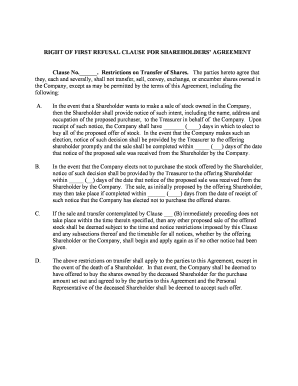
A Right of First Refusal Shareholders Agreement is a contract among a company and its shareholders that restricts transfers of stock by giving existing shareholders or the company the first opportunity to purchase shares before they are sold to third parties. The agreement defines triggering events, notice procedures, valuation methods, time limits to exercise the right, and remedies for breach. It helps preserve ownership structure, prevent unwanted investors, and provide an orderly mechanism for share transfers in private companies, closely held corporations, and startup cap tables.

Why parties use a Right of First Refusal Shareholders Agreement

A clear ROFR agreement reduces ownership disputes, preserves control, and sets predictable sale mechanics. It protects minority and majority interests by ensuring existing shareholders can match third-party offers and prevents dilution from unexpected transfers.

Why parties use a Right of First Refusal Shareholders Agreement

Who typically uses this agreement

Different stakeholders rely on ROFR provisions to control share transfers and protect economic or governance rights.

  • Founders and majority shareholders who want to restrict outsider ownership and preserve voting control.
  • Investors and venture capital firms seeking preemptive access to attractive secondary sales.
  • Company legal counsel and officers who manage corporate governance and recordkeeping for equity transactions.

The agreement is common in startups, family companies, closely held businesses, and venture-backed entities where orderly transfer rules are essential.

Representative signer profiles

Founder-CEO

A founder who holds voting control and wants to keep equity within the founding team. They use the ROFR to block transfers that would change control and to ensure any sale offers are first offered to insiders, often requiring valuation mechanics and quick exercise windows.

Institutional Investor

A venture investor or private equity firm that requires ROFR clauses to protect exit value and maintain strategic influence. The investor typically negotiates clear notice, matching procedures, valuation methods, and transfer exceptions in term sheets and subscription agreements.

Core elements to include in a professional ROFR shareholders agreement

A well-drafted agreement balances enforceability and clarity. Include concrete procedures for offers, timing, valuation, exceptions, and remedies to reduce future disputes and ensure predictable outcomes.

Triggering Events

Specify which transfers trigger the ROFR (e.g., sale, gift, pledge, assignment) and exclude routine transfers like estate distributions where appropriate.
Notice Procedure

Describe how an offer is presented to holders — required content, delivery method, and start of the exercise window.

Exercise Window

Fix a clear period (in days) for holders to accept or decline the offer and detail extensions or partial exercises.

Valuation Method

Provide a valuation formula or third-party appraisal process to establish price and resolve disputes over fair value.

Permitted Transfers

List carve-outs such as transfers to affiliates, family members, or pursuant to estate planning to avoid unintended obstacles.

Remedies

State consequences for breach (specific performance, injunctive relief, damages) and whether transfer voids occur if procedures are not followed.

How to complete and execute a ROFR shareholders agreement

Follow a consistent sequence to ensure the document is enforceable and recorded in corporate books.

  • 01
    Review Existing Documents: Check articles, bylaws, and shareholder registers for conflicting provisions.
  • 02
    Draft or Update Terms: Define triggers, notice, valuation, and exceptions in clear language.
  • 03
    Obtain Signatures: Have all required parties sign; follow authentication rules for electronic signatures.
  • 04
    File with Records: Record agreement in corporate minute book and update share ledger.

Typical ROFR transaction workflow

A standard sale uses a short, repeatable workflow so parties understand rights and deadlines.

  • Offer to Transfer: Selling shareholder delivers a written offer with price and terms.
  • Notice to Holders: Company or holders receive the offer per contract notice rules.
  • Exercise Decision: Eligible holders accept, decline, or partially exercise within the window.
  • Transfer Completion: If exercised, sale closes and share ledger is updated.

Recommended digital workflow settings

Configure eSignature workflows to mirror the agreement's procedural steps and evidence requirements.

Field Configuration
Signer Authentication Email plus optional SMS code or SSO for higher assurance
Routing Order Sequential routing preserves clear approval history
Expiration & Reminders Set expiration (e.g., 30 days) and automated reminders
Storage & Audit Store signed PDF with audit trail and export options

Technical considerations for eExecution and storage

Ensure your platform supports required formats, authentication, and retention to prove execution and attribution.

  • File Formats: PDF, DOCX, HTML, XLSX
  • Integrations: Salesforce, NetSuite, Google Workspace
  • Authentication: Email, SMS, KBA, SSO

Store executed copies in a secure, access-controlled repository and preserve the audit trail to meet evidentiary needs.

Common timing elements and typical durations

The agreement should state explicit timeframes. Below are common contractual durations used by practitioners.

Offer Notice Period:

Commonly 10–30 days for holders to receive and review the offer.

Exercise Window:

Typical 15–45 days for exercise; specify extension rules if any.

Closing and Transfer:

Allow 7–30 days after exercise for payment and share transfer.

Record Update Timeline:

Company should update the share ledger immediately upon closing.

Statute of Limitations Note:

Contractual claims use state limitations; consult counsel for applicable period.

Key milestones from offer to transfer

A numbered milestone sequence clarifies obligations and evidentiary steps for parties and corporate officers.

01

Trigger Event Occurs

Sale, assignment, or other defined transfer event initiates the process.

02

Notice Issued

Seller provides written offer containing material terms and price.

03

Exercise Period

Holders decide to accept, partially accept, or decline within the set window.

04

Transfer & Ledger Update

Closing, payment, and immediate update of corporate ownership records.

Common drafting and execution pitfalls

  • Ambiguous valuation clauses that leave price determination to dispute and litigation risk.
  • Vague notice or delivery mechanics that create uncertainty about when the exercise window begins.
  • Failure to list permitted transfers or carve-outs, unintentionally blocking routine estate or affiliate transfers.
  • Incomplete signing or mismatched names between share certificates and agreement parties causing enforcement problems.

Security and compliance considerations for e-signed agreements

Encryption: TLS 1.2/1.3 in transit; AES-256 at rest
Audit Trail: Timestamps, IP, and action logs retained
Certifications: SOC 2 Type II and ISO 27001 available
HIPAA Support: BAA available where PHI is involved
21 CFR Part 11: Controls for regulated records supported
ESIGN / UETA: Conforms with ESIGN and UETA principles

Potential legal and commercial risks of a flawed agreement

Enforceability Risk: Ambiguities may render clauses unenforceable in court
Breach Remedies: Counterparties may pursue damages or injunctive relief
Tax Consequences: Unintended transfer characterization can trigger tax liabilities
Operational Delay: Poor procedures can slow valid transfers and business actions
Litigation Costs: Disputes over valuation or notice raise legal expenses
Recordkeeping Failures: Missing ledger updates can impair future financing or M&A

How ROFR compares with related transfer mechanisms

ROFR is one of several transfer controls; the table summarizes key distinctions versus common alternatives.

Criteria Right of First Refusal Tag-Along Right
Transfer Control
Shareholder Consent Needed often automatic participation
Typical Use prevent outside buyers protect minority sale proceeds
Notification Requirement formal written notice seller typically must notify

eSignature platform pricing and capability snapshot

Basic vendor pricing and feature availability for executing and storing shareholders agreements electronically. Confirm plan details with the vendor before purchase.

signNow DocuSign Adobe Sign PandaDoc HelloSign
Starting Price $8/user/mo $15/user/mo $14/user/mo $19/user/mo $15/user/mo
Free Trial 7-day trial Varies by plan Varies by plan Varies by plan Varies by plan
Bulk Send Yes Varies by plan Varies by plan Varies by plan Varies by plan
Audit Trail Yes Yes Yes Yes Yes
HIPAA Compliant Yes Yes Yes Varies by plan Varies by plan
Envelope Cap No cap 100 envelopes/user/year Varies Varies Varies

Practical examples of ROFR in use

Two condensed examples show how ROFR clauses operate in real scenarios and the practical outcomes they produce.

Startup Example

Founder receives an unsolicited purchase offer from an outside buyer

  • Existing investors are notified per contract
  • Investors exercise their ROFR, matching the offer and keeping ownership internal while avoiding litigation over price determination.

Investor Exit Example

A minority investor seeks to sell to a strategic buyer

  • Company issues formal notice to shareholders
  • The company declines, investor sells only after follow-up procedures, and proceeds are distributed per agreement terms while cap table stays intact.

Practical drafting and execution tips

Apply clear, objective language and consistent procedures to reduce disputes and speed transactions.

Be specific on valuation
Use defined formulas, appraisal procedures, or a tied-price mechanism to limit disagreement and litigation over fair value.
Set clear notice rules
Specify required notice content, delivery methods, and when the exercise clock starts to avoid timing disputes.
Include carve-outs
Define permissible family, affiliate, and estate transfers to reduce operational friction and unintended blockers.
Preserve audit evidence
Keep executed copies, delivery receipts, and the eSignature audit trail to support enforcement or future transactions.

Frequently asked questions about ROFR shareholders agreements

Answers to common execution, enforceability, and procedural questions to help practitioners avoid mistakes and comply with U.S. electronic signature rules.


Need help? Contact support

be ready to get more
Join over 28 million airSlate SignNow users