Establishing secure connection… Loading editor… Preparing document…
Navigation

Fill and Sign the Sale Business Form
Fill and Sign the Sale Business Form

How it works

Open the document and fill out all its fields.
Apply your legally-binding eSignature.
Save and invite other recipients to sign it.

Rate template

4.5
64 votes
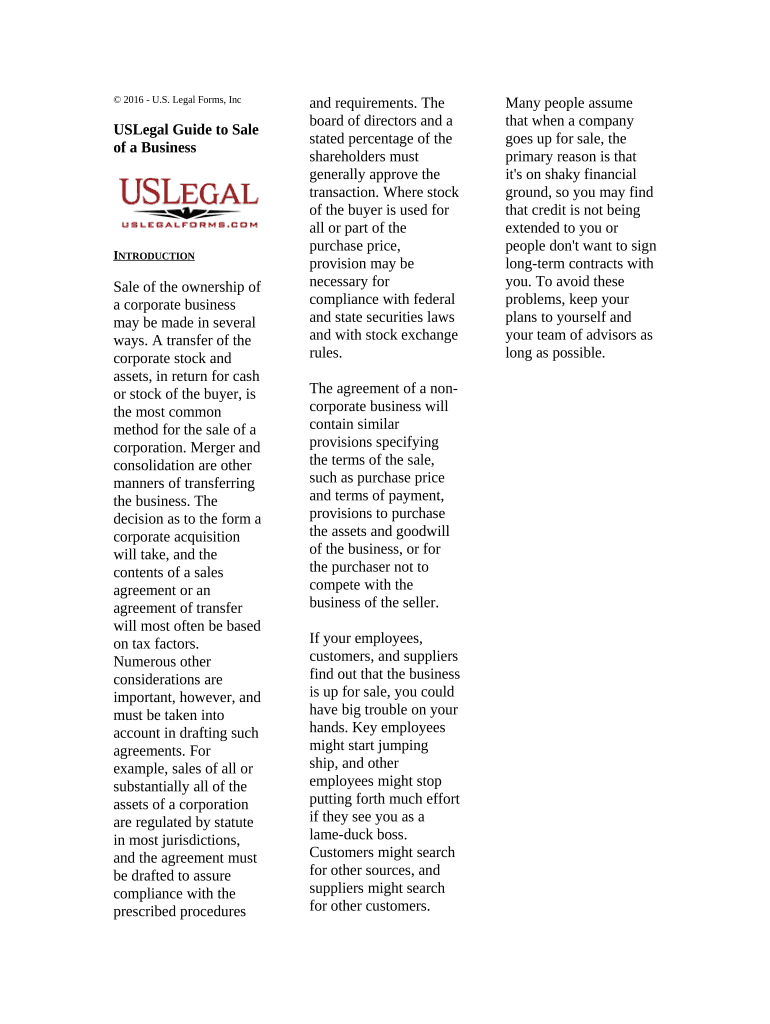
© 2016 - U.S. Legal Forms, Inc USLegal Guide to Sale of a Business I NTRODUCTION Sale of the ownership of a corporate business may be made in several ways. A transfer of the corporate stock and assets, in return for cash or stock of the buyer, is the most common method for the sale of a corporation. Merger and consolidation are other manners of transferring the business. The decision as to the form a corporate acquisition will take, and the contents of a sales agreement or an agreement of transfer will most often be based on tax factors. Numerous other considerations are important, however, and must be taken into account in drafting such agreements. For example, sales of all or substantially all of the assets of a corporation are regulated by statute in most jurisdictions, and the agreement must be drafted to assure compliance with the prescribed procedures and requirements. The board of directors and a stated percentage of the shareholders must generally approve the transaction. Where stock of the buyer is used for all or part of the purchase price, provision may be necessary for compliance with federal and state securities laws and with stock exchange rules. The agreement of a non- corporate business will contain similar provisions specifying the terms of the sale, such as purchase price and terms of payment, provisions to purchase the assets and goodwill of the business, or for the purchaser not to compete with the business of the seller. If your employees, customers, and suppliers find out that the business is up for sale, you could have big trouble on your hands. Key employees might start jumping ship, and other employees might stop putting forth much effort if they see you as a lame-duck boss. Customers might search for other sources, and suppliers might search for other customers. Many people assume that when a company goes up for sale, the primary reason is that it's on shaky financial ground, so you may find that credit is not being extended to you or people don't want to sign long-term contracts with you. To avoid these problems, keep your plans to yourself and your team of advisors as long as possible. B UY – S ELL A GREEMENTS A buy - sell agreement is an agreement between partners of a partnership or between a shareholder and a corporation whereby the parties agree to the terms and conditions of a future sale of the partners or shareholder's interest. By signing the agreement, the party contractually limits his or her ability to dispose of his or her interest in the partnership or corporation to the terms of the agreement. It may provide for the transfer of shares upon the death of a partner or shareholder. A buy - sell agreement is useful in assuring the orderly transfer of interests in the partnership or corporation. By limiting a party's ability to dispose of his or her interest in the partnership or corporation, control of the partnership or corporation may be assured. These agreements provide for the later modification upon written agreement by all stockholders or partners. S ELLING M EMORANDUM A selling memorandum presents information about your company, products, industry, and market in a simplified format that presents your company in a very positive light. The beginning contains an executive summary that briefly lays out your key selling points, and tells the buyer why you want to sell. Other sections describe the facts about your company's history, structure, and operations; the asking price and basic terms you're looking for; your industry, market, and products; your employees and physical assets; historical and projected financial statements; and any other information that will explain why this is such a strong opportunity. Be mindful of your audience don't divulge any information that you wouldn't want your competitors to see. Your selling memorandum is essentially a marketing tool, but it is recommended to have it reviewed by a lawyer and accountant (it's likely that your accountant will provide the financial information you include). It is important that the statements are accurate and not misleading or incomplete, even though in most cases the memorandum is not considered a prospectus that would need to comply with SEC or state securities regulations.. Don't try to cover up problems, as this will likely cause distrust by the buyer for everything you say after that. You could be also sued for fraud. Do not show your selling memorandum to anyone who hasn't signed a confidentiality agreement. That includes your accountant, business broker, and other professionals (your lawyer will already be bound by professional responsibility requirements so a formal confidentiality agreement isn't necessary). D ISCLOSURE D UTIES In dealing with potential buyers, you must be truthful and complete in the information you share about your business. It's fine to be optimistic and present the positive side of things. For example, you may prepare a selling memorandum that highlights all the advantages your company has over the competition. However, you also need to be inform the buyer of any potential problems in your business you are aware of. You should present possible solutions when you discuss them, but they must be disclosed to avoid claims involving fraud. You can be sued for fraud if you make material misrepresentations of fact about your business. Material generally means anything that, if known to the buyer, would cause a change in the price paid for the business. Misrepresentation may also include failing to speak.. The fact that the buyer didn't ask you if your customers were likely to cancel their contracts next year doesn't mean that you can't be sued for not mentioning it. Misrepresentations can be something that you knew but didn't disclose, or in some cases information that you were reckless or grossly negligent in not finding out. The issue of liability for fraud is one reason you should have your lawyer review any written material you pass on to buyers, to be sure that it is accurate and provides all the information it should. To be successful in a lawsuit for fraud, the buyer would have to prove that he or she reasonably relied on your statement (or the fact that you made no statement). Reasonable reliance implies that the buyer uses common sense in relying on the statement. This is one reason the buyer conducts a due diligence investigation of your business before the purchase agreement is signed. Securities fraud potentially applies to all business transactions. If you sell the stock in your corporation, or accept stock in the buyer's corporation as payment, you may be required to make disclosure obligations under federal and state securities laws. If you're contemplating a transaction that involves a sale or exchange of stock, expert legal assistance on a variety of issues should be sought, including what you can, can't, and must say about your business. Fraudulent conveyance is another claim that may be raised by creditors. If you and the buyer set up a deal in such a way that one or both of you should have known that the transferred company would fail, you may be liable to pay back the purchase price. For example, if you are overly optimistic, and lead the buyer to take on more debt than the company can repay, the company may go bankrupt. The bankruptcy judge can require you to pay back the purchase price and rescind the sale. This is to give any unsecured creditors of the business a fair chance at getting paid when the company is liquidated. Your potential liability for fraudulent conveyance may last for up to six years after the sale, so it's important that you check out the buyer and his or her resources, to be sure that the company has a good chance of survival after you sell it. S ALES A GREEMENTS The sales agreement is the key document in buying the business assets or stock of a corporation. It is important to make sure the agreement is accurate and contains all the terms of the purchase. It is recommended to have an attorney review this document. The agreement should define everything that you intend to purchase of the business, assets, customer lists, intellectual property, and goodwill. The following is a checklist of items, among others, that should be addressed in the agreement: Names of Seller, Buyer, and Business Background information Assets being sold Purchase price and Allocation of Assets Covenant Not to Compete Any adjustments to be made The Terms of the Agreement and payment terms List of inventory included in the sale Compliance with the Bulk Sales laws of the state Any representation and warranties of the seller Any representation and warranties of the buyer Determination as to the access to any business information Determination as to the running of the business prior to closing Contingencies Possibilities of having the seller continue as a consultant Fees, including brokers fees Date of closing Get the signed purchase agreement into escrow immediately and sign off any contingencies quickly. Make sure you go through the Allocation of Purchase Price in the beginning of the escrow process not at the end which happens most of the time. B UYING AN E XISTING B USINESS Most businesses are purchased by companies as a means of diversification or expansion. In these situations several of the ingredients of success are usually present: the business has good reasons for the acquisition, it has experience in the industry to be entered through long contact, it has skilled people to evaluate acquisition candidates, it has the means to make the purchase in cash or through contact with funding sources, and it has the ability to run the purchased business. Nevertheless, many acquisitions flounder. Similarly, the prospective buyer may be a wealthy individual with many years of business experience but presently no corporate base. Such an individual is functionally equivalent to a company in means and in experience. Buying an existing business is also, finally, one of the alternatives available to the would-be entrepreneur. He or she faces the same decision manufacturers call the "make or buy" decision: Should we tool up to make this product or buy it from someone else? To make some-thing from scratch usually takes longer but offers opportunities to shape the product exactly as the builder intends it to function. To buy the product usually gets the buyer to the starting line much faster but limits his or her choice to a preexisting design. The individual entering business must keep in mind that buying a business is not a way to avoid initial fund-raising chores. In its summary of the issue, for example, the U.S. Small Business Administration (on its site titled "Buying a Business") makes the following somewhat erroneous statement: "Many find the idea of running a small business appealing, but lose their motivation after dealing with business plans, investors, and legal issues associated with new start-ups. For those disheartened by such risky undertakings, buying an existing business is often a simpler and safer alternative." The reason entrepreneurs worry over business plans and talk to investors is because they want to raise money they don't have. A person lacking funds but wishing to buy an existing business must also project the business into the future, have a plan, and undergo the process of raising funds. Books exist that boldly promise to teach the entrepreneur how to buy a business with not a penny down—but few people actually have the persuasive powers or profiles of experience to make that sort of thing happen. Buying rather than building a business is a decision to be reached after the funding effort has at least been started and looks reasonably promising. Once the funding issues are resolved sufficiently to turn the entrepreneur into an actual buyer, meaning that at least a portion of the down payment is in hand, the key elements of buying a business are 1) formulation of clear objectives (homework), 2) search and contact, 3) evaluation of the target (sometimes called due- diligence), and 4) negotiation and purchase. These elements are very frequently iterated in an actual acquisition program, meaning that failure to close deals and the learning that has taken place while getting to an unsatisfactory result will cause the entrepreneur to rethink the process, sometimes from the beginning. Initial homework consists of exploring the industry or specialty that looks most suitable to the talents and experience of the buyer. A part of that homework is to learn the going price for different types of enterprises. That, in turn, may cause changes —and even require additional fundraising efforts. A search for candidates may reveal that not too many businesses are available or available in the right locations, that prices may be high or most candidates in trouble. Evaluation of businesses after contact may generate wrong assumptions about the real returns possible. Negotiations may fail. Buying a company is almost always a learning process unless the buyer is very experienced, (perhaps even working in the business already) the business to be purchased and its ownership are well known (possibly in the extended family), and everything is easily negotiated because of previous relationships. OBJECTIVES A buyer's earlier experience (business or avocational) usually sets the stage for formulating goals. Buyers rarely set out to buy into altogether unknown industries, but they may not know the business at its highest levels. For example, a person may know a business from an operational but not from a marketing point of view—or the reverse. Some kind of homework is usually involved. SEARCH Sellers of businesses will advertise themselves or engage the services of a business broker. Finding candidates is thus similar to recruiting employees. Sources of leads are newspaper ads, the Internet, or brokers who also advertise themselves. Well- developed Internet resources usually enable a buyer to locate businesses within a state or zip code zone further subdivided by type of business and even asset- size categories. Brokers specializing in different regions or nationally are relatively easy to find. Substantial searching around is, of course, implied—but provides a great deal of information on what is available, what asking prices are, and where the nearest targets are located. Searching can be handed to a broker who will then call or e-mail the buyer with suggestions. Examples of sites, including one that advertises businesses for sale directly (cityfeetBiz) and of brokers (United Business Brokers, serving cities in Utah, Nevada, California, and Idaho), are provided in the references; there are many more. EVALUATION Once contact has been established with a candidate, a process of mutual exploration begins, usually with a visit to the candidate's place of business where, following a tour of the place, preliminary discussions begin. The motivations of buyers and sellers are essentially the same. Each wishes to establish the qualifications of the other—and the buyer must therefore be prepared to give as much as he/she gets, namely to display his or her abilities to buy the business. If the buyer has no business identity, the seller will usually ask for references and not make financial disclosures beyond those advertised until the buyer's status and net worth have been carefully checked. In the normal course of events several contacts will take place before the buyer can obtain information sufficient to study the targeted business closely. That process is described further later in this entry. Evaluation of a business is central to price negotiations later and must be carried out with care and diligence in order to avoid legal and financial problems later. NEGOTIATIONS AND PURCHASE Assuming that the evaluation has produced satisfactory results, negotiations may become necessary to resolve remaining open issues. These can take many forms and may deal with just about any aspect of the business, from the handling of certain liabilities to employment contracts for key employees or executives. Eventually a purchase agreement will be drawn up, usually involving legal professionals, and the purchase finalized with signatures and transfers of funds. EVALUATION OF A BUSINESSES The evaluation of a business can be divided into four clusters: the seller's history and motivations, legal matters affecting the operation, the financial status of the business, and the condition and prospects of the business in its market (its products, services, and future). The buyer, of course, will want to know the history of the business, how it came about, how it developed, and why the seller is now willing to sell. The usual reason for the sale of a small business is the age of the seller: he or she wishes to retire and does not have children or relatives willing to take over. A business is also often for sale because it is being spun off from a larger operation because it no longer fits. Why it no longer fits then becomes a matter of interest to the buyer— who is, above all, interested in discovering weaknesses in the business. Legal matters concern pending lawsuits or regulatory problems some of which may have to be dealt with by the new owner. Leases and other long-term legal obligations are usually reviewed in this context —ideally with the help of the buyer's own legal advisor. Financial evaluation is based on the thorough review of the company's books—its balance sheet and income statement going back at least five years or to the beginning of the business, whichever is earlier. Ideally, again, audited financial returns are best or, if the seller is unwilling to pay for an audit, tax filings with the IRS can be used for a separate view of finances. Sole proprietorships and partnerships do not have stock and therefore sales of the businesses are always based on assets; the level of attention to assets will therefore depend on their character and value. Depending on the situation, the buyer may wish to undertake an inventory of assets at his or her own expense or to engage the services of an appraiser. Such detailed checking of physical assets is not usual, however, but inspections by knowledgeable people (if the buyer lacks personal expertise) are usually arranged. Normally the books of a well-run business will accurately reflect asset values. If the business is poorly run, the offered price can hedge against risks. Most careful buyers will use the company's financial data to develop an alternative valuation of the business using discounted cash flow analysis. For more detail on this subject, please see the entries titled Discounted Cash Flow and Mergers & Acquisitions in this volume. Such valuation typically involves projecting operating results of the business out in time, which requires a good grasp of the company's products, processes, and likely futures sales and profits in an evolving market— the last category of evaluation. The value of the business as calculated using such analysis is then compared to the asking price. If the two values are reasonably close, an agreement is likely. If far apart, negotiations need to ensue or the buyer may elect to stop discussions. Finally, the buyer must strive to understand the business thoroughly enough to have confidence to run it in the future. From an internal perspective this means a good grasp of how the company is run internally, who its suppliers are, how processes run—and above all the state and morale of the employees. Looked at from the outside, the buyer must understand the company's distribution channel(s), major customers or categories of customers, the market itself, and forces that impact on that market. In fact, direct contact with the customers of the company being sold is highly advisable— being, in effect, an early effort of marketing to the buyer's future customers. Some businesses operate in very tricky environments. An example may be an environmental services provider whose business absolutely demands strict government enforcement to underpin sales. In such a case careful examination of regulatory trends—and their easing or tightening in good and bad economic times—may reveal hidden weaknesses in a business. This broad analysis, delving deeply into details that invite a closer look, is invaluable in making projections into the future. FINANCING Whether the buyer and seller ultimately agree to an installment sale, a leveraged buyout, a stock exchange, or an earn-out to transfer ownership of the company (see the entry Selling a Company for descriptions of these options), the sale cannot proceed if the buyer is unable to secure adequate financing. Most small businesses are acquired by buyers who finance a considerable portion of the purchase price themselves. Even so, the buyer must still make sure that he or she has enough money to make a down payment and cover the business's capital requirements. Sometimes, then, buyers are forced to secure financing from outside sources. The level of these will depend on the buyer's personal investment. Lenders or investors like to see the buyer deeply committed before they come to the table pen in hand. Lending institutions like banks and consumer finance companies are more open to borrowers involved in purchasing larger companies, but even in these instances, the institutions often ask buyers to put up the company's inventory, machinery, real estate, and accounts receivable as collateral. Sensible buyers in need of outside financing will make certain that they approach potential lenders with a comprehensive and well-considered loan proposal (including a good business plan). Thus the entrepreneur is unlikely to avoid that task even when buying an existing business. CLOSING THE DEAL Closings are generally done either by means of an escrow settlement or through the services of an attorney who performs settlement. In an escrow settlement, the money to be deposited, the bill of sale, and other relevant documents are placed with a neutral third party known as an escrow agent until all conditions of sale have been met. After that, the escrow agent disburses the held documents and funds in accordance with the terms of the contract. If an attorney performs settlement, meanwhile, he/she—acting on behalf of both buyer or seller, or for the buyer—draws up a contract and acts as an escrow agent until all stipulated conditions of sale have been met. Whereas escrow settlements do not require the buyer and the seller to get together to sign the final documents, attorney- performed settlements do include this step. Several documents are required to complete the transaction between business seller and business buyer. The purchase and sale agreement is the most important of these, but other documents often used in closings include the escrow agreement; bill of sale; promissory note; security agreement; settlement sheet; financing statement; and employment agreement. BIBLIOGRAPHY cityfeetBiz. Web Site. Available from http://www.cityfeetbusin essesforsale.com/. Retrieved on 26 May 2006. Ennico, Cliff. "Buying a Business; Getting a Private Mailbox." Entrepreneur. 17 June 2003. Hollander, Linda. Bags to Riches: Success Secrets for Women in Business. Celestial Arts, 2003. "How to Buy a Business." Entrepreneur. 6 September 2005. Klueger, Robert F. Buying and Selling a Business: A Step-by- Step Guide. John Wiley & Sons, 2004. Steingold, Fred, and Emily Dostow. The Complete Guide to Buying a Business. Nolo, 2005. Tuttle, Samuel S. Small Business Primer: How To Buy, Sell, and Evaluate a Business. streetsmartbooks, 2002. United Business Brokers. Web Site. Available from http://unitedbusinessbro kers.com/. Retrieved on 26 May 2006. U.S. Small Business Administration. "Buying a Business." Available from http://www.sba.gov/start ing_business/startup/buy .html. Retrieved on 25 May 2006. Hillstrom, Northern Lights updated by Magee, ECDI

Useful instructions on finalizing your ‘Sale Business Form’ digitally

Feeling overwhelmed with paperwork? Look no further than airSlate SignNow, the leading eSignature platform for both individuals and businesses. Bid farewell to the monotonous task of printing and scanning documents. With airSlate SignNow, you can effortlessly complete and sign documents online. Take advantage of the powerful features included in this intuitive and cost-effective platform to transform your document management strategy. Whether you need to approve forms or collect signatures, airSlate SignNow simplifies the process, requiring only a few clicks.

Follow this detailed guide:

  1. Access your account or register for a complimentary trial with our service.
  2. Select +Create to upload a file from your device, cloud storage, or our template collection.
  3. Open your ‘Sale Business Form’ in the editor.
  4. Click Me (Fill Out Now) to set up the form on your end.
  5. Insert and designate fillable fields for other participants (if necessary).
  6. Proceed with the Send Invite settings to solicit eSignatures from others.
  7. Download, print your copy, or convert it into a reusable template.

No need to worry if you have to collaborate with others on your Sale Business Form or send it for notarization—our platform offers all the tools you need to accomplish such tasks. Sign up with airSlate SignNow today and take your document management to the next level!

Here is a list of the most common customer questions. If you can’t find an answer to your question, please don’t hesitate to reach out to us.

Need help? Contact Support

The best way to complete and sign your sale business form
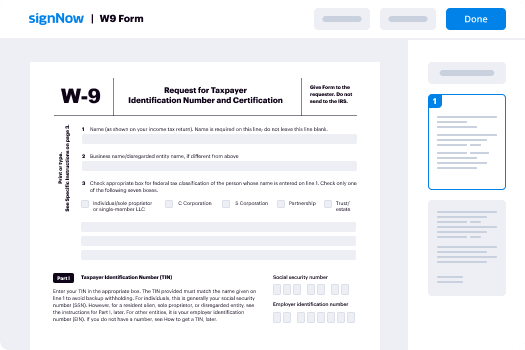
Save time on document management with airSlate SignNow and get your sale business form eSigned quickly from anywhere with our fully compliant eSignature tool.

How to Sign a PDF Online How to Sign a PDF Online

How to fill out and sign documents online

Previously, working with paperwork required pretty much time and effort. But with airSlate SignNow, document management is quick and simple. Our powerful and user-friendly eSignature solution enables you to effortlessly fill out and eSign your sale business form online from any internet-connected device.

Follow the step-by-step guidelines to eSign your sale business form template online:

  • 1.Sign up for a free trial with airSlate SignNow or log in to your account with password credentials or SSO authorization option.
  • 2.Click Upload or Create and import a file for eSigning from your device, the cloud, or our form library.
  • 3.Click on the file name to open it in the editor and use the left-side menu to fill out all the empty areas accordingly.
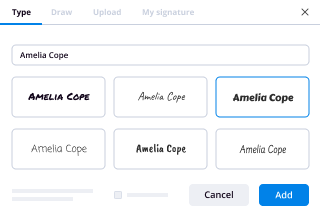
  • 4.Drop the My Signature field where you need to approve your sample. Provide your name, draw, or upload a photo of your regular signature.
  • 5.Click Save and Close to accomplish editing your completed document.

As soon as your sale business form template is ready, download it to your device, save it to the cloud, or invite other people to electronically sign it. With airSlate SignNow, the eSigning process only takes a couple of clicks. Use our robust eSignature solution wherever you are to deal with your paperwork successfully!

How to Sign a PDF Using Google Chrome How to Sign a PDF Using Google Chrome

How to fill out and sign documents in Google Chrome

Completing and signing paperwork is easy with the airSlate SignNow extension for Google Chrome. Adding it to your browser is a quick and efficient way to deal with your paperwork online. Sign your sale business form sample with a legally-binding electronic signature in just a few clicks without switching between applications and tabs.

Follow the step-by-step guidelines to eSign your sale business form in Google Chrome:

  • 1.Navigate to the Chrome Web Store, locate the airSlate SignNow extension for Chrome, and add it to your browser.
  • 2.Right-click on the link to a document you need to sign and select Open in airSlate SignNow.
  • 3.Log in to your account using your password or Google/Facebook sign-in option. If you don’t have one, sign up for a free trial.
  • 4.Use the Edit & Sign menu on the left to fill out your template, then drag and drop the My Signature field.
  • 5.Upload a photo of your handwritten signature, draw it, or simply enter your full name to eSign.
  • 6.Make sure all information is correct and click Save and Close to finish modifying your form.

Now, you can save your sale business form template to your device or cloud storage, email the copy to other people, or invite them to eSign your document with an email request or a protected Signing Link. The airSlate SignNow extension for Google Chrome enhances your document workflows with minimum time and effort. Try airSlate SignNow today!

How to Sign a PDF in Gmail How to Sign a PDF in Gmail How to Sign a PDF in Gmail

How to complete and sign forms in Gmail

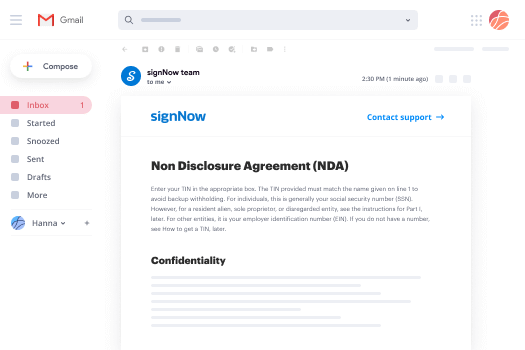
Every time you receive an email with the sale business form for signing, there’s no need to print and scan a file or save and re-upload it to a different program. There’s a much better solution if you use Gmail. Try the airSlate SignNow add-on to quickly eSign any documents right from your inbox.

Follow the step-by-step guide to eSign your sale business form in Gmail:

  • 1.Navigate to the Google Workplace Marketplace and locate a airSlate SignNow add-on for Gmail.
  • 2.Install the tool with a related button and grant the tool access to your Google account.
  • 3.Open an email containing an attached file that needs approval and use the S key on the right sidebar to launch the add-on.
  • 4.Log in to your airSlate SignNow account. Opt for Send to Sign to forward the document to other parties for approval or click Upload to open it in the editor.
  • 5.Drop the My Signature option where you need to eSign: type, draw, or upload your signature.

This eSigning process saves efforts and only takes a few clicks. Take advantage of the airSlate SignNow add-on for Gmail to update your sale business form with fillable fields, sign paperwork legally, and invite other parties to eSign them al without leaving your inbox. Improve your signature workflows now!

How to Sign a PDF on a Mobile Device How to Sign a PDF on a Mobile Device How to Sign a PDF on a Mobile Device

How to complete and sign forms in a mobile browser

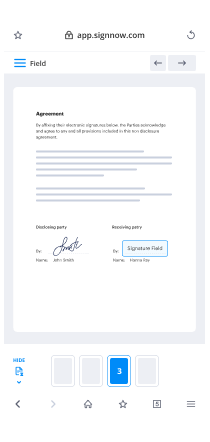
Need to quickly complete and sign your sale business form on a mobile phone while doing your work on the go? airSlate SignNow can help without the need to set up extra software applications. Open our airSlate SignNow tool from any browser on your mobile device and create legally-binding eSignatures on the go, 24/7.
Follow the step-by-step guidelines to eSign your sale business form in a browser:

  • 1.Open any browser on your device and go to the www.signnow.com
  • 2.Sign up for an account with a free trial or log in with your password credentials or SSO option.
  • 3.Click Upload or Create and add a file that needs to be completed from a cloud, your device, or our form catalogue with ready-to go templates.
  • 4.Open the form and fill out the blank fields with tools from Edit & Sign menu on the left.
  • 5.Add the My Signature field to the form, then type in your name, draw, or upload your signature.

In a few easy clicks, your sale business form is completed from wherever you are. Once you're done with editing, you can save the file on your device, build a reusable template for it, email it to other people, or invite them eSign it. Make your paperwork on the go quick and efficient with airSlate SignNow!

How to Sign a PDF on iPhone How to Sign a PDF on iPhone

How to fill out and sign forms on iOS

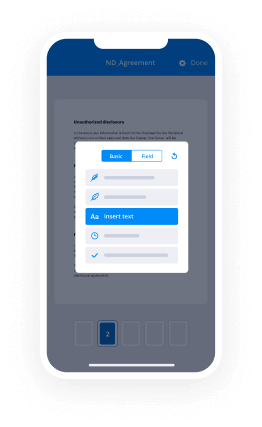
In today’s business community, tasks must be done quickly even when you’re away from your computer. Using the airSlate SignNow app, you can organize your paperwork and approve your sale business form with a legally-binding eSignature right on your iPhone or iPad. Install it on your device to conclude contracts and manage documents from just about anywhere 24/7.

Follow the step-by-step guidelines to eSign your sale business form on iOS devices:

  • 1.Open the App Store, find the airSlate SignNow app by airSlate, and set it up on your device.
  • 2.Launch the application, tap Create to add a template, and choose Myself.
  • 3.Select Signature at the bottom toolbar and simply draw your autograph with a finger or stylus to eSign the form.
  • 4.Tap Done -> Save after signing the sample.
  • 5.Tap Save or use the Make Template option to re-use this document in the future.

This method is so simple your sale business form is completed and signed in a few taps. The airSlate SignNow app works in the cloud so all the forms on your mobile device remain in your account and are available whenever you need them. Use airSlate SignNow for iOS to boost your document management and eSignature workflows!

How to Sign a PDF on Android How to Sign a PDF on Android

How to fill out and sign documents on Android

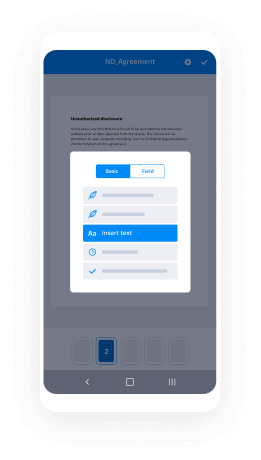
With airSlate SignNow, it’s simple to sign your sale business form on the go. Set up its mobile application for Android OS on your device and start improving eSignature workflows right on your smartphone or tablet.

Follow the step-by-step guide to eSign your sale business form on Android:

  • 1.Go to Google Play, search for the airSlate SignNow app from airSlate, and install it on your device.
  • 2.Log in to your account or register it with a free trial, then import a file with a ➕ button on the bottom of you screen.
  • 3.Tap on the uploaded file and select Open in Editor from the dropdown menu.
  • 4.Tap on Tools tab -> Signature, then draw or type your name to eSign the template. Complete blank fields with other tools on the bottom if required.
  • 5.Use the ✔ key, then tap on the Save option to end up with editing.

With an easy-to-use interface and full compliance with major eSignature standards, the airSlate SignNow app is the perfect tool for signing your sale business form. It even operates offline and updates all form changes once your internet connection is restored and the tool is synced. Complete and eSign documents, send them for eSigning, and create re-usable templates anytime and from anywhere with airSlate SignNow.

Sign up and try Sale business form
  • Close deals faster
  • Improve productivity
  • Delight customers
  • Increase revenue
  • Save time & money
  • Reduce payment cycles