Establishing secure connection…Loading editor…Preparing document…

Agreement for Sale of Law Practice with Restrictive Covenant

This template is fully customizable. Edit the text, fill out the fields, and send it for signature. Give it a try!
Agreement for Sale of Law Practice with Restrictive Covenant

What this Agreement Is and When it Applies

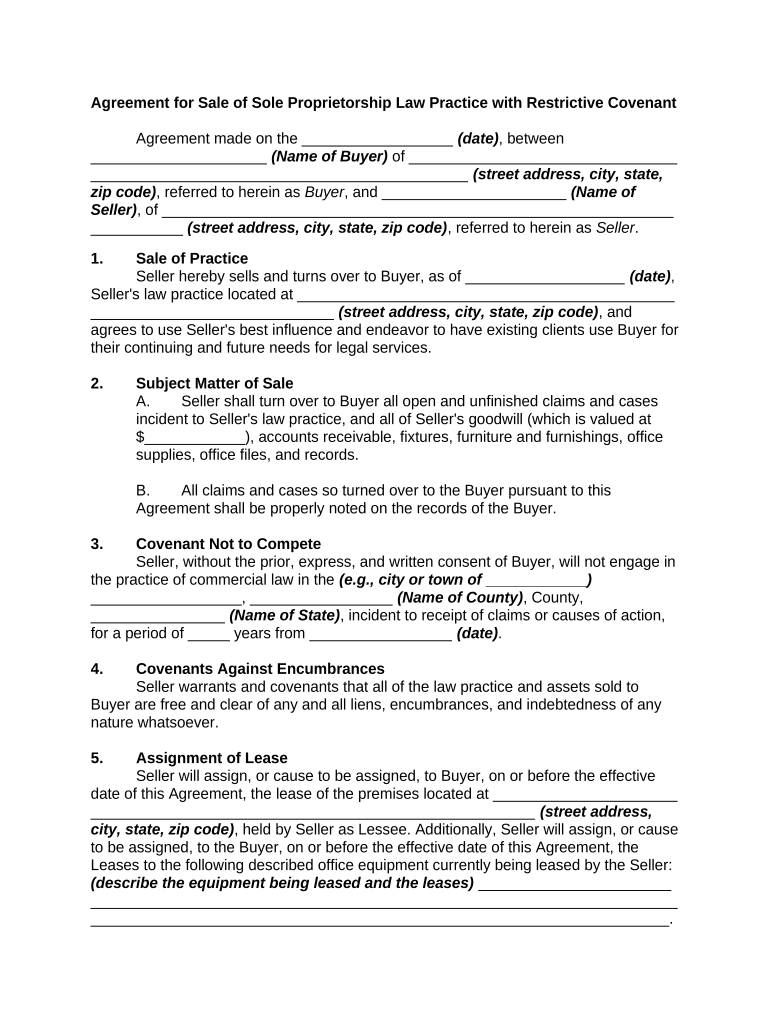
An Agreement for Sale of Law Practice with Restrictive Covenant is a written contract by which an attorney or firm transfers ownership of a law practice's assets, client matters, and related goodwill to a buyer, while the seller agrees to post-closing restraints on practice or solicitation. The agreement typically covers included assets, excluded matters, purchase price and payment terms, transitional obligations, client-file handling, and a covenant limiting competition or solicitation for a defined period, territory, and scope. It governs ethical, client-consent, tax, and professional-license issues that arise during and after the transfer.

Why a Formal Sale Agreement with a Restrictive Covenant Matters

Use a formal agreement to document the scope of assets transferred, protect client confidentiality, allocate liabilities, and set enforceable limits on post-sale competition. A clear covenant reduces post-closing disputes, supports valuation, and clarifies transitional responsibilities for client communication, files, and trust accounts.

Why a Formal Sale Agreement with a Restrictive Covenant Matters

Who typically uses this agreement

Typical users include solo practitioners, retiring partners, acquiring attorneys, and law firm managers arranging asset or practice transfers.

  • Selling attorney or retiring partner negotiating exit terms and client transitions.
  • Purchasing attorney or firm acquiring client files, goodwill, and fee streams.
  • Practice managers and compliance officers coordinating records, trust accounting, and ethical notices.

Each party should involve counsel and, where applicable, an accountant to address tax consequences and bar rules.

Roles who sign and enforce the agreement

Selling Attorney

A sole practitioner or partner who transfers practice assets and agrees to noncompetition or nonsolicitation terms. Seller responsibilities often include client notices, transfer of files, and cooperating with transition for a short handover period.

Purchasing Attorney

An individual or entity acquiring the practice who assumes client relationships subject to consent, may take over fee arrangements, and is responsible for post-closing client communications, trust accounting, and continued compliance with professional rules.

Core elements to include in the sale agreement

A comprehensive agreement addresses the assets sold, purchase price mechanics, client consents, transitional services, restrictive covenant specifics, and representations and warranties — each with measurable terms and timelines.

Assets Included

List tangible and intangible assets, client lists, files, goodwill, and any technology transferred; attach detailed schedules and exhibits.
Purchase Price

State total consideration, payment schedule, escrow terms, and any earnout or holdback tied to collections or accounts receivable.

Client Transition

Describe notice template, consent process, file transfer methods, and who will handle pending matters until effective date.

Restrictive Covenant

Define geographic scope, duration, prohibited activities, carve-outs, and remedies for breach; tailor to reasonableness under state law.

Representations

Seller and buyer representations on authority, outstanding liabilities, fee splits, and compliance with professional rules.

Post-Closing Support

Specify consulting period, staff transition, access to records, and training or introductions to clients.

Step-by-step: completing the agreement

Follow a sequence from negotiation through closing to ensure client protections, ethical compliance, and clean transfer of assets.

  • 01
    Negotiate Terms: Agree on assets, price, and covenant scope in writing.
  • 02
    Due Diligence: Buyer reviews files, conflicts, trust accounts, and liabilities.
  • 03
    Draft Agreement: Counsel prepares express clauses, schedules, and consents.
  • 04
    Execute & Close: Signatures, payments, client notices, and file delivery occur.

Post-closing and amendment checklist

After closing, follow a clear checklist for transition tasks and documented amendments if circumstances change.

01

Client Notices:

Send written notices and obtain client consents when required.
02

Trust Accounting:

Reconcile and transfer retainers per state bar rules.
03

File Transfer:

Deliver or copy files, preserving privileged materials and redactions.
04

Staff Transition:

Offer employment terms or referral agreements for staff.
05

Amendment Process:

Use a written amendment signed by both parties for changes.
06

Post-Closing Audit:

Confirm collections, unsettled matters, and final accounting.

Typical document flow for signatures and handover

A predictable signing and delivery sequence reduces risk and preserves client rights during transfer.

  • Prepare Documents: Assemble agreement, schedules, and client-consent forms.
  • Signatures: Parties sign; witnesses or notarization if required.
  • Client Notification: Provide notices and obtain consents as needed.
  • File Handover: Transfer physical or electronic files with inventory.

Setting up a digital signing workflow

Configure routing, authentication, and storage to match the agreement's security and ethical requirements.

Field Configuration
Routing Order Choose sequential or parallel signing per party roles
Authentication Use email, SMS code, or stronger multi-factor options
Notary / RON Enable RON sessions when notarization is required
Retention Archive executed copies and audit trails for compliance

Technical and format considerations for eSigning

Choose a platform that supports required formats, notarization options, and audit trails.

  • File Formats: PDF and DOCX supported
  • Integrations: Salesforce, NetSuite, Google Workspace, Microsoft 365
  • Audit Trail: IP, timestamp, and signer certificate capture

Ensure the vendor supports secure storage, export to trusted repositories, and any necessary BAAs for protected data.

Security and compliance controls to verify

ESIGN / UETA: Legal framework for e-sign enforceability
HIPAA (BAA): BAA required for PHI handling
SOC 2: Third-party control assurance available
Encryption: TLS 1.2/1.3 in transit; AES-256 at rest
21 CFR Part 11: Support for FDA-regulated records
ISO 27001: Information security management certification

Common preparation errors to avoid

  • Failing to obtain or document client consent for transfer of ongoing matters, which can breach ethical rules and impede post-sale billing.
  • Drafting an overly broad restrictive covenant that courts may find unreasonable and therefore unenforceable under state law.
  • Not reconciling or segregating trust account funds before transfer, exposing parties to regulatory and disciplinary risk.
  • Neglecting to allocate accounts receivable and unpaid fees clearly, resulting in post-closing disputes over collections and adjustments.

Potential legal and professional risks

Ethics Sanctions: Disbarment risk
Civil Liability: Breach damages exposure
Restrictive Void: Covenant unenforceable
Tax Consequences: Unanticipated liabilities
Trust Account Penalty: Regulatory fines
Client Claims: Malpractice or fee disputes

Practical scenarios that illustrate common structures

These example scenarios show how parties structure transactions and covenants to balance value and enforceability.

Solo Retirement Sale

A solo attorney sells practice to an associate, transferring client lists and files

  • Buyer pays portion upfront and the remainder over 12 months based on collections
  • The covenant restricts practice within a 25-mile radius for two years and requires seller assistance for a 90-day transition.

Small Firm Acquisition

A three-attorney firm sells a regional office to another firm, assigning certain matters and staff

  • Purchase price includes goodwill allocation and escrow for fee disputes
  • Restrictive covenant limits partner solicitation of transferred clients for three years and provides liquidated damages for breach.

How this agreement differs from a simple bill of sale

Compare essential legal attributes to decide whether a full sale agreement with covenant or a basic transfer instrument is appropriate.

Criteria Agreement for Sale Simple Bill of Sale
Enforceability
Restrictive Covenant
Client Consent Required often required rarely required
Notarization common optional

Comparing eSignature vendors for executing the agreement

Vendors vary on price, bulk-send features, HIPAA support, and envelope or session limits; signNow appears first for neutral comparison.

signNow DocuSign Adobe Sign PandaDoc HelloSign
Starting Price $8/user/mo $15/user/mo $14/user/mo $19/user/mo $15/user/mo
Free Trial 7-day free trial Varies Varies Varies Varies
Bulk Send Yes Yes Yes Yes No
Audit Trail Yes Yes Yes Yes Yes
HIPAA Compliant Yes Yes Yes No No
Envelope Cap No cap 100 envelopes/user/yr Varies Varies Varies

Timeframes and common deadlines to track

Identify and calendar key deadlines: closing date, client notice windows, escrow release dates, and tax reporting milestones.

Due Diligence Period:

Typically 14–60 days depending on transaction complexity

Client Notice Period:

Commonly 10–30 days for transition and consent

Closing Date:

Date when assets and files transfer

Escrow Release:

Per escrow terms, often post-final accounting

Tax Reporting:

Report sales per IRS rules for the tax year

Key milestones from negotiation to full transition

A sequential milestone view helps coordinate signing, client transfers, and operational handover to avoid compliance gaps.

01

Negotiate Terms

Define assets, price, covenant scope, and timelines

02

Execute Agreement

Signatures, notarization, and any witness attestations

03

Client Transition

Send notices and obtain consents where required

04

Post-Closing Turnover

Transfer files, reconcile trust accounts, and audit

Frequently asked questions — practical answers

Answers to common legal, procedural, and technical questions about selling a law practice with a restrictive covenant.


Need help? Contact support

be ready to get more
Join over 28 million airSlate SignNow users