Establishing secure connection…Loading editor…Preparing document…

Invitation Letter to Visit USA

This template is fully customizable. Edit the text, fill out the fields, and send it for signature. Give it a try!
Invitation Letter to Visit USA

What an Invitation Letter to Visit USA Is

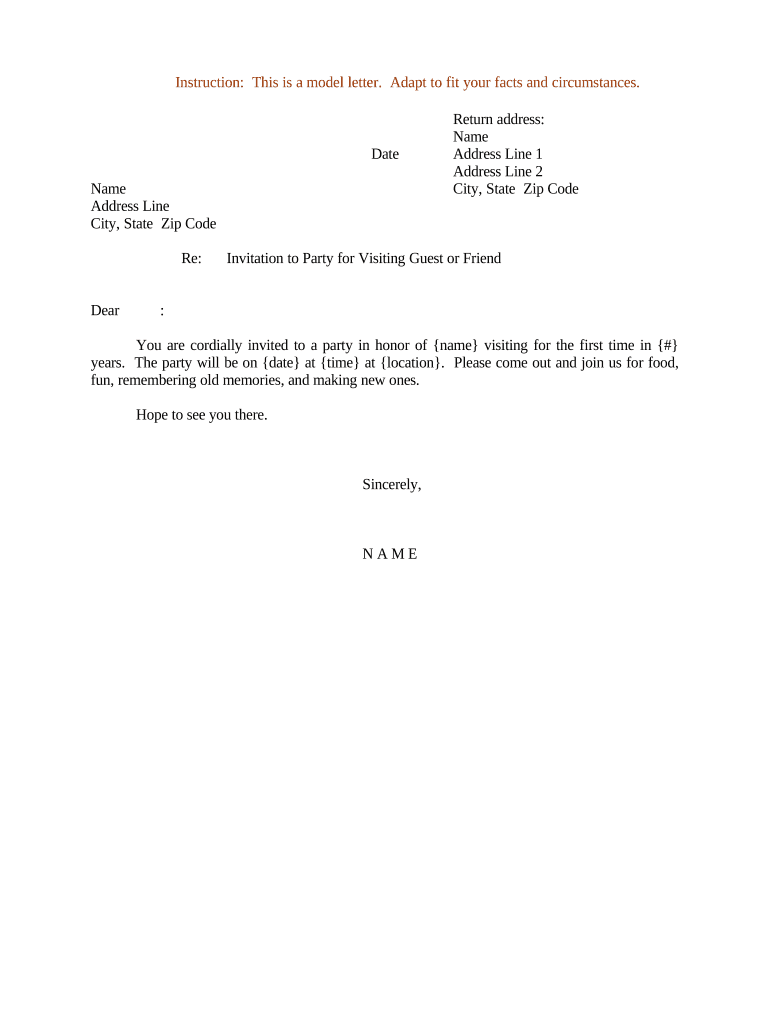
An Invitation Letter to Visit USA is a written statement from a U.S.-based host that describes the purpose, duration, and arrangements for a foreign national's temporary visit. Consular officers and visa applicants commonly use it as supporting evidence for B-1/B-2 or other nonimmigrant visa applications. The letter typically identifies both parties, explains the relationship, sets out travel dates and planned accommodations, and clarifies whether the host will provide financial support. The letter does not guarantee visa approval but helps establish itinerary and intent to comply with U.S. immigration rules.

Why include an Invitation Letter in a visa package

A clear invitation letter strengthens a visa application by documenting the visit purpose, host commitment, travel plans, and any financial support. It gives consular officers factual context and helps applicants explain ties to both the U.S. host and their home country.

Why include an Invitation Letter in a visa package

Who typically prepares or requests this letter

Common requestors and preparers include the U.S. host, the foreign visitor, and immigration or legal advisers.

  • U.S. hosts or family members — Provide contact details, relationship to applicant, and accommodation or support plans.
  • Visa applicants — Attach the letter to the DS-160 or visa interview packet as supporting documentation.
  • Immigration attorneys or sponsors — Draft or review letters for consistency with petition paperwork and evidence requirements.

Essential parts of a professional Invitation Letter to Visit USA

A concise, well-structured letter includes identity details, trip purpose, dates, accommodation and financial arrangements, a clear statement of intent, and a signature block to verify authenticity.

Host identity

Full legal name, U.S. address, phone number, email, immigration status if relevant; include a copy of passport or green card for corroboration.
Visitor identity

Visitor's full legal name, passport number, date of birth, nationality, and relationship to the host to establish identity and connection.

Purpose and dates

Clear statement of visit purpose (tourism, family, medical, study visit) and planned arrival and departure dates to set the itinerary.

Accommodation & support

Whether the host provides lodging, meals, or financial support; specify amounts, duration, and any commitments or limits.

Itinerary details

High-level travel plan, places to be visited, and any events or appointments that explain the trip's scope and timing.

Declaration & signature

Host's signed statement of truthfulness with date; include notarization if the consulate or petitioner requests it.

Step-by-step: prepare and deliver the Invitation Letter

Follow these core steps to produce a concise, consulate-ready letter.

  • 01
    Draft the content: Write host and visitor details, purpose, dates, and commitments.
  • 02
    Attach support: Include copy of host ID and proof of residence.
  • 03
    Sign and notarize: Sign; notarize only if requested or recommended.
  • 04
    Provide to applicant: Send the final letter to the visa applicant for submission.

How the invitation letter fits into the visa process

This sequence explains where the letter typically appears in application workflows and what each party does.

  • Host prepares letter: Drafts, signs, and gathers supporting ID or proof of residence.
  • Applicant assembles packet: Adds letter to DS-160 confirmation and supporting documents.
  • Consular review: Officer assesses letter alongside applicant's ties and purpose of travel.
  • Interview support: Applicant presents letter during visa interview or uploads it as requested.

Practical settings for digital preparation and sharing

Decide how you create, authenticate, and deliver the letter to ensure traceability and consistency.

Field Recommended Setting
Authoring format PDF or DOCX to preserve layout
Signature type Typed or eSignature accepted; ink if consulate requests
Authentication Include scanned host ID to corroborate identity
Delivery method Email PDF to applicant; retain originals for records

Digital signing and secure delivery options

Use secure platforms to capture signatures and preserve an audit trail when you share the letter electronically.

  • Document formats: PDF and DOCX preserve formatting and are accepted by consulates in most cases.
  • Authentication options: Email confirmation, SMS code, or platform-specific two-factor authentication increase confidence in signer identity.
  • Storage and export: Export signed copies and the platform audit trail (timestamps, IP) for submission and recordkeeping.

Security and compliance considerations for electronic letters

Encryption: TLS 1.2/1.3 in transit; AES-256 at rest
Legal framework: ESIGN and UETA recognize electronic signatures in the U.S.
HIPAA readiness: HIPAA-compliant workflows require a BAA for PHI
Audit trail: Timestamp, signer IP, and action log preserved
Access controls: Role-based access and two-factor authentication options
Certifications: SOC 2 Type II, ISO 27001 available

Key risks and consequences of incorrect letters

Visa denial: Inaccurate or contradictory statements can contribute to refusal
Processing delays: Missing or inconsistent details may trigger additional document requests
Misrepresentation: False statements risk immigration penalties, including inadmissibility
Privacy exposure: Sharing excessive personal data without safeguards can violate privacy expectations
Notarization mismatch: Consulate-specific notarization requirements can invalidate unsigned or unnotarized copies
Financial liability: Host commitments to support must be accurate to avoid disputes

Common preparation mistakes to avoid

  • Using informal language or vague dates that leave purpose and duration ambiguous can undermine credibility with consular officers.
  • Failing to include corroborating documents such as host ID, proof of address, or relationship evidence often prompts follow-up requests and delays.
  • Providing inconsistent names or passport numbers between the invitation and visa application commonly leads to processing questions or interview refusals.
  • Assuming notarization is unnecessary without checking the specific consulate's guidance may cause an otherwise valid letter to be rejected.

Timing and practical deadlines for producing the letter

There is no fixed federal filing deadline for an invitation letter, but timing affects usefulness: prepare it early enough to accompany application materials or the interview packet.

Provide on request:

Supply the letter whenever the visa applicant or consulate requests supporting evidence.

Before interview:

Aim to finalize the letter several weeks before the scheduled visa interview.

For petition-based cases:

Include the letter with family- or employer-sponsored petition paperwork when indicated.

If notarization needed:

Allow extra time for notarization or apostille processing as required by the consulate.

Record retention:

Keep signed copies until after travel and any relevant administrative periods have passed.

Key milestones from draft to delivery

Use these sequential milestones to prepare an invitation letter that is complete and ready for submission or presentation.

01

Draft letter

Collect host and visitor details and write the initial draft.

02

Attach supporting ID

Scan host ID and proof of residence to corroborate the letter.

03

Sign / notarize

Sign the final letter; notarize only if required by the consulate.

04

Deliver to applicant

Email or provide hard copy to the visa applicant for submission.

Representative eSignature vendor comparison for sending Invitation Letters

Below is a concise feature-and-price comparison to consider when choosing an eSignature provider for invitation letters and supporting documents.

signNow DocuSign Adobe Sign PandaDoc HelloSign
Starting Price $8/user/mo $15/user/mo $14/user/mo $19/user/mo $15/user/mo
Free Trial 7-day free trial Varies by plan Varies by plan Varies by plan Varies by plan
Bulk Send Yes Yes Yes Yes No
Audit Trail Yes Yes Yes Yes Yes
HIPAA Compliant Yes Yes Yes No No
Envelope Cap No cap 100 envelopes/user/year Varies by plan Varies by plan Varies by plan

Real-world examples involving Invitation Letters

These concise examples show how organizations or individuals used invitation letters in common scenarios.

Optica Ventures LLC — COO

The host prepared a concise invitation and attached ID and accommodation proof to the visa packet.

  • The consulate reviewed the supporting documents during the interview.
  • The applicant presented the signed letter and corroborating host documents at the interview, helping clarify the visit purpose and timeline.

Xerox — Director of Operations

For employee short-term visits, the company provided an invitation that included business meeting schedules and local contacts.

  • HR supplied itinerary and lodging details.
  • Consular officers accepted the letter as part of a broader packet documenting the business purpose and planned return to the employee's home country.

Frequently asked questions about Invitation Letters to Visit USA

Answers to common questions about format, legal effect, notarization, electronic signatures, and recordkeeping for invitation letters.


Need help? Contact support

be ready to get more
Join over 28 million airSlate SignNow users