Establishing secure connection…Loading editor…Preparing document…

Letter Apologizing for Missing Appointment

This template is fully customizable. Edit the text, fill out the fields, and send it for signature. Give it a try!
Letter Apologizing for Missing Appointment

What a Letter Apologizing for Missing Appointment Is and When to Use It

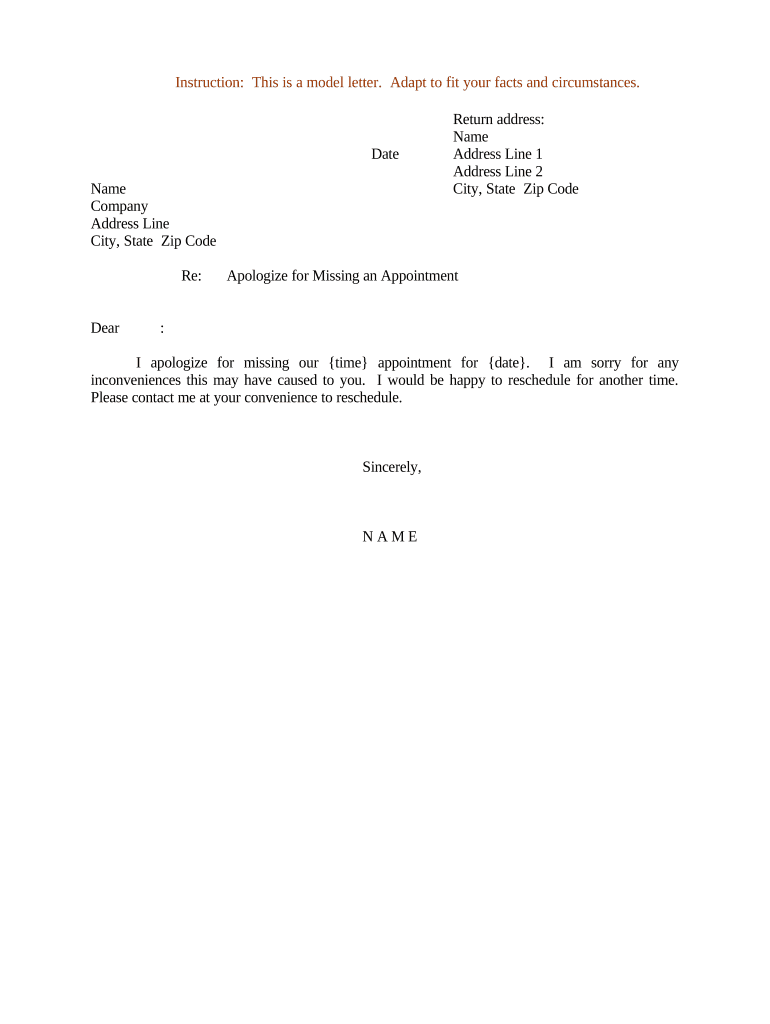
A Letter Apologizing for Missing Appointment is a concise, professional written notice used to acknowledge a missed meeting, explain the reason, and propose a remedy such as rescheduling or compensation. It preserves the relationship, documents the incident, and reduces misunderstanding by creating a clear record. Organizations use this letter for client meetings, medical visits, interviews, inspections, and vendor appointments; the tone should be sincere, factual, and offer a next step to repair any inconvenience caused.

Why sending an apology letter matters

An apology letter restores trust, documents the missed appointment for internal records, and helps avoid penalties, missed fees, or contract disputes. It also creates a clear path to reschedule and shows professionalism.

Why sending an apology letter matters

Who commonly sends this letter

Use the letter whenever a missed appointment created a material inconvenience or when a written record supports follow-up or billing resolution.

  • Healthcare providers notifying patients of missed visits and offering rescheduling options.
  • Businesses and sales teams apologizing for missed client meetings and proposing new dates.
  • Individuals or administrative staff informing counterparties of the reason and next steps.

Core components to include in your apology letter

A professional apology letter follows a simple structure: a clear subject line, a direct apology, the factual reason, acknowledgment of inconvenience, proposed remedy or next steps, and contact information for follow-up.

Subject line

Clear subject like 'Apology for Missed Appointment on MM/DD/YYYY' so recipients immediately understand the letter's purpose and can find it later.
Opening apology

Concise statement accepting responsibility and apologizing. Avoid defensive language; be direct and courteous to preserve the relationship.

Reason stated

A brief factual explanation (e.g., emergency, scheduling error). Do not overshare personal details; keep statements verifiable and relevant.

Acknowledge impact

Recognize the inconvenience caused and, if applicable, mention any costs or time lost to show awareness and empathy.

Remedy offered

Propose concrete next steps: reschedule options, refunds, or alternative accommodations and include specific dates/times to expedite resolution.

Closing and contact

Provide full contact details, preferred communication method, and an offer to answer questions; sign with name, title, and date for clarity.

Essential information to capture

Sender name: Full legal name
Recipient name: Full name or organization
Appointment date: Original date/time
Missed date: Date missed
Proposed remedy: Reschedule options
Contact details: Phone and email

Step-by-step: drafting and sending the letter

Follow these steps to produce a clear, courteous apology letter and complete the follow-up efficiently.

  • 01
    Draft the apology: State apology, reason, and acknowledgement.
  • 02
    Offer remedy: Propose specific reschedule options or compensation.
  • 03
    Review tone: Keep language professional and nondefensive.
  • 04
    Send and record: Deliver via agreed channel and save a copy.

How to set up an online apology letter workflow

Configure a simple digital workflow to generate, sign, and archive apology letters consistently.

Field Configuration
Template Pre-fill sender, recipient, and appointment fields
Signature method Allow typed or e-signature collection
Authentication Email or SMS code for recipient verification
Reminders Automatic follow-up if no reply in 3–7 days

Where to send or file the completed letter

Choose delivery and filing channels based on the relationship and recordkeeping needs; always retain a copy in your records.

  • Email delivery: Send signed PDF to recipient and save copy in CRM
  • Postal mail: Use certified mail for formal notices where proof of delivery matters
  • Internal file: Upload letter to client file or case management system
  • Attach to billing: Link letter to invoice or appointment record if fees apply

Digital delivery and signature considerations

Use systems that retain a tamper-evident copy and an audit trail to support dispute resolution and internal compliance.

  • File formats: Accepts PDF and DOCX upload
  • Authentication: Email or SMS verification options
  • Audit trail: Timestamp, IP, and signer details

Timing: when to send and follow up

Timely delivery improves outcomes—send the apology promptly and follow a short escalation schedule if needed.

Send quickly:

Within 24–48 hours of the missed appointment

Offer dates:

Provide two to three specific reschedule options

First follow-up:

If no response, follow up in 3–5 business days

Escalation:

Escalate to manager or account lead after 7–10 days

Record retention:

Keep a copy for internal records per retention policy

Common mistakes to avoid

  • Vague phrasing that fails to specify which appointment was missed, causing confusion and delay in rescheduling.
  • Apologizing without proposing concrete next steps, leaving the recipient unsure how to resolve the issue.
  • Using defensive or blaming tone; this often escalates frustration and damages trust rather than repairing it.
  • Failing to save a dated, signed copy in the client file, which prevents clear evidence if disputes arise.

Risks and potential consequences

Relationship harm: Loss of client trust
Billing disputes: Fees or refunds may be required
Operational delay: Project or service schedule impact
Contract breach: Potential remedies if material
Regulatory risk: Healthcare appointments may involve HIPAA concerns
No criminal penalty: Letters themselves rarely create legal penalties

Real-world examples of digital apology letters in practice

Organizations use digital letters to document missed appointments and speed resolution while keeping audit trails.

Martin Properties — Tim Martin, Founder

Martin Properties centralized appointment communications to prevent missed closings and reduce back-and-forth.

  • The new process reduced turnaround time for rescheduling.
  • "I can process and execute all of these documents online with 100% compliance and built-in security. Whether on mobile or working offline, I can get forms back to their necessary parties efficiently."

Fertility Centers — John Butler, Founder

A healthcare practice standardized apology letters with secure delivery and recordkeeping.

  • Standard templates ensured consistent patient outreach.
  • "The airSlate SignNow team has been exceptional, responsive, the API has been great, and we're extremely happy that we chose airSlate SignNow as a company."

eSignature vendor comparison for sending and signing apology letters

Select an eSignature provider that supports secure signing, audit trails, and the authentication level your organization requires; pricing and feature availability vary by plan and vendor.

signNow DocuSign Adobe Sign PandaDoc HelloSign
Starting Price $8/user/mo $15/user/mo $14/user/mo $19/user/mo $15/user/mo
Free Trial 7-day free trial, no credit card Varies by plan Varies by plan Varies by plan Varies by plan
Bulk Send Yes (Business Premium) Yes Yes Yes Varies
Audit Trail Yes Yes Yes Yes Yes
HIPAA Compliant Yes (BAA available) Yes Yes No No

Frequently asked questions about apology letters and e-signing

Answers to common practical and legal questions when drafting, delivering, and storing apology letters for missed appointments.


Need help? Contact support

be ready to get more
Join over 28 million airSlate SignNow users