Establishing secure connection…Loading editor…Preparing document…

Letter Regarding Outstanding Attorney Fees

This template is fully customizable. Edit the text, fill out the fields, and send it for signature. Give it a try!
Letter Regarding Outstanding Attorney Fees

What the Letter Regarding Outstanding Attorney Fees Is

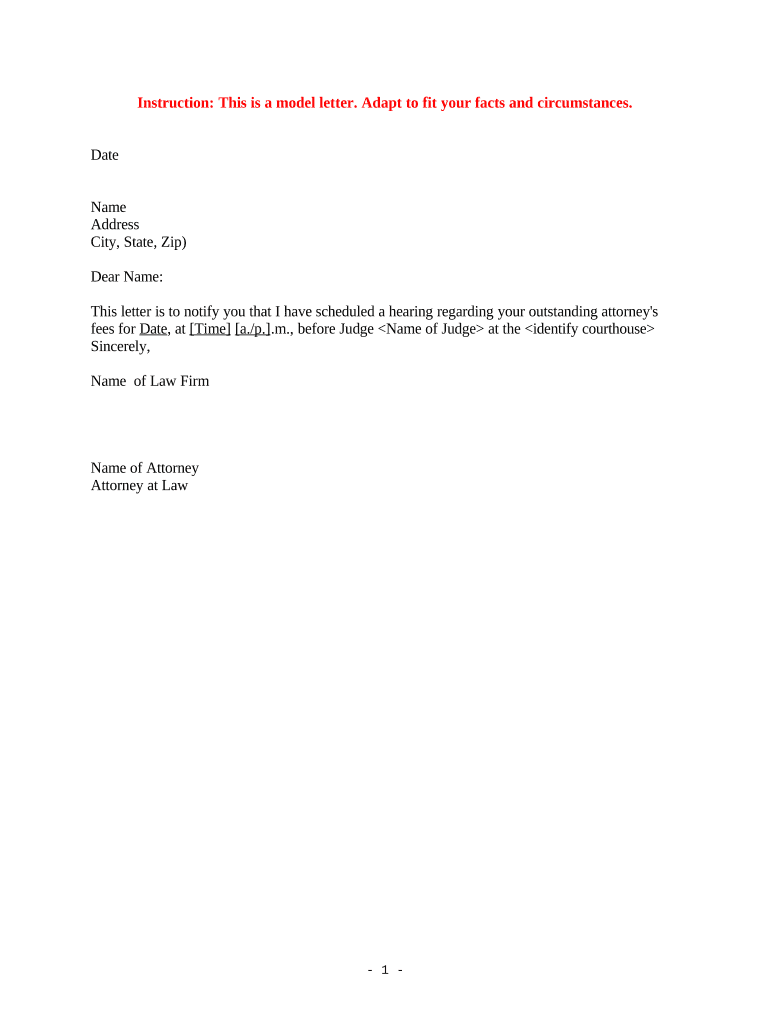
The Letter Regarding Outstanding Attorney Fees is a formal written demand used by an attorney or law firm to notify a client or third party of unpaid legal charges, itemize those charges, and request payment by a stated deadline. It typically references the engagement agreement, attaches or cites invoice numbers, and explains available payment methods and dispute procedures. The letter serves both as a billing communication and a documented step that can support collections, lien filings, or court petitions when followed by appropriate enforcement steps and retained evidence.

Why a Clear Fee Letter Matters

A well‑drafted Letter Regarding Outstanding Attorney Fees creates a formal record of the debt, clarifies amounts and deadlines, and reduces ambiguity in client communications while preserving evidence for collections or litigation.

Why a Clear Fee Letter Matters

Typical Users and Stakeholders

Attorneys, law firm billing administrators, collections teams, and in-house legal departments commonly prepare and send this letter to preserve rights and prompt payment.

  • Private practice attorneys who need a written trail before collections or court action.
  • Corporate legal departments issuing fee demands to contractors or former employees.
  • Billing teams and third-party collectors seeking documented proof of services and amounts.

Who Prepares and Who Signs

Billing Manager

Prepares the itemized statement, verifies invoice numeration, and updates the accounts receivable ledger. Ensures attachments match billed time and expense entries, retains audit evidence, and escalates discrepancies to supervising counsel for decision on collections or write-offs.

Managing Attorney

Reviews and approves the fee demand, confirms compliance with the engagement agreement, and authorizes any escalation such as collections referral or lien filing. Documents approval for the client file and signs or delegates signature authority as required.

Essential Elements to Include in the Letter

A concise, professional letter should include identifying information, a clear statement of the amount due, supporting invoice details, a payment deadline, contact instructions, and the consequences of nonpayment.

Header

Firm name, address, client name, file or matter number, and date to ensure the letter is clearly linked to the engagement.
Amount Due

The total unpaid balance stated as a dollar amount, specifying whether fees, costs, or interest are included and the billing period covered.

Itemization

List of invoices or time entries with dates and brief descriptions so the recipient can identify disputed items quickly.

Payment Terms

Exact payment deadline (MM/DD/YYYY preferred), accepted payment methods, and instructions for submitting payment or proof of payment.

Next Steps

Consequences for nonpayment such as collections referral, lien filing, or court action; include any applicable contractual remedies.

Contact Info

Name, phone, and email of the person to contact with questions and instructions for disputing charges or requesting an invoice breakdown.

Step-by-Step: How to Prepare and Send the Letter

Follow a concise workflow to draft, approve, deliver, and archive the letter while preserving evidence of delivery and any signatures.

  • 01
    Draft: Compose the letter with itemized fees and attach supporting invoices.
  • 02
    Review: Have supervising counsel or billing manager verify amounts and attachments.
  • 03
    Sign: Obtain an authorized signature—electronic or wet—captured with an audit trail.
  • 04
    Deliver: Send via tracked mail or compliant e-signature platform and retain proof.

Typical Digital Workflow Settings for Online Completion

Configure the e-delivery workflow to require authentication, attach invoices, and capture a complete audit trail for each signed letter.

Field Configuration
Signer Authentication Email with optional SMS code or ID verification
Signature Type Electronic signature with timestamp; image overlay optional
Invoice Attachment Attach PDF invoices and expense receipts for verification
Retention Setting Store signed letter and audit trail for configured retention period

Delivery Options and Platform Requirements

Choose a delivery method that supports secure authentication, audit logging, and verifiable proof of delivery.

  • File Formats: PDF preferred; DOCX accepted
  • Integrations: Connects to case management systems
  • Notary Support: Supports remote online notarization where permitted

How Electronic Delivery and Signing Typically Works

A predictable digital workflow reduces friction: prepare the document, authenticate signers, capture consent, and retain a signed copy with an audit trail.

  • Prepare: Upload letter and attach itemized invoices
  • Authenticate: Confirm signer identity with email or SMS
  • Sign: Signer reviews and applies electronic signature
  • Archive: System stores completed letter and audit log

Common Timing Considerations and Recommended Deadlines

Set clear timing expectations in the letter and align internal escalation timelines so actions occur predictably if payment is not received.

Payment Deadline:

Typically 30 days from receipt; specify MM/DD/YYYY due date

Response Period:

Allow 10–14 days for dispute notification before escalating

Collections Referral:

Refer to collections after missed deadline and final notice

Statute of Limitations:

Monitor governing state's limitations period before initiating suit

Recordkeeping:

Retain copies for accounting and audit per retention policy

Key Milestones from Draft to Enforcement

Track these milestones to preserve rights and maintain an auditable process from initial demand through potential enforcement.

01

Draft and Attachments

Compile the letter, invoices, and engagement agreement for review.

02

Internal Approval

Obtain managing attorney sign-off and document authorization.

03

Delivery and Signature

Send via chosen method and capture proof of delivery or signature.

04

Escalation or Enforcement

Refer to collections, file lien, or commence legal action if unpaid.

Common Pitfalls to Avoid

  • Failing to itemize services and dates, which makes verification difficult and increases the chance of dispute or nonpayment.
  • Sending letters without confirming current address or electronic consent, which can undermine delivery and ESIGN compliance.
  • Omitting engagement agreement references or invoice numbers, causing confusion about which charges are disputed or unpaid.
  • Not preserving completed audit trails or signed copies when using electronic delivery, leaving gaps in evidence for enforcement.

Risks and Consequences of Incorrect or Incomplete Letters

Late Payment Interest: Accrues contractual interest and collection costs
Collection Costs: Adds attorney fees and court costs
Lien or Judgment: Possible lien filing or judgment entry
Client Relationship: Risk of client dissatisfaction or dispute
Fee Dispute: May trigger mediation or fee arbitration
Regulatory Sanctions: Noncompliance may risk professional sanctions

Comparison: eSignature Pricing and Feature Summary

Signatures for demand letters can be obtained via many vendors; below is a concise pricing and feature snapshot with signNow listed first for reference.

signNow DocuSign Adobe Sign PandaDoc HelloSign
Starting Price $8/user/mo $15/user/mo $14/user/mo $19/user/mo $15/user/mo
Free Trial 7-day free trial, no credit card Varies Varies Varies Varies
Bulk Send Yes Yes Yes Yes No
Audit Trail Yes Yes Yes Yes Yes
HIPAA Compliant Yes Yes Yes No No

Real-World Examples of Use

The following case notes illustrate how organizations used a fee demand letter template and electronic workflows to improve collections and recordkeeping.

Martin Properties

Martin Properties used the letter template to formalize outstanding fee requests across rental management engagements.

  • Reduced turnaround time for fee collection.
  • Founder Tim Martin reported streamlined execution and consistent compliance across devices, noting secure, auditable delivery and faster recovery of owed fees without in-person meetings.

Fertility Centers of Illinois

Fertility Centers applied a standardized demand letter tied to service invoices to accelerate receivables.

  • Improved internal tracking and response.
  • The firm highlighted better integration with case files and tighter controls over disputed charges, reducing reconciliation time and improving audit readiness.

Practical Tips for Accurate and Efficient Completion

Follow these best practices to reduce disputes and preserve enforceability when issuing a fee letter.

Reference the Engagement Agreement
Cite the specific engagement clause that governs fees and payment terms to ground the demand in the parties' contract and reduce ambiguity.
Itemize Charges Clearly
Provide invoice numbers, dates, services described succinctly, and attach supporting billing records to simplify verification and limit disputes.
Specify Exact Due Date
Use MM/DD/YYYY format for deadlines, explain accepted payment methods, and indicate consequences for missing the deadline to prompt timely payment.
Preserve Evidence
Retain signed copies, delivery receipts, and audit logs from electronic platforms to support collection or court proceedings if needed.

FAQs — Common Questions About Fee Letters

Answers to frequent questions about validity, e-signing, notarization, disputes, and recordkeeping for Letters Regarding Outstanding Attorney Fees.


Need help? Contact support

be ready to get more
Join over 28 million airSlate SignNow users