Establishing secure connection…Loading editor…Preparing document…

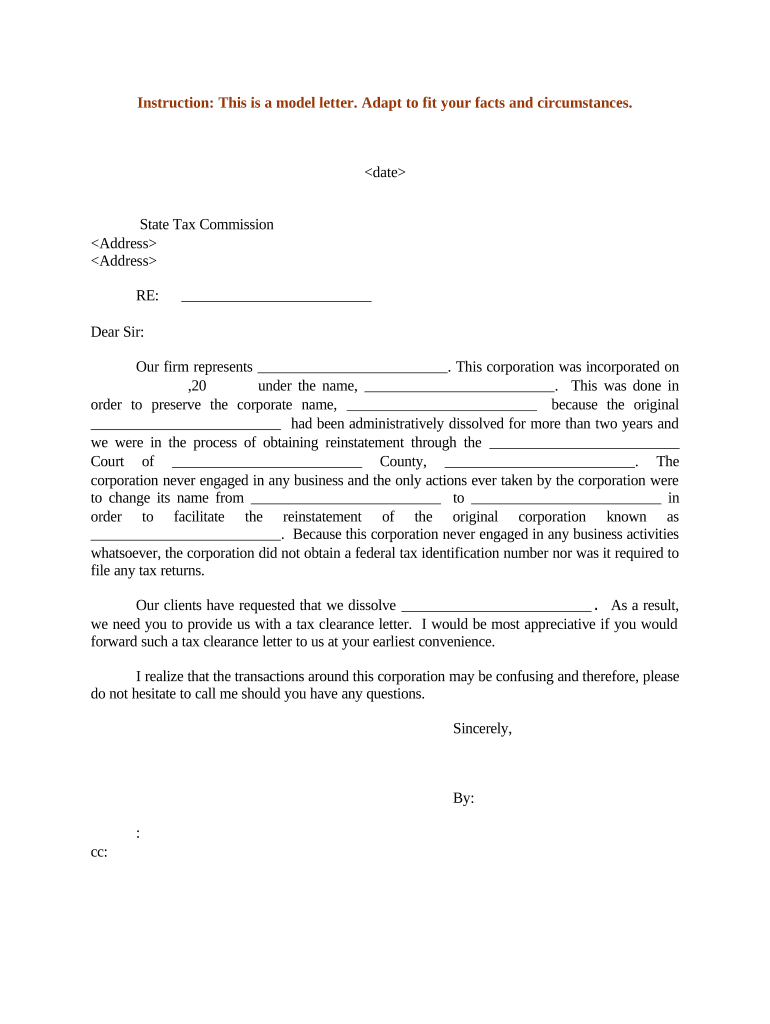
Letter Requesting Tax Clearance Letter

This template is fully customizable. Edit the text, fill out the fields, and send it for signature. Give it a try!
Letter Requesting Tax Clearance Letter

What a Letter Requesting Tax Clearance Letter Is

A Letter Requesting Tax Clearance Letter is a formal written request submitted to a tax authority asking for confirmation that an individual or business has no outstanding tax liabilities for a specified period or transaction. Typically used in mergers, property sales, license applications, or business closures, the letter asks the agency to review taxpayer records and issue a clearance or a statement of tax standing. It summarizes taxpayer identity, tax identification numbers, the period under review, and the purpose for the request, and it often lists attachments such as returns, payment proof, or power of attorney documentation.

Why Request an Official Tax Clearance

A Letter Requesting Tax Clearance Letter provides objective confirmation of tax standing, reduces closing risk, and supports regulatory or licensing requirements. Receiving official clearance can speed transactions, avoid escrow holds, and provide legal certainty for buyers, lenders, or licensing agencies.

Why Request an Official Tax Clearance

Who Typically Prepares and Uses This Letter

Common users include corporate counsel, tax advisors, escrow officers, title companies, and business owners preparing transactions.

  • Buyers and lenders seeking assurance of no outstanding tax liens before closing.
  • Businesses closing operations or selling assets that require official tax clearance.
  • License applicants or permit holders required to demonstrate current tax compliance.

Step-by-Step: Prepare and Submit the Letter

Follow these steps to prepare and submit a Letter Requesting Tax Clearance Letter to the appropriate tax agency or state department.

  • 01
    Gather Documents: Collect returns, payment proofs, and ID.
  • 02
    Draft Letter: Include taxpayer identity, period, purpose, and attachments list.
  • 03
    Authenticate Signer: Attach POA or have authorized officer sign.
  • 04
    Submit: Send to the correct tax office by certified mail or e-filing.

How to Configure a Digital Workflow for This Letter

Set up a digital workflow to create, route, and retain a Letter Requesting Tax Clearance Letter efficiently and securely.

Field Configuration
Authentication Email link, SMS code, or KBA as needed
Signature Type Typed name, drawn signature, or digital cert
Retention Store PDF/A with audit trail for reproduction
Notifications Automated status emails and completion receipts

Distribution and Submission Methods

Preferred distribution channels include certified mail, secure portal upload, and e-submission through agency web forms or authorized e-filing services.

  • Email: Limited acceptance; check agency policy.
  • Certified Mail: Proof of delivery and tracking.
  • E-Submission: Agency-specific portal or authorized e-file.

Routing and Confirmation: What Happens After Submission

This section summarizes routing and confirmation steps when requesting a tax clearance from a tax authority.

  • Choose Agency: Determine federal or state authority based on tax type.
  • Attach Proof: Include returns, proof of payment, and lien searches.
  • Tracking: Request written acknowledgement or tracking number.
  • Receive Clearance: Agency issues written clearance or statement of tax status.

Typical Timelines and Processing Expectations

Timing depends on agency; some requests are processed within weeks, others take months depending on backlog and complexity.

Typical Processing Time:

Two to eight weeks for many state tax agencies.

Expedited Requests:

Some states offer expedited handling for a fee or for closing deadlines.

Federal Clearances:

IRS statements are less common; contact IRS practitioner priority service.

Missing Information:

Incomplete letters can add weeks for follow-up or rejection.

Recordkeeping:

Keep proof of submission and receipt for at least three years.

Penalties and Risks for Incorrect or Incomplete Letters

Late Filing: May delay transactions.
Incorrect TIN: Triggers backup withholding.
False Statements: Potential civil or criminal penalties.
Missing POA: Agency may refuse clearance.
Rejected Request: Causes re-submission and delays.
Tax Penalties: IRS fines per IRC §6721.

Common Mistakes to Avoid

  • Omitting the taxpayer identification number or providing an incorrect EIN/SSN leads to verification failures and often requires supplemental documentation.
  • Failing to include the exact tax periods or using vague date ranges forces the agency to request clarification before processing the clearance.
  • Not identifying the correct jurisdiction—federal versus state taxes—can misdirect your request and significantly extend processing time.
  • Submitting unsigned letters, incomplete attachments, or lacking required power of attorney leads to outright rejection in many agencies.

How This Letter Compares to Other Tax Compliance Documents

Compare common variants: formal clearance letter, tax compliance certificate, and agency-issued statements; availability and requirements differ by jurisdiction.

Document Type Agency Letter Certificate
Formal Name clearance letter compliance certificate
Issued By state/irs state agency
Notarization varies rarely required
Common Use closings, sales permit, licensing

eSignature Vendor Comparison for Completing and Submitting Clearance Letters

Pricing and feature snapshot for eSignature platforms commonly used to complete and submit tax clearance letters and supporting documents.

signNow DocuSign Adobe Sign PandaDoc HelloSign
Starting Price $8/user/mo $15/user/mo $14/user/mo $19/user/mo $15/user/mo
Free Trial Yes, 7-day trial No No Yes, limited Yes, limited
Bulk Send Yes Yes Yes Yes No
Audit Trail Yes Yes Yes Yes Yes
HIPAA Compliant Yes Yes Yes No No

Real-World Examples

These real-world examples show how organizations used a Letter Requesting Tax Clearance Letter during transactions and closings.

Optica Ventures

Optica Ventures needed official confirmation of no state tax liens before finalizing a property purchase to satisfy lenders' requirements.

  • signNow streamlined document routing and delivered audit trail online.
  • The agency responded with a clearance letter within three weeks, enabling timely closing without escrow holdbacks; accurate attachments and verified signer authority prevented follow-up requests from the revenue department.

Martin Properties

Martin Properties required IRS acknowledgement before transferring ownership of a commercial parcel as part of a merger closing.

  • Provided supporting tax returns and proof of payments.
  • Using a formal letter and complete attachments avoided delays; the title company accepted the clearance statement as evidence of tax compliance, allowing the transaction to close on schedule.

Security and Compliance Essentials

Encryption Transit: TLS 1.2/1.3 protects data in motion.
Encryption Rest: AES-256 secures data at rest.
SOC 2: SOC 2 Type II certification available.
HIPAA BAA: BAA required for PHI workflows.
ESIGN & UETA: Compliant with U.S. e‑signature law.
Audit Trail: Detailed timestamps, IPs, and actions.

Frequently Asked Questions About Tax Clearance Letters

Answers to common questions about preparing, signing, and submitting a Letter Requesting Tax Clearance Letter and handling follow-up requests.


Need help? Contact support

be ready to get more
Join over 28 million airSlate SignNow users