Establishing secure connection…Loading editor…Preparing document…

Letter Regarding Stipulation of Dismissal

This template is fully customizable. Edit the text, fill out the fields, and send it for signature. Give it a try!
Letter Regarding Stipulation of Dismissal

What the Letter Regarding Stipulation of Dismissal Is

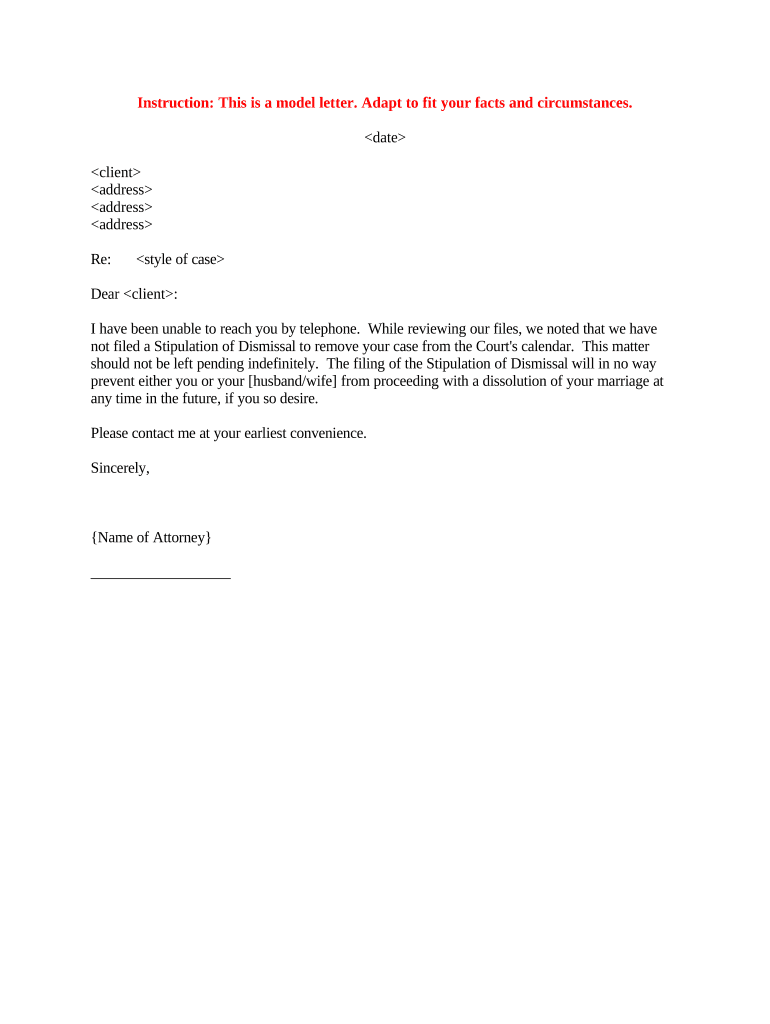
Letter Regarding Stipulation of Dismissal is a concise formal correspondence used in civil litigation to notify opposing counsel, parties, and the court that the parties have agreed to dismiss all or specified claims by stipulation. It typically accompanies a stipulation of dismissal or requests the court to enter an order reflecting the parties’ agreement. The letter summarizes the terms of dismissal, identifies the case caption and docket number, states whether the dismissal is with or without prejudice, and clarifies who will bear costs or fees, enabling clerks and judges to process the filing accurately.

Why a Clear Letter Matters

A clear letter creates a concise, court-ready record of the parties’ dismissal agreement, reduces clerical follow-up, accelerates docket entry, and documents allocation of costs or reserved claims, thereby minimizing future disputes over case status or fee responsibility.

Why a Clear Letter Matters

Who Typically Prepares and Receives This Letter

Typical senders include litigation attorneys, pro se parties, and court clerks coordinating stipulations and administrative staff.

  • Litigation attorneys drafting or filing the stipulation of dismissal; ensures court receives agreed terms and signature history.
  • Pro se parties who must document dismissal terms clearly for the record and future enforcement.
  • Court clerks and judges who need an explicit summary to process docket changes and enter orders.

Core Elements to Include in the Letter

These components ensure the Letter Regarding Stipulation of Dismissal is complete, actionable, and acceptable for court processing and opposing parties.

Case ID

Include the full caption, docket number, court name, and judge where applicable. Accurate identifiers ensure the clerk associates the letter with the correct case and prevent misfiling across complex dockets or related matters.
Summary

Provide a concise paragraph describing which claims or causes of action are dismissed, any retained counts, and whether dismissal is conditional or contingent on payment, performance, or other terms agreed by the parties.

Disposition

State explicitly 'with prejudice' or 'without prejudice' and explain any limited scope of dismissal, such as dismissal of specific counts, parties, or claims, to preserve clarity about future litigation rights.

Costs

Record who is responsible for court costs, attorneys’ fees, and whether each party waives or reserves claims for costs; include amounts if agreed to avoid later disputes about fee allocation.

Attachments

List attached documents such as the executed stipulation of dismissal, proposed order, settlement agreement, or exhibits, and identify which documents should be filed or kept under seal where permitted.

Service

Certify how service was completed — electronic service, hand delivery, or mail — and include dates and recipient contact details to create a clear chain of communication for court records.

Step-by-Step: Preparing and Submitting the Letter

Follow these sequential steps to draft, secure signatures, file, and confirm the Letter Regarding Stipulation of Dismissal with counsel and the court.

  • 01
    Assemble Details: Gather case caption, docket number, terms, and signatures.
  • 02
    Draft Letter: Summarize stipulation terms and reference attached stipulation.
  • 03
    Obtain Signatures: Collect signatures from all parties or counsel.
  • 04
    File and Serve: File with court and serve all parties per local rules.

Configuring a Digital Workflow for This Letter

Set up a digital workflow to prepare, sign, and file the letter together with the stipulation to reduce manual steps and errors.

Field Configuration
Document Upload PDF or DOCX; include stipulation as exhibit
Signature Order Specify sequential or parallel signing
Authentication Email or SMS code; consider ID check
Filing Integration Connect to PACER or court e-filing where available

Typical Routing from Draft to Docket

This outlines the typical routing: prepare the letter, obtain signatures, file with the court, and confirm docket entry for the official record.

  • Prepare: Draft letter and attach stipulation of dismissal.
  • Sign: All parties or counsel sign and date the letter.
  • File: Submit to court clerk by e-filing or paper.
  • Confirm: Obtain stamped copy or docket update for records.

Digital Signing and File Format Considerations

Choose a platform that supports PDF/DOCX, secure authentication, audit trail, and exportable certificate for evidence of signing.

  • File Formats: PDF and DOCX supported
  • Integrations: PACER, cloud storage, and case management
  • Authentication: Email, SMS, and optional KBA

Deadlines and Time-Sensitive Considerations

Key filing and procedural deadlines to track when preparing, signing, and submitting the Letter Regarding Stipulation of Dismissal, including service and docket entry timing.

Service Receipt Deadline:

Serve other parties per local rule; often same day as filing.

Court Filing Deadline:

File by the date agreed in stipulation or per court schedule.

Appeal Window:

Note tolling if dismissal with prejudice; consult rule for deadlines.

Clerk Processing Time:

Local clerks typically update docket within 1–14 business days.

Record Retention Trigger:

Retention begins on docket entry or effective dismissal date.

Milestone Timeline from Agreement to Record

Sequential milestones showing the path from parties' agreement through filing, court action, docketing, and retention obligations for the final record.

01

Agreement Reached

Parties finalize terms and prepare stipulation and accompanying letter.

02

Signatures Obtained

All required signatories sign the letter and stipulation.

03

File with Court

Submit by e-filing or paper according to local rules.

04

Docket Entry

Clerk enters dismissal; retain stamped documents for records.

Common Preparation Pitfalls to Avoid

  • Using vague language or failing to state whether dismissal is with or without prejudice can create uncertainty about parties' rights to refile similar claims.
  • Omitting the docket number or using an incorrect case caption frequently causes clerks to misassociate the letter, delaying processing and adding administrative burden.
  • Neglecting to attach the executed stipulation or proposed order means the court has no operative document to enter, often prompting a clerk request.
  • Failing to serve all parties or counsel per local rules can result in incomplete service and may require re‑service or supplemental filings.

Required Information and Fields at a Glance

Full Legal Name: Exact party name on record
Docket Number: Exact court case number as filed
Case Caption: Plaintiff v. Defendant full caption
Signature & Date: Original signature and signing date
Counsel Contact: Attorney name, firm, bar number
Disposition Type: With prejudice or without prejudice

Penalties and Risks from Incorrect Letters

Misidentified Case: Letter misfiled; docket confusion
Missing Signatures: Court may reject filing
Incorrect Disposition: Alters re‑filing rights
Late Filing: May miss appeal window
Service Errors: Waives notice or process
Conflicting Terms: Leads to enforcement disputes

eSignature Solutions: Pricing and Feature Snapshot

Comparative starting prices and key capabilities for common eSignature providers; signNow is listed first per vendor comparison conventions.

signNow DocuSign Adobe Sign PandaDoc HelloSign
Starting Price $8/user/mo $15/user/mo $14/user/mo $19/user/mo $15/user/mo
Free Trial Yes, 7-day free trial No No Yes, limited Yes, limited
Bulk Send Yes Yes Yes Yes No
Audit Trail Yes Yes Yes Yes Yes
HIPAA Compliant Yes Yes Yes No No

Realistic Use Cases for the Letter

Examples illustrate how the letter clarifies dismissal terms and supports court processing in common settlement and mediation outcomes.

Settlement Dismissal

Parties settled a contract dispute and negotiated payment terms tied to dismissal in writing to avoid further litigation.

  • Stipulation conditioned on full payment.
  • The letter summarized settlement terms, identified the case and docket number, stated the dismissal was with prejudice upon payment, and attached the executed stipulation and proposed order for the clerk to enter, reducing follow-up contacts.

Dismissal After Mediation

After successful mediation, parties agreed to dismiss certain tort claims while preserving others in a written stipulation.

  • Partial dismissal to narrow issues.
  • The letter described which counts were dismissed without prejudice, noted reserved claims, attached the mediation settlement, and certified service on all counsel so the court could enter the partial dismissal and proceed with remaining issues.

Practical Tips for Accuracy and Efficiency

Follow these best practices to reduce rework, avoid clerk requests, and ensure the letter accomplishes the parties' intended dismissal outcomes.

Use precise language
Always state exact disposition language—'with prejudice' or 'without prejudice'—and describe the scope of dismissal. Avoid ambiguous terms like 'resolved' without clarification. Precision prevents disputes about re-filing and clarifies parties' future rights and obligations in court records.
Match court captions
Copy the case caption and docket number exactly from court filings. Small differences can cause clerks to misfile documents, delay docketing, or require supplemental filings. Double-check spelling of party names and include judge or division where helpful.
Attach executed documents
Attach the fully executed stipulation of dismissal and any settlement agreement or proposed order. If confidentiality or sealing is required, follow local rules for sealed filings and provide guidance to the clerk on which documents to file publicly.
Document service
Certify service method and dates in the letter, and include contact details for served counsel. For e-service, confirm local rule acceptance and retain proof of transmission to avoid disputes about notice or late service.

Frequently Asked Questions

Answers to common questions about preparing, signing, filing, correcting, and withdrawing a Letter Regarding Stipulation of Dismissal.


Need help? Contact support

be ready to get more
Join over 28 million airSlate SignNow users