Establishing secure connection…Loading editor…Preparing document…

College Application Letter

This template is fully customizable. Edit the text, fill out the fields, and send it for signature. Give it a try!
College Application Letter

What a College Application Letter Is and When It’s Used

A College Application Letter is a personalized written statement submitted by an applicant or recommender to a college or university as part of an admissions file. It can be a cover letter accompanying transcripts, a formal letter of intent for admission pathways (early decision, transfer, or readmission), or a supplemental recommendation that highlights qualifications, context, and the applicant’s academic and extracurricular achievements. Institutions use these letters to assess fit, motivation, and background details that do not appear in transcribed test scores or standard application fields, and they are typically retained within the applicant record for admissions review.

Why a Clear, Accurate Letter Matters for Admissions

A well-crafted College Application Letter clarifies an applicant’s purpose, explains special circumstances, and supplements the core application. Admissions committees rely on these letters to evaluate maturity, writing ability, and context; accuracy and timeliness reduce processing delays and preserve the integrity of the application file.

Why a Clear, Accurate Letter Matters for Admissions

Who Prepares and Relies on These Letters

Several roles create, submit, or review College Application Letters depending on the situation.

  • High school seniors and transfer students — prepare personal letters that explain goals and relevant background to admissions committees.
  • School counselors and college advisors — draft or verify letters that contextualize grades, course rigor, and school-specific details.
  • Recommenders (teachers, coaches, employers) — submit recommendation letters that attest to character and academic potential.

Each audience has different expectations for tone and content; applicants should follow the receiving institution’s submission guidelines precisely.

Representative Signatories and Their Roles

Applicant

High school seniors or transfer students write personal or cover letters to explain academic goals, enrollment preferences, and special circumstances; letters should be factual, concise, and consistent with application data.

Recommender

Teachers, counselors, or employers provide third-party endorsement of an applicant’s performance and character; recommenders must identify their relationship to the applicant and include specific examples supporting admissions claims.

Essential Elements of a Professional College Application Letter

A complete letter follows a consistent structure and includes identification, context, and a clear closing. Admissions officers look for concise facts, relevant anecdotes, and contact information for verification.

Header

Date, applicant full legal name, mailing address, phone number, and email for file matching and follow-up communications.
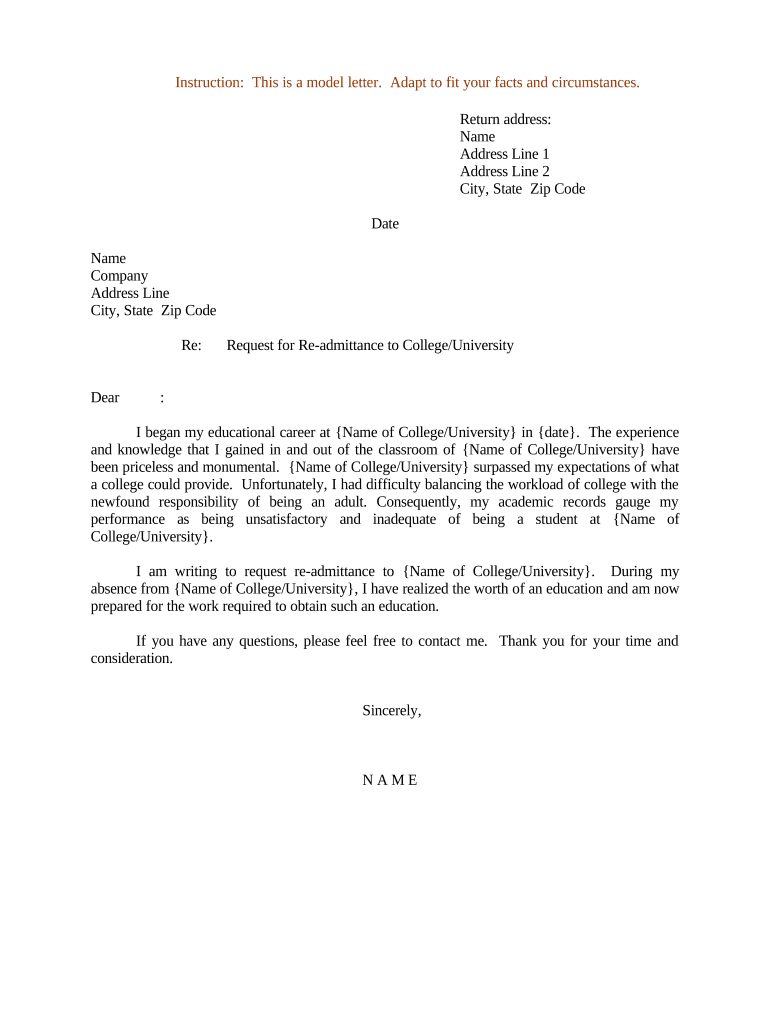
Salutation

Address the correct office or program (e.g., 'Admissions Office, [Program Name]') to ensure routing and avoid delays.

Opening Statement

One or two sentences stating purpose: application type, program, or recommendation role and relationship to the applicant.

Supporting Details

Concise paragraphs that highlight achievements, explain circumstances (e.g., gaps, test delays), or provide context not shown elsewhere.

Closing

Clear summary of intent, availability for questions, and preferred contact method for verification.

Signature

Typed name, signature (handwritten or e-signed), and date; include title and institution for recommenders.

Required Information and Key Fields

Full Legal Name: Applicant’s legal name.
Date of Birth: MM/DD/YYYY preferred.
Mailing Address: Street, city, state, ZIP.
Email Address: Primary contact email.
Program Applied: Intended major or program.
Signature Block: Sign and date.

Step-by-Step: Prepare and Submit Your Letter

Follow a short sequence to ensure the letter aligns with the application portal and arrives on time.

  • 01
    Draft: Write a concise, factual letter that addresses the application requirements.
  • 02
    Review: Proofread for accuracy, match names/dates to official records.
  • 03
    Format: Save as PDF and include page headers with applicant name and birthdate.
  • 04
    Submit: Send via the institution’s preferred channel before the stated deadline.

Configuring an Online Submission Workflow

Set up fields and signer options to match the receiving institution’s requirements and to capture an auditable record of submission.

Field Configuration
Auto-fill Prepopulate name and contact fields to reduce errors.
Conditional Fields Show additional inputs only when applicable to the applicant.
Signer Authentication Require email or SMS code verification for attribution.
Return Copy Automatically send signed PDF to the applicant and institution.

Where and How to Send the Letter

Use the institution’s specified channel to ensure the letter is matched to the right application record.

  • Application Portal: Upload PDF to the college portal under supplemental materials.
  • Admissions Email: Email the correct admissions address when permitted by the school.
  • Counselor Upload: Have the school counselor submit through the official counselor portal.
  • Postal Mail: Send a physical signed copy only when the school explicitly accepts mailed materials.

Digital Submission and Signature Requirements

Confirm the receiving institution’s policy on electronic letters and accepted signature methods before submitting.

  • Accepted Formats: PDF and PDF/A are widely accepted.
  • Authentication: Email verification or SMS code suffices for many schools.
  • Integrations: Works with common systems like Google Workspace and Microsoft 365.

Timelines and Typical Deadlines to Watch

Adhere to the school’s stated deadlines for early, regular, and rolling admissions; late letters may not be considered.

Early Decision / Action:

Commonly due by November 1 or November 15; check each college’s date.

Regular Decision:

Often due January 1; institutions may vary by weeks.

Rolling Admissions:

Submit as early as possible; earlier files receive fuller consideration.

Transcript / Recommendation Timing:

Request school submissions 2–4 weeks ahead of deadline to ensure matching.

Late Materials Window:

Some schools accept materials for a brief post-deadline period; confirm with admissions.

Common Mistakes to Avoid

  • Using inconsistent names or birthdates between the letter and application causing identity mismatches and processing delays.
  • Submitting the wrong program name or campus location which can cause the letter to be routed incorrectly.
  • Failing to follow the school’s specified file format and size limits, resulting in rejection or unreadable uploads.
  • Relying on unsigned scanned images without a clear signature block, which some admissions offices will treat as incomplete.

Consequences of Errors or Late Submission

Missed Deadline: Application may be incomplete.
Mismatched Identity: Record linking failure.
Unsigned Letter: Considered unofficial.
Incorrect Program: Misrouted to wrong review committee.
Privacy Violation: Unauthorized disclosures risk FERPA issues.
Incomplete Verification: Admissions may request resubmission.

Practical Examples of Letter Use

Realistic scenarios show how letters function in different admissions pathways and who should prepare them.

Early Decision Applicant

A senior describes focused academic aims and specific program interest

  • Letter emphasizes single-choice commitment
  • The applicant attaches a one-page letter to the portal, references submitted test scores, and ensures the admissions office receives a signed PDF and confirmation receipt for the file.

Recommender Submission

A teacher provides character and classroom evidence

  • Letter highlights two concrete examples of leadership
  • The recommender uploads a signed recommendation through the counselor portal, includes contact details for verification, and requests an emailed confirmation that the letter was matched to the correct applicant.

Practical Tips for Accurate and Efficient Letters

Follow these practical measures to reduce errors, speed processing, and preserve evidentiary value when submitting letters.

Match Official Records
Confirm that names, birthdates, and program names match other application materials and test registrations to avoid mismatches during admissions processing.
Use PDF Format
Convert letters to PDF/A where possible to preserve formatting and ensure compatibility with institutional file systems and archival requirements.
Include Contact Information
Provide reliable contact details for the author so admissions staff can verify statements quickly if clarification is needed.
Keep It Concise
Limit letters to one page when possible; admissions reviewers prefer concise, evidence-based statements rather than lengthy narratives.

How a College Application Letter Differs from Similar Documents

Compare purpose and submission requirements so you choose the correct document type for an admissions file.

Document Type College Application Letter Personal Statement
Purpose supplemental context primary narrative
Typical Length 1 page 500–650 words
Submission Method portal/email/upload portal text box or upload
Signature Required often yes for recommenders usually no for essay text

Typical eSignature Vendor Pricing and Feature Comparison

Electronic signature solutions vary by price model and compliance features; signNow is listed first for comparison across common criteria.

signNow DocuSign Adobe Sign PandaDoc HelloSign
Starting Price $8/user/mo $15/user/mo $14/user/mo $19/user/mo $15/user/mo
Free Trial 7-day free trial Yes Yes Yes Yes
Bulk Send Yes (Business Premium) Yes Yes Yes No
Audit Trail Yes Yes Yes Yes Yes
HIPAA Compliant Yes (BAA) Yes Yes No No

Frequently Asked Questions About College Application Letters

Answers to common questions about format, signatures, and acceptance of electronic letters.


Need help? Contact support

be ready to get more
Join over 28 million airSlate SignNow users