Establishing secure connection…Loading editor…Preparing document…

Letter Requesting Execution of Withdrawal of Probated Claim

This template is fully customizable. Edit the text, fill out the fields, and send it for signature. Give it a try!
Letter Requesting Execution of Withdrawal of Probated Claim

What this Letter Is and when it is used

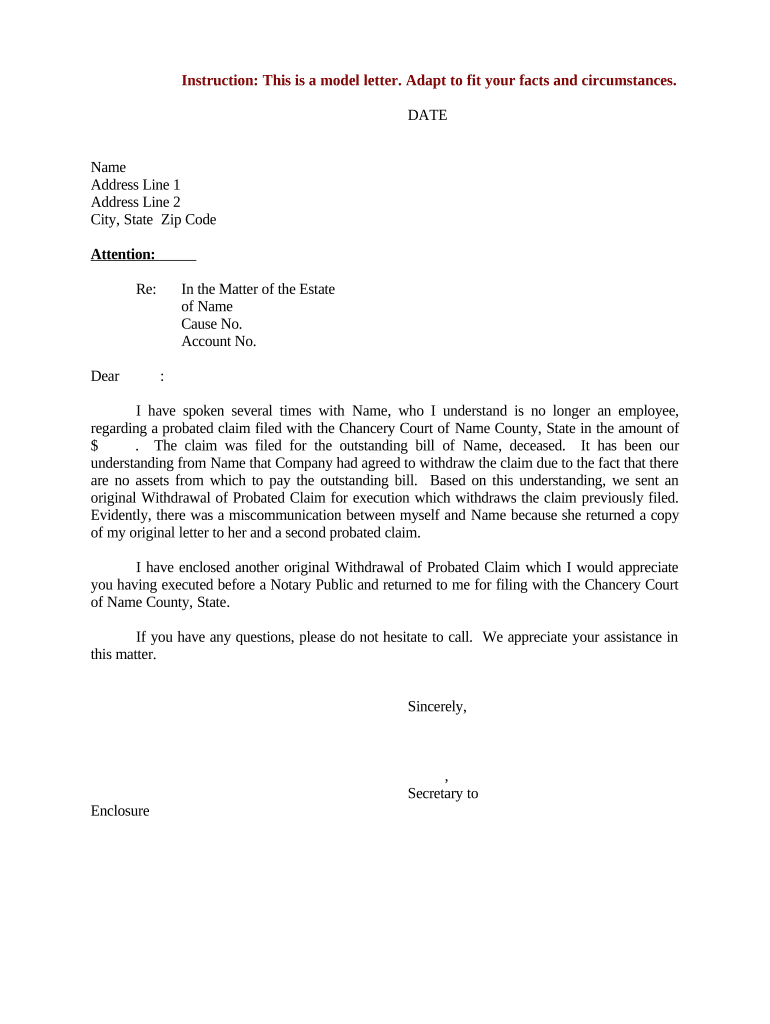
A Letter Requesting Execution of Withdrawal of Probated Claim is a formal written request submitted to the personal representative, attorney, or probate court asking that a previously filed claim against an estate be withdrawn and formally executed as withdrawn. It sets out the claim identifier, reason for withdrawal, and any conditions (for example, settlement or clerical correction). The letter documents mutual agreement or unilateral withdrawal and creates a written trail for estate records and the court file to prevent later disputes about the claim’s status.

Why a clear withdrawal letter matters

A concise, properly executed withdrawal letter reduces litigation risk, clarifies estate accounting, and creates an auditable record for probate files and creditors. It helps the personal representative reconcile claims and prevents duplicate payments.

Why a clear withdrawal letter matters

Who typically prepares and receives this letter

Use a formal, dated signature block and follow any probate-court formatting or local filing rules to ensure acceptance.

  • Creditor or claimant preparing the withdrawal to clear their claim against the estate and preserve settlement terms.
  • Personal representative or executor who needs written proof to update estate accounting and notify beneficiaries.
  • Probate attorney or court clerk who must record or accept the withdrawal for the official file.

Step-by-step: Preparing the withdrawal letter

Follow these sequential steps to prepare a clear and enforceable withdrawal letter for a probated claim.

  • 01
    Identify Claim: Reference docket number, claimant name, and filing date for precise identification.
  • 02
    State Reason: Briefly explain why the claim is withdrawn (settled, duplicate, clerical error).
  • 03
    Add Conditions: Note any conditions or reservation of rights, if applicable.
  • 04
    Sign & Date: Have authorized signer date and sign; include printed name and contact information.

Digital workflow settings for completing the letter online

When preparing the letter in an electronic workspace, configure fields and routing to match legal and court requirements.

Field Configuration
Document Upload PDF or DOCX; combine attachments into one file before upload.
Recipient Roles Set roles: Claimant, Personal Representative, Attorney, Court Clerk.
Authentication Use email plus SMS or ID check for stronger signer attribution.
Template Save Save as template to reuse language and reduce errors.

Typical submission flow for the withdrawal letter

The process below outlines common routing from preparer to court record or estate file.

  • Prepare Letter: Draft, attach supporting documents, and date the letter.
  • Obtain Signature: Signer signs physically or via compliant e-signature method.
  • Deliver Copy: Send to personal representative and court clerk as required.
  • File in Record: Court or estate administrator files or annotates the withdrawal in case file.

Key components every professional withdrawal letter should include

A well-structured letter includes identification, a clear statement of withdrawal, signatory authority, any conditions, attached proof of settlement where relevant, and filing instructions.

Case Identification

Docket number, estate name, county, and court caption so the letter is immediately associated with the correct probate matter and avoids clerical misrouting.
Declarative Statement

A plain sentence stating 'Claimant hereby withdraws Claim No. X' so there is an unambiguous act of withdrawal recorded in writing.

Supporting Facts

Short explanation or documentation (settlement agreement, proof of payment) that explains why the claim is withdrawn and supports closure.

Signer Authority

Printed name, title, bar number if attorney, and contact details to establish who has authority to withdraw the claim and how to reach them.

Conditions

Any conditional language (for example, 'withdrawn upon full payment') spelled out to prevent future disputes about the scope of the withdrawal.

Filing Directions

Instructions or copies showing the party served and the date of service so the estate record reflects accurate routing and receipt.

Technical considerations for e-signing and e-filing

Keep a copy of the signed file and audit trail in your estate records and, if required, submit the signed copy to the probate court per local rules.

  • File Types: PDF and DOCX supported
  • Audit Trail: IP, timestamp, and signer log
  • Authentication: Email, SMS, or ID verification

Timing and filing expectations

Observe court orders and local deadlines; some withdrawals must be filed or noted before the estate is closed or distributions are made.

Immediate Notice:

Provide notice to personal representative when withdrawal occurs, ideally same day.

Court Filing:

File or submit notice per probate-court procedure within the court’s scheduling window.

Accounting Cycle:

Update estate accounting before next beneficiary distribution cycle.

Record Retention:

Keep executed withdrawal with probate records for the applicable retention period.

Contestation Window:

Allow time for any court challenge before final distributions, following local rules.

Common preparation errors to avoid

  • Missing or incorrect claim identification causes clerks to misfile the withdrawal and leads to administrative delays and additional correspondence.
  • Using informal language or vague terms (for example, 'no longer pursuing') that leaves open whether withdrawal is conditional or without prejudice.
  • Failing to include signer authority or contact information, which can prompt the court to demand proof of authority before accepting the withdrawal.
  • Not retaining the signed original or audit trail for the required retention period, making it difficult to rebut later disputes or to prove withdrawal.

Legal risks and consequences of an improper withdrawal

Invalid Signature: May be unenforceable
Incorrect Claim ID: Misfiled or ignored
Unauthorized Signer: Subject to challenge
Ambiguous Language: Leads to litigation
Missing Proof: Court may reject filing
Late Filing: May impact distributions

Typical eSignature vendor pricing and capability snapshot

Common vendor pricing and feature differences for e-signature platforms used to execute and archive legal letters; signNow is listed first per platform-comparison convention.

signNow DocuSign Adobe Sign PandaDoc HelloSign
Starting Price $8/user/mo $15/user/mo $14/user/mo $19/user/mo $15/user/mo
Free Trial 7-day free trial Varies by plan Varies by plan Varies by plan Varies by plan
Bulk Send Yes Yes Yes Yes Varies by plan
Audit Trail Yes Yes Yes Yes Yes
HIPAA Compliant Yes Yes Yes No No
Envelope Cap No cap 100 envelopes/user/year Varies by plan Varies by plan Varies by plan

Frequently asked questions about withdrawing a probated claim

Answers to common questions about validity, signatures, notarization, and electronic filing when withdrawing a claim from probate records.


Need help? Contact support

be ready to get more
Join over 28 million airSlate SignNow users