Establishing secure connection…Loading editor…Preparing document…

Letter Regarding Settlement Offer on Deed of Trust

This template is fully customizable. Edit the text, fill out the fields, and send it for signature. Give it a try!
Letter Regarding Settlement Offer on Deed of Trust

What the Letter Regarding Settlement Offer on Deed of Trust Is

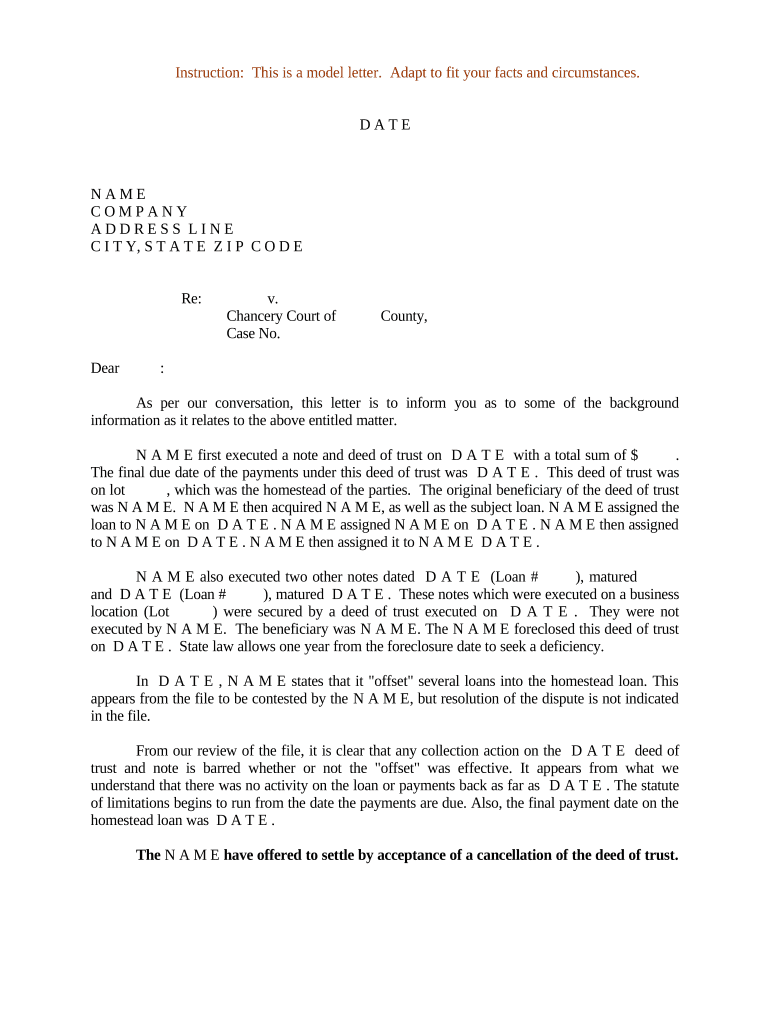
A Letter Regarding Settlement Offer on Deed of Trust is a written notice from a borrower, servicer, or representative that proposes terms to resolve indebtedness secured by a deed of trust. The letter references the specific deed of trust, summarizes the settlement amount or modification, states payment and timing instructions, and explains any conditions required to obtain a release or reconveyance. It is used in pre-foreclosure negotiations, loan workouts, short-pay settlements, or payoff scenarios and should be precise about parties, dates, payment methods, and document recording instructions to avoid disputes.

Why a Clear Settlement Letter Matters

A well-drafted settlement offer letter clarifies the proposed resolution, reduces misunderstandings, and creates a record of terms that supports enforceability and later recording. It helps coordinate lender, borrower, title company, and escrow actions while preserving rights and minimizing risk.

Why a Clear Settlement Letter Matters

Who Typically Prepares or Receives This Letter

Common users include borrowers, mortgage servicers, title agents, and attorneys who manage loan settlements.

  • Real Estate Professionals and Title Agents coordinating recording and reconveyance with county clerks.
  • Mortgage Servicers and Lenders evaluating payoff amounts and release conditions.
  • Borrowers and Borrower Representatives negotiating reduced payoffs or reinstatement terms.

The letter is part of the transaction record and should be distributed to all parties who will approve, fund, or record the settlement.

Step-by-Step: Preparing a Settlement Offer Letter

Follow these sequential steps to draft, verify, and deliver a legally clear settlement offer letter related to a deed of trust.

  • 01
    Identify Parties: List borrower, lender, servicer, and trustee exactly as on the deed.
  • 02
    Reference Deed: Cite deed recording details: county, book/page or instrument number.
  • 03
    State Terms: Specify settlement amount, due date, and payment method.
  • 04
    Delivery and Recording: Explain how funds release triggers reconveyance and recording instructions.

Frequently Asked Questions about Settlement Offer Letters

Answers to common questions about validity, delivery, signing, and recording of settlement offer letters for deeds of trust.


Need help? Contact support

eSignature Vendor Comparison for Executing Settlement Letters

Common vendor features and starting prices useful when choosing an eSignature provider to execute and retain settlement offer letters.

signNow DocuSign Adobe Sign PandaDoc HelloSign
Starting Price $8/user/mo $15/user/mo $14/user/mo $19/user/mo $15/user/mo
Free Trial 7-day free trial No No Yes, limited Yes, limited
Bulk Send Yes Yes Yes Yes No
Audit Trail Yes Yes Yes Yes Yes
HIPAA Compliant Yes Yes Yes No No

Penalties and Risks from Incorrect Settlement Letters

Recording Rejection: Delays or rejections by recorder
Title Defect: Clouded title or unresolved lien
Financial Loss: Forfeited settlement funds
Legal Disputes: Breach claims or litigation
Tax Consequences: Unexpected tax reporting implications
Regulatory Fines: Penalties for consumer disclosure failures

Common Preparation Mistakes to Avoid

  • Using informal names instead of legal names which causes recording office rejections and title mismatches.
  • Omitting the exact recording reference for the deed of trust; ambiguous references delay reconciliation.
  • Failing to specify payment application and fees, leaving parties to dispute what the settlement satisfies.
  • Skipping distribution to escrow, title, and recorder offices which results in missed reconveyance or liens remaining.

Core Elements to Include in the Settlement Offer Letter

Include every component below to make the offer clear, verifiable, and suitable for recording or escrow processing.

Party Identification

Full legal names and roles of borrower, lender, trustee, and any servicer involved to ensure correct party attribution and title matching.
Deed Details

Complete recording reference, county, instrument number, and original recording date so the lien is precisely identified.

Settlement Terms

Exact payment amount, allocation to principal/interest/fees, and whether the amount is a payoff, short payoff, or modification.

Conditions

Any prerequisites such as executed reconveyance, release forms, or proof of funds; specify who is responsible for recording costs.

Delivery Instructions

Where funds are to be sent, required escrow instructions, and how reconveyance will be returned or filed with the recorder.

Signatures & Auth

Authorized signatures, dates, and notarization or witness blocks where required for recording or enforcement.

Typical Processing Flow for a Settlement Offer Letter

A concise workflow showing who prepares, reviews, signs, and records the settlement letter and related reconveyance.

  • Draft: Prepare letter with deed references and settlement terms.
  • Review: Lender and title review and approve terms.
  • Execute: Authorized signers sign and notarize if required.
  • Record: Submit to county recorder and confirm reconveyance.

Digital Signing and Technical Considerations

Choose a platform that supports PDF/DOCX, audit trails, and required authentication for consumer-facing settlements.

  • File Formats: PDF, DOCX are supported for signed final documents
  • Integrations: Works with Salesforce, NetSuite, Google Workspace, and Procore for workflow automation
  • Authentication: Email, SMS, or advanced signer authentication available for stronger signer attribution

Ensure the chosen provider meets legal requirements for attribution and retention under ESIGN and UETA and supports exporting signed files for recording and long-term storage.

Security and Compliance Considerations

Encryption: TLS 1.2/1.3 in transit; AES-256 at rest
Audit Trail: Detailed timestamp, IP, and action log
Regulatory: ESIGN, UETA, and 21 CFR Part 11 support
HIPAA: HIPAA compliance available with BAA
SOC 2 / ISO: SOC 2 Type II and ISO 27001
Accessibility: WCAG 2.0 Level AA support

Who May Sign and Who Has Authority

Borrower / Homeowner

The borrower or authorized agent must sign with name exactly as on the deed; a power of attorney must be attached and comply with state POA rules if signing on the borrower’s behalf.

Lender / Servicer

An authorized officer or designated representative of the lender or servicer signs to accept terms; include printed name, title, and corporate authority documentation when required.

Use Cases: How Organizations Use Settlement Letters

Real-world scenarios that illustrate how a settlement offer on a deed of trust is used and resolved.

Title Company Coordination

A title agent prepares a settlement offer referencing a recorded deed

  • Agent confirms payoff and escrow instructions
  • The agent forwards a signed release to the county recorder and updates the title report to reflect reconveyance and clear the lien from the chain of title.

Servicer Short Pay

A mortgage servicer issues a short-pay settlement offer to resolve defaulted loan

  • Offer conditions include certified funds and executed release
  • Upon receipt and verification of funds, the servicer signs the reconveyance and arranges recording with escrow to finalize the settlement.

Practical Tips for Accurate and Efficient Letters

Best practices to reduce errors, speed processing, and maintain a defensible audit trail.

Confirm Identity and Deed
Verify legal names, deed recording details, and current lienholder status before drafting to prevent rejected recordings and title issues.
Use Clear Monetary Language
Write the settlement amount in numbers and words, and explain how the payment is allocated among principal, interest, and fees to prevent later disputes.
Preserve Audit Trails
Use electronic signing solutions that record timestamps, IP addresses, and signer authentication to support enforceability under ESIGN and UETA.
Coordinate Recording Steps
Share instructions with title/escrow early, specify who pays recording fees, and confirm submission method to avoid processing delays.
be ready to get more
Join over 28 million airSlate SignNow users