Establishing secure connection…Loading editor…Preparing document…

Letter Regarding Estate Bequest to Church

This template is fully customizable. Edit the text, fill out the fields, and send it for signature. Give it a try!
Letter Regarding Estate Bequest to Church

What this Letter Is and When to Use It

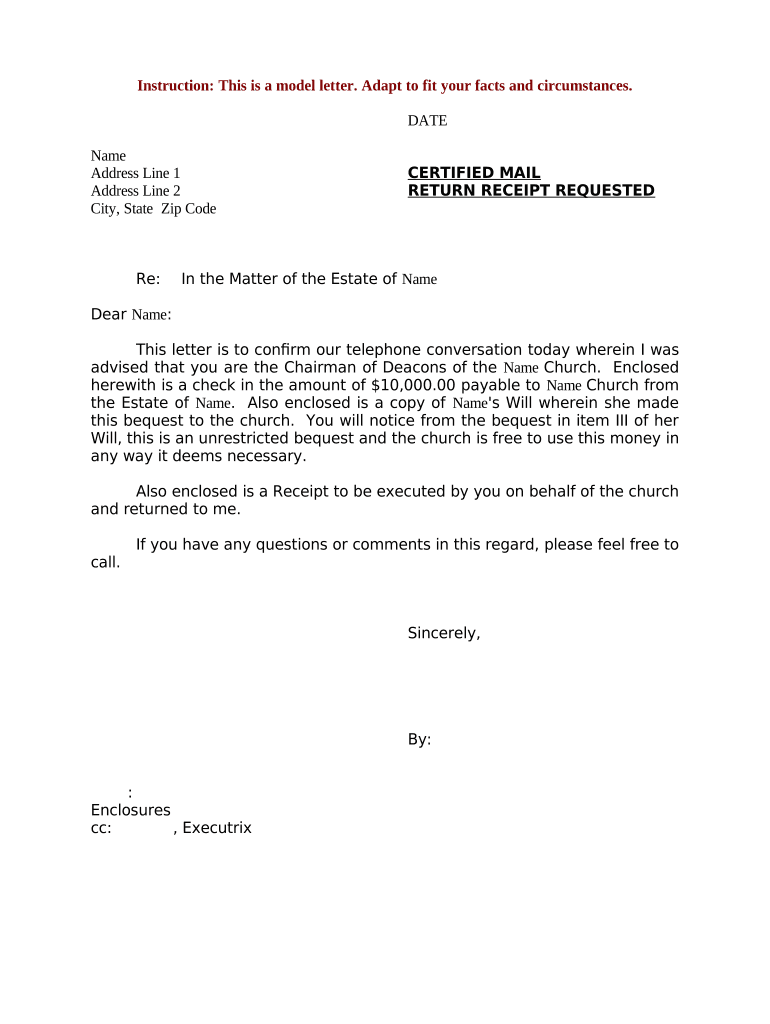
A Letter Regarding Estate Bequest to Church is a formal written notice used by an estate testator, executor, or personal representative to communicate a specific legacy gift to a religious organization. It explains the bequest type (specific gift, percentage, or residual), identifies the designated church, and records any conditions or intended purposes for the funds or property. This letter supplements testamentary documents and can assist the recipient in acknowledging intent, planning for stewardship, and coordinating next steps with the estate administrator or attorney during probate.

Why a Clear Written Notice Matters

A clear letter documents intent, reduces ambiguity in probate, and helps the church confirm acceptance and intended use of the gift.

Why a Clear Written Notice Matters

Who Typically Prepares and Receives This Letter

Use this letter to create a clear record for probate files, beneficiary acceptance, and accounting purposes.

  • Testator or donor communicating personal charitable intent to the church in advance of probate.
  • Executor or personal representative notifying the church of a bequest during estate administration.
  • Estate attorney advising parties and documenting the bequest for probate records and acceptance.

Who Can Sign and Deliver the Letter

Executor / PR

An executor or personal representative signs to report a bequest on behalf of the estate during probate; their authority derives from the will or court appointment and should match probate filings.

Donor / Testator

A living testator or donor may send an advisory letter to the church confirming testamentary intent, but such a letter does not replace a valid will or codicil; legal counsel can advise whether changes require a formal amendment.

Essential Parts of a Professional Bequest Letter

A succinct, well-structured letter reduces confusion and supports efficient estate administration. Include identification, gift terms, and contact details.

Sender ID

Full legal name, role (testator, executor, trustee), and contact information so the church can verify authority and follow up with estate representatives.
Recipient Details

Full legal name of the church or parish, mailing address, and the name and title of the person receiving the notice (pastor, finance director, or gift officer).

Gift Description

Clear description of the bequest: specific dollar amount, percentage of estate, particular asset (real property, securities), or residual bequest details.

Designated Purpose

If the bequest is restricted, state the intended use (endowment, building fund, scholarship) and any limitations or conditions attached to the gift.

Reference Documents

Cite related testamentary documents (will date, codicil date) and probate file or case number, if available, so records can be cross-checked.

Signature Block

Signature of the authorized party, printed name, title (Executor), and date; note whether the signature is notarized or witnessed if required.

Step-by-Step: Preparing and Sending the Bequest Letter

Use these steps to draft, verify, and deliver the letter so the church and estate administrator have a clear, auditable record.

  • 01
    Draft Letter: Describe the gift, purpose, and related testamentary documents.
  • 02
    Verify Authority: Confirm signatory is testator, executor, or attorney-in-fact.
  • 03
    Obtain Authentication: Notarize or witness the signature if the state or institution requires it.
  • 04
    Deliver and Confirm: Send via tracked mail or secure eDelivery and request written acknowledgment.

How Electronic Completion and Delivery Typically Works

Electronic workflows can streamline delivery while preserving an audit trail; follow authentication and retention rules to maintain legal effect.

  • Upload Document: Convert the letter to PDF or DOCX and upload to an eSignature platform.
  • Place Fields: Add signature, date, and contact fields and any conditional items.
  • Authenticate Signer: Use email, SMS code, or stronger methods where required by law or policy.
  • Record Audit Trail: Capture timestamp, IP address, and signer actions for evidentiary support.

Typical eSignature Configuration for a Bequest Letter

Configure fields and authentication to reflect legal needs and the church's internal acceptance policies.

Field Configuration
Signature Mandatory signed field with MM/DD/YYYY date
Role Field Dropdown: Testator | Executor | Trustee
Reference Field Free-text for will date and probate number
Authentication Email plus optional SMS code for added assurance

Delivery Options and Platform Considerations

When using electronic platforms, match authentication level to legal requirements and retain signed copies in both PDF and native platform formats for records.

  • Email: Fast, auditable, but confirm church accepts emailed notices.
  • Certified Mail: Provides physical proof of delivery and receipt.
  • eSignature Platform: Preserves an electronic audit trail and supports notarization options.

Timing Considerations and Typical Deadlines

Timely notification helps the church plan and the executor fulfill estate duties; some steps have statutory or administrative timeframes.

Probate Filing:

File within county deadlines after death as required by state probate court.

Notice to Beneficiaries:

Send beneficiary notices per state probate rules, often within 30–90 days of appointment.

Acknowledgment Request:

Request written acceptance from church; allow 14–30 days for response.

Asset Transfer:

Coordinate transfer timing during estate settlement and after court approval where required.

Record Retention:

Retain original letter for the estate file per retention guidance below.

Key Milestones in Notifying and Settling a Bequest

Sequential milestones show typical progression from notice to transfer during estate administration.

01

Prepare Letter

Draft and verify all identifying information for clarity.

02

Authenticate Signature

Notarize or use verified eSignature if required by recipient or state.

03

Deliver Notice

Send by certified mail or secure electronic delivery and log proof.

04

Coordinate Transfer

Work with church and estate counsel on timing and compliance.

Common Preparation Errors to Avoid

  • Using informal language or vague terms for the gift that make it unclear whether the bequest is specific, residual, or percentage based.
  • Failing to match the church's legal name exactly, which can cause account or acceptance delays for assets or funds.
  • Omitting proof of authority such as executor appointment or failing to attach probate case references for verification.
  • Assuming an advisory letter changes a will; amendments require a valid codicil or a new will executed according to state law.

Risks and Consequences of an Incorrect or Incomplete Letter

Delayed Distribution: May delay probate asset transfers.
Rejection: Church could decline restricted or unclear gifts.
Accountability: Executor could face accounting challenges.
Tax Implications: Incorrect valuations may affect estate tax reporting.
Legal Disputes: Ambiguity can trigger beneficiary contests.
Loss of Intent: Vague language may defeat donor's charitable purpose.

Security and Compliance When Using eSignature Tools

Encryption: TLS 1.2/1.3 in transit; AES-256 at rest.
Audit Trail: Timestamped logs capture IP, actions, and signer events.
Certifications: SOC 2 Type II and ISO 27001 evidence security controls.
Legal Frameworks: ESIGN and UETA support e-signature validity in most states.
HIPAA Support: Business Associate Agreement available for covered health data.
Access Controls: SSO, role-based permissions, and MFA options exist.

Selected eSignature Pricing and Capability Summary

Compare starting prices and core capabilities for common eSignature providers to assess cost and compliance fit for estate communications.

signNow DocuSign Adobe Sign PandaDoc HelloSign
Starting Price $8/user/mo $15/user/mo $14/user/mo $19/user/mo $15/user/mo
Free Trial 7-day free trial Trial available Trial available Trial available Trial available
Bulk Send Yes Yes Yes Yes No
Audit Trail Yes Yes Yes Yes Yes
HIPAA Compliant Yes Yes Yes No No

Real-World Use Examples

Illustrative scenarios show how letters support estate administration and church stewardship.

Executor Notification

An executor notifies a historic parish of a $50,000 restricted bequest

  • Executor attaches will date and probate number
  • The church acknowledges receipt, places funds in a restricted account, and records the gift for later distribution according to the restriction.

Donor Advisory Letter

A donor writes to inform the church of a residuary gift intent

  • Letter references the will date and requests receipt confirmation
  • The church records the donor's intent, consults its gift acceptance policy, and coordinates with the estate’s attorney at settlement.

Common Questions About Bequest Letters and Electronic Handling

Answers to frequent questions about validity, signature method, and how to ensure the church can accept and act on the bequest.


Need help? Contact support

be ready to get more
Join over 28 million airSlate SignNow users