Establishing secure connection…Loading editor…Preparing document…

Sample Letter for Foreclosure Eviction

This template is fully customizable. Edit the text, fill out the fields, and send it for signature. Give it a try!
Sample Letter for Foreclosure Eviction

What the Sample Letter for Foreclosure Eviction Is

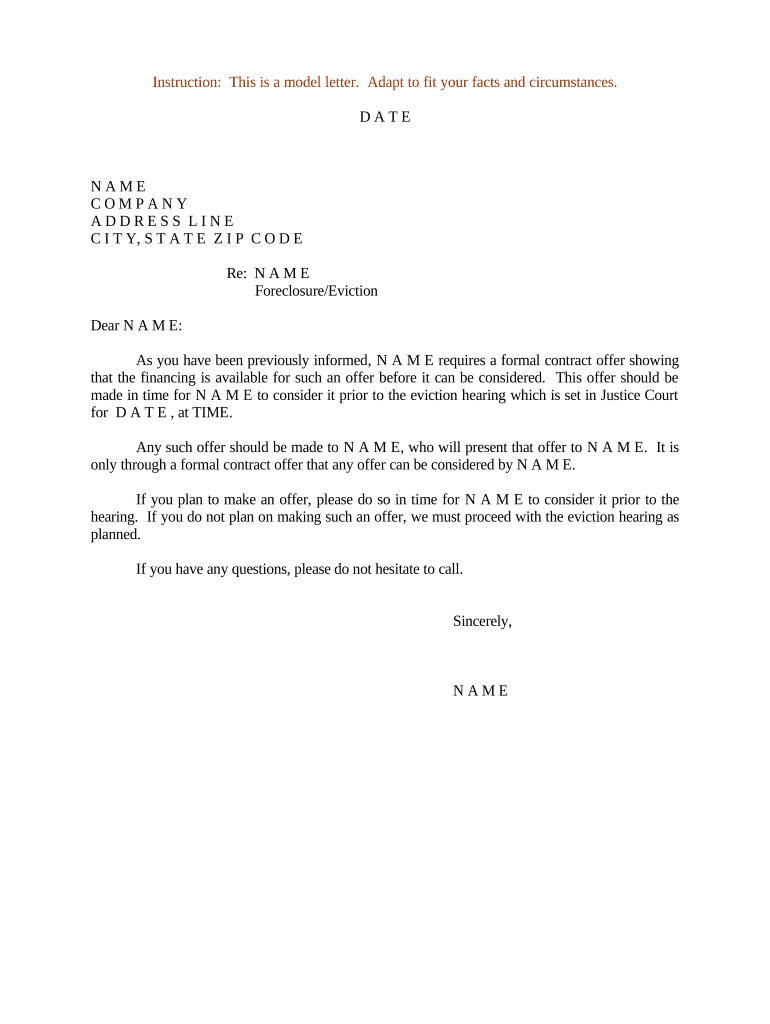
A Sample Letter for Foreclosure Eviction is a formal written notice used by lenders, servicers, or property owners to inform occupants that a property is subject to foreclosure and that eviction proceedings may follow. The template frames required factual details — property identification, borrower name, loan or account number, foreclosure status, applicable cure or redemption periods, and the effective date of notice — while preserving a clear audit trail for legal review. Use the sample as a drafting aid only; adapt language to comply with federal statutes and the controlling state foreclosure and landlord–tenant laws.

Why a Clear, Compliant Sample Letter Matters

A well-structured sample letter reduces legal risk by ensuring required facts are stated, establishes evidence of notice, and supports consistent practice across cases. It helps document the foreclosure timeline and creates a defensible record if service, cure periods, or court filings are contested.

Why a Clear, Compliant Sample Letter Matters

Who Typically Uses This Sample Letter

The template is used by organizations and professionals handling foreclosure matters who must deliver clear written notice while remaining compliant with statute and court rules.

  • Mortgage servicers and foreclosure departments who must standardize notices across large portfolios.
  • Property managers and asset managers handling post-foreclosure tenant relocation and lease terminations.
  • Attorneys and paralegals preparing evidence for eviction proceedings or court filings.

Key Components of an Effective Foreclosure Eviction Letter

Include specific, verifiable elements to make the letter actionable and defensible. Each component should be fact-based, dated, and tied to supporting records or statutes so recipients and courts can verify the notice quickly.

Recipient Details

Full legal name and current mailing address of the occupant and any other parties entitled to notice; include unit number when applicable and cross-check with title records.
Property Identification

Street address, parcel number (APN), and brief property description; reference loan or account number to link the notice to servicing records.

Foreclosure Status

Clear statement of the foreclosure stage (e.g., notice of default, sale scheduled, trustee’s sale completed) and the effective date of that status.

Legal Basis

Cite the controlling state statute or court order authorizing eviction or possession enforcement, and summarize any relevant cure or redemption rights.

Action Required

Describe what the occupant must do (vacate by date, cure default, contact servicer) and provide precise deadlines and contact details for inquiries.

Proof and Attachments

List and attach supporting documents such as the recorded notice of default, trustee’s sale notice, court order, and proof of mailing or service.

Required Information and Fields at a Glance

Property Address: Full street address
Occupant Name: Legal name(s) only
Loan Number: Servicer account ID
Effective Date: MM/DD/YYYY format
Deadline to Vacate: Exact date stated
Attachments: List supporting records

Step-by-Step: Preparing and Sending the Letter

Follow a consistent sequence to prepare the notice, preserve evidence, and comply with local procedure before initiating eviction actions.

  • 01
    1. Gather Records: Collect deed, notice of default, trustee sale notice, and tenant lease if applicable.
  • 02
    2. Draft Letter: Populate template fields, attach exhibits, and cite applicable statute or order.
  • 03
    3. Serve Notice: Send by required methods (mail, personal service) and record proof of service.
  • 04
    4. Preserve Audit Trail: Retain signed copy, delivery receipts, and any electronic audit logs.

Where to File, Send, or Submit the Notice

Delivery method depends on state law and the notice type; maintain copies of everything and follow court filing rules if proceeding to enforcement.

  • Primary Mailing: Send to occupant’s primary residence address on record.
  • Servicer Contact: Copy the loan servicer and recorded lienholder as required.
  • Court Filings: File required affidavits or proof of service with the eviction court if proceeding.
  • Recordation: Record notices when statute requires or when beneficial for title clarity.

Digital Signing and eSubmission: Technical Considerations

Use reliable e-signature workflows when permitted by law; ensure capture of signer intent, attribution, and an immutable audit trail per ESIGN and UETA.

  • Authentication: Email link, SMS code, or advanced ID verification
  • Audit Trail: Timestamp, IP, and action log retention
  • Integrations: Connect with systems like Salesforce, NetSuite, or Google Workspace

eSignature Pricing and Feature Snapshot for Letter Execution

Compare common pricing and feature criteria when choosing an eSignature vendor to prepare and deliver foreclosure- and eviction-related notices; signNow is listed first per vendor comparison conventions.

signNow DocuSign Adobe Sign PandaDoc HelloSign
Starting Price $8/user/mo $15/user/mo $14/user/mo $19/user/mo $15/user/mo
Free Trial 7-day free trial Varies Varies Varies Varies
Bulk Send Yes Yes Yes Yes No
Audit Trail Yes Yes Yes Yes Yes
HIPAA Compliant Yes Yes Yes No No

Penalties and Risks for Incorrect or Improper Notice

Invalid Service: May void eviction and delay possession
Wrongful Eviction: Subject to damages and court sanctions
Statutory Noncompliance: Missed cure periods undermine enforcement
Record Gaps: Poor audit trail weakens defense in litigation
Electronic Exception: Some foreclosure notices excluded from ESIGN
Privacy Risk: Improperly shared PII can trigger liabilities

Practical Tips for Accurate, Efficient Completion

Apply consistent naming, date formats, and indexing to reduce disputes and enable quick retrieval during legal review.

Use Clear Dates and Formats
Enter all dates as MM/DD/YYYY to avoid ambiguity. Where a statute counts days, also state the statutory basis and the calculated deadline to avoid later confusion.
Attach Verifying Documents
Include recorded notices, trustee sale documentation, and proof of mailing or personal service. Attach a table of exhibits and cross-reference them in the letter body.
Document Service Method
Record the method used (first-class mail, certified mail, personal service), include tracking or affidavit numbers, and preserve delivery receipts as part of the case file.
Preserve an Unalterable Copy
Store the signed notice and audit trail in secure, tamper-evident storage with access logs to support admissibility in court.

Common Mistakes to Avoid When Preparing Notices

  • Using informal language that fails to convey legal consequence and required action clearly.
  • Missing or incorrect property identifiers that allow recipients to dispute the notice’s applicability.
  • Failing to attach or reference governing court orders or recorded notices relied upon.
  • Relying on an eSignature where the particular foreclosure/eviction notice is excluded by law.

Illustrative Use Cases

Two practical scenarios show how the sample letter is applied and documented in routine foreclosure workflows.

Mortgage Servicer Example

The servicer issues a default notice and then a foreclosure eviction letter to the occupant to start vacancy planning.

  • The letter cites the trustee’s sale date and a 30-day vacate deadline.
  • The servicer attaches sale notice and proof of mailing, stores the signed copy in an encrypted repository, and files a proof-of-service affidavit with the county court when proceeding to eviction.

Property Manager Example

After a lender completes a trustee sale, a property manager sends a standardized eviction notice to remaining occupants.

  • The notice lists relocation resources and a final vacate date.
  • The manager documents delivery method, keeps all attachments for 7 years, and coordinates with legal counsel for any contested possession actions.

Typical Signers and Approvers

Servicing Manager

A Servicing Manager reviews foreclosure documentation, approves the eviction letter language, and signs to attest accuracy. They must ensure the account history supports the stated defaults and that all statutory preconditions to eviction have been met before sending notice.

Legal Counsel

In-house or outside counsel approves legal citations, confirms jurisdictional notice requirements, and signs or certifies the attached affidavit of service when litigation or contested possession is likely.

Frequently Asked Questions About Foreclosure Eviction Letters

Answers to common legal and procedural questions that arise when drafting, signing, or delivering foreclosure eviction notices.


Need help? Contact support

be ready to get more
Join over 28 million airSlate SignNow users