Establishing secure connection…Loading editor…Preparing document…

Letter Opposing Reinstatement of Military Draft

This template is fully customizable. Edit the text, fill out the fields, and send it for signature. Give it a try!
Letter Opposing Reinstatement of Military Draft

What the Letter Opposing Reinstatement of Military Draft Is

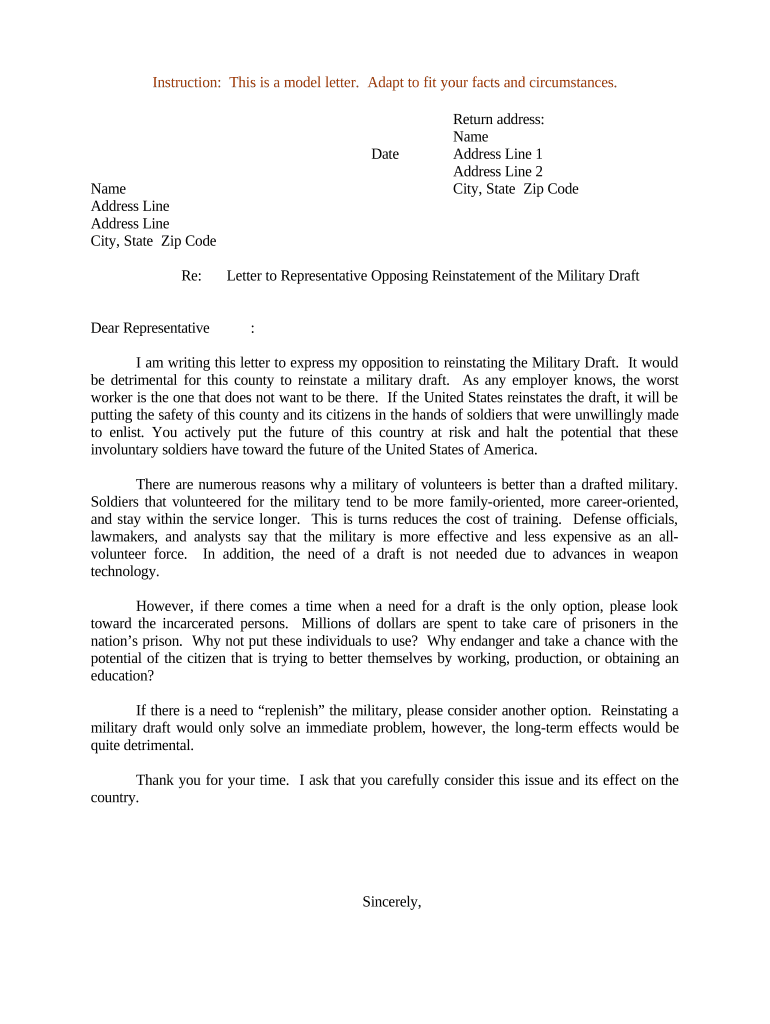
A Letter Opposing Reinstatement of Military Draft is a formal, written statement submitted by an individual or group to elected officials, legislative committees, agency docket records, or media outlets to express opposition to proposals reintroducing conscription. The document should state the author’s relationship to the issue, present concise factual reasons and evidence for opposition, request specific legislative or administrative action, and include contact information for follow-up. It functions as a persuasive public comment that may be entered into official records, distributed to decision makers, and retained as part of advocacy records.

Why This Letter Matters for Policy and Public Record

A clear, well‑documented letter ensures your position is recorded in the public or legislative record, helps lawmakers assess constituent sentiment, and supports evidence-based policy debate while preserving a written record for later reference.

Why This Letter Matters for Policy and Public Record

Who Typically Prepares and Sends These Letters

Individuals and organized groups commonly prepare letters to influence legislative and administrative decisions.

  • Individual constituents writing to their member of Congress or state legislators; personal perspective and local impact statements are common.
  • Civic organizations and advocacy groups coordinating template letters and signatures to demonstrate collective opposition at scale.
  • Elected officials' staff, policy advisors, and legal counsel compiling constituent input and preparing formal submissions for committee records.

Collections of individual letters and aligned organizational statements are often more effective when submitted within the same comment window and addressed to the correct decision maker.

Essential Elements to Include in the Letter

Include a concise position statement, factual support, a specific request, signatory details, and optional attachments; maintain a professional tone and provide contact information for verification.

Position Statement

Open with a short, direct sentence stating opposition to draft reinstatement and the specific proposal or bill number if available.
Reasons and Evidence

Provide verifiable facts, data, and sources that support your position; cite studies, fiscal estimates, or social impacts when possible.

Requested Action

State the action you are asking the recipient to take, for example vote against, delay, or seek public hearings.

Signatory Details

List the full legal name, affiliation (if any), city and state, and contact email or phone for follow-up verification.

Attachments

Attach supporting documents such as reports, petitions, or constituent surveys; label each attachment clearly for review.

Tone and Accuracy

Keep language factual and civil to avoid defamation risks; correct legal or factual errors before submission.

Required Data Elements and Recordkeeping Details

Signatory Full Name: As shown on ID
Affiliation / Organization: Employer or group name
Address and Contact: City, state, email
Date of Letter: MM/DD/YYYY format
Target Recipient: Official name or committee
Attachments List: Brief filenames enumerated

Step‑by‑Step: Draft, Verify, and Submit Your Letter

Follow these sequential steps to prepare a clear, verifiable objection and deliver it to the correct decision maker.

  • 01
    Identify Recipient: Confirm bill number, committee, or agency docket
  • 02
    Draft Statement: Write concise position, evidence, and requested action
  • 03
    Collect Signatures: Gather names and contact info; verify accuracy
  • 04
    Submit and Track: Send via verified channel and retain delivery proof

Typical Routing and Filing Options for Submission

Letters can be sent to individual offices, committee clerks, regulatory dockets, or published via organizational campaigns; choose the route that ensures official receipt and record placement.

  • Legislative Office: Address to member or committee clerk for record inclusion
  • Agency Docket: Submit to the official regulatory docket for formal comment
  • Organizational Campaign: Aggregate constituent letters for coordinated delivery
  • Public Distribution: Share copies with media or public archives as permissible

Configuring an Online Template for Collective Submissions

Design an online form that standardizes key fields, validates signatory data, and records timestamps for auditability.

Custom Form Field and Configuration Settings Field name | Platform behavior and validation rules
Template Name, Version and Usage Save template, track version, set public or restricted access
Required Signers, Roles and Order Make name and contact fields required; define signer order if collecting multiple approvals
Authentication Method, Strength and Options Use email verification or SMS code; stronger authentication for high‑volume campaigns
Conditional Fields, Visibility and Logic Show follow‑up questions only when relevant to streamline responses
Notifications, Reminder Schedule and Expiration Configure confirmation emails, reminders, and a closing date for submissions

Delivery Channels, File Formats, and Integrations

Choose compatible file formats and platform integrations to ensure reliable submission and recordkeeping.

  • File Formats: PDF, DOCX supported
  • Integrations: Salesforce, Google Workspace, NetSuite
  • Accessibility: WCAG 2.0 Level AA

Using standard formats and connections to CRM or cloud storage preserves submission metadata, improves tracking, and supports later verification without changing original content.

Timing Considerations and Recommended Submission Windows

Plan submissions around legislative and regulatory timelines to maximize consideration; allow time for verification and follow‑up.

Pre‑Vote Lead Time:

Submit two to four weeks before scheduled committee or floor votes

Regulatory Comment Periods:

Submit within the official docket window, often 30 days or as posted

Acknowledgment Follow‑Up:

Allow two weeks to request receipt confirmation if none received

Campaign Deadlines:

Coordinate organizational calls to action to meet target delivery dates

Record Retention Start:

Retain copies immediately upon sending for proof of submission

Common Mistakes to Avoid When Preparing the Letter

  • Using emotional or unverified claims without factual support undermines credibility and increases the risk of rebuttal or removal from official records.
  • Addressing the wrong recipient or omitting bill identifiers (bill number, session) can prevent the letter from being associated with the intended legislative action.
  • Failing to include contact details or using inconsistent signatory names prevents verification and can exclude the submission from official consideration.
  • Submitting duplicate or automated mass letters without clear individualization may be deprioritized by clerks and reduce perceived constituent engagement.

Legal and Practical Risks to Consider

Defamation Risk: Avoid false factual assertions
Privacy Exposure: Do not disclose others' private data
Record Rejection: Incorrect recipient can void consideration
Lost Credibility: Inaccuracies harm persuasive impact
Duplicate Submissions: May be filtered or disregarded
Missed Deadlines: Late submissions unlikely to be reviewed

Practical Examples of Digital Collection and Delivery

Organizations and small teams often use online templates and eSign tools to collect individualized constituent letters at scale.

Brian Fitzgibbons — Optica Ventures LLC

A small advocacy group used a hosted form to collect constituent letters before a committee vote, ensuring accurate metadata and delivery.

  • Centralized collection reduced administrative friction by consolidating responses.
  • "The interface is simple and easy‑to‑use for our team; more importantly, it is just as easy for our customers."

Tim Martin — Martin Properties

A local civic coalition coordinated template letters to multiple legislators with tracked confirmations, improving follow‑up accuracy.

  • Templates ensured consistent messaging across hundreds of submissions.
  • "I can process and execute all of these documents online with 100% compliance and built‑in security."

Practical Tips for Accurate, Credible Letters

Follow these practical drafting and submission habits to strengthen the persuasive value and admissibility of your letter.

Be Concise and Specific
Limit the letter to one or two pages, cite the bill or docket identifier, and state the requested action clearly to increase the likelihood staff will read and record your comment.
Verify Factual Claims
Double‑check statistics, dates, and citations; include links or attachments to primary sources to support claims and avoid factual disputes that reduce credibility.
Personalize When Possible
Add one or two sentences about local impact or personal experience — individualized details are more persuasive than identical mass submissions.
Keep an Audit Trail
Retain copies of sent letters, delivery confirmations, and any replies; maintain a spreadsheet of submissions to track recipient, date, and verification status.

Representative eSignature Pricing and Capability Comparison

Common eSignature providers differ in price, envelope limits, and compliance features; signNow appears first below for easy reference.

signNow DocuSign Adobe Sign PandaDoc HelloSign
Starting Price $8/user/mo $15/user/mo $14/user/mo $19/user/mo $15/user/mo
Free Trial 7‑day free trial Varies by vendor Varies by vendor Varies by vendor Varies by vendor
Bulk Send Yes Yes Yes Yes No
Audit Trail Yes Yes Yes Yes Yes
HIPAA Compliant Yes Yes Yes No No

Frequently Asked Questions About the Letter Opposing Reinstatement of Military Draft

Answers to common procedural and legal questions about drafting, signing, and submitting opposition letters to legislative or regulatory bodies.


Need help? Contact support

be ready to get more
Join over 28 million airSlate SignNow users