Letter to Local Counsel Regarding Hearing
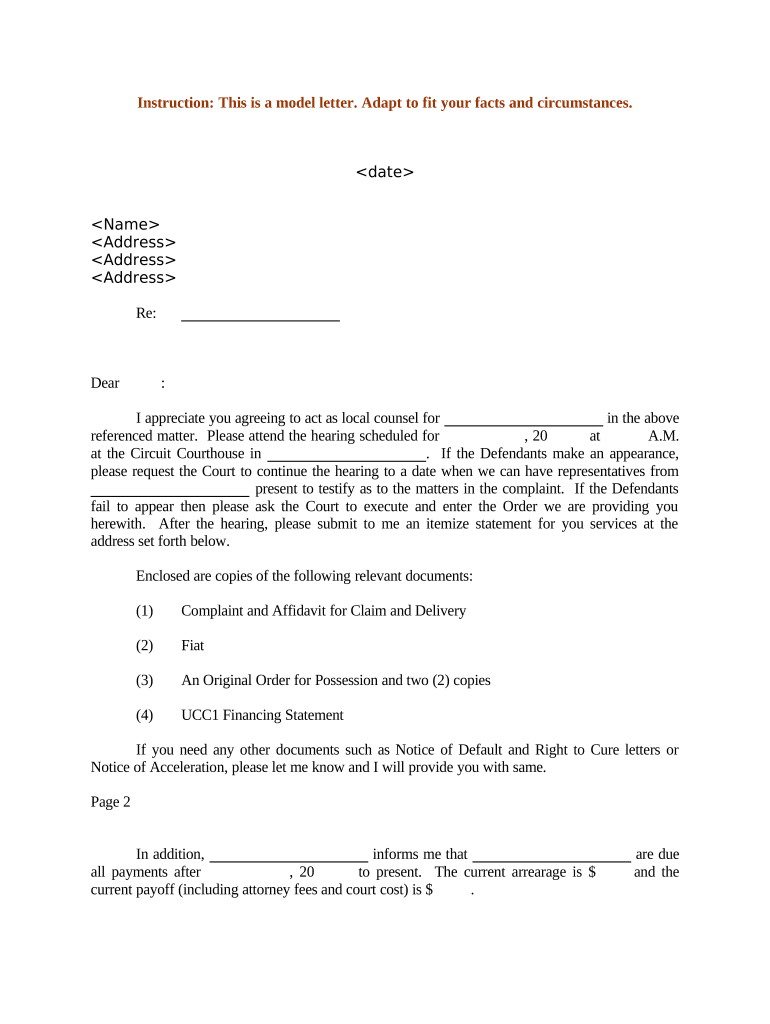
What the Letter to Local Counsel Regarding Hearing Is
Why a Clear Letter Matters for Hearing Readiness
A precise letter aligns lead and local counsel on tasks, deadlines, and evidence, reducing miscommunication and last-minute issues. It documents expectations, confirms local rules, and helps ensure filings, exhibit exchanges, and witness preparation occur on time.

Who Typically Prepares and Receives This Letter
Typical users include lead counsel who needs venue-specific assistance, general counsel coordinating litigation across jurisdictions, and parties who require local representation for courtroom presence.
- Lead Counsel coordinating strategy and assigning courtroom tasks to local counsel.
- Local Counsel providing venue rules, court customs, and on-site representation.
- Clients or corporate GC arranging logistics, exhibits, witness coordination, and filings.
Step-by-Step: Preparing and Sending the Letter
-
01Prepare Case Summary: Summarize facts, procedural history, and outstanding motions.
-
02List Hearing Details: State date, time, court, judge, and docket number.
-
03Assign Tasks: Specify who handles filings, exhibits, witness prep, and appearances.
-
04Request Confirmation: Ask local counsel to confirm procedures, availability, and any local rules.
Configure an Online Workflow for Delivery and Tracking
| Field | Configuration |
|---|---|
| Signer Order | Send to lead counsel, then local counsel in venue. |
| Required Attachments | Include complaint, motions, exhibit list, and prior orders. |
| Authentication | Email plus optional SMS code for signer verification. |
| Archive | Save signed letter as PDF/A with audit trail metadata. |
Delivery and Platform Considerations
Ensure the delivery method supports secure transmission, signature capture, and retention of audit trails for the Letter to Local Counsel Regarding Hearing.
- File Formats: PDF, DOCX, and TIFF supported.
- Integrations: Connects with Google Workspace and Microsoft 365.
- Authentication: Email, SMS, or two-factor methods.
How Delivery and Confirmation Typically Work
-
Assemble: Attach complaint, motions, exhibit list.
-
Address: Add lead counsel and local counsel emails.
-
Send: Deliver via secure eSignature workflow.
-
Confirm: Request written acknowledgment and timing confirmation.
Timing Checklist and Critical Deadlines
Hearing Notice:
Send immediately on scheduling to confirm attendance and logistics.
Exhibit Exchange Deadline:
Provide exhibit lists at least 7–14 days before hearing to allow review.
Witness Availability:
Confirm witness schedules and contact details 5–10 days before hearing.
Filing Deadlines:
Note local motion cutoff times and same-day filing requirements.
Final Confirmation:
Request final courtesy confirmation 24–48 hours before the hearing.
Common Preparation Pitfalls to Avoid
- Missing or incomplete court caption may result in rejected filings or misdirected notices; verify docket number and party names before sending the letter.
- Failing to list exhibits with identifiers causes confusion at hearings; provide exhibit numbers, short descriptions, and copies to local counsel and opposing parties.
- Assuming local rules are uniform across courts leads to missed deadlines; always request local practice guidance and confirm service procedures.
- Relying solely on verbal confirmations increases risk; obtain written acknowledgment, timestamps, and an audit trail within the e-signature platform.
Consequences of Incomplete or Late Letters
eSignature Pricing and Feature Snapshot for Sending the Letter
| signNow | DocuSign | Adobe Sign | PandaDoc | HelloSign | |
|---|---|---|---|---|---|
| Starting Price | $8/user/mo | $15/user/mo | $14/user/mo | $19/user/mo | $15/user/mo |
| Free Trial | Yes, 7-day trial | Varies | Varies | Varies | Varies |
| Bulk Send | Yes | Yes | Yes | Yes | No |
| Audit Trail | Yes | Yes | Yes | Yes | Yes |
| HIPAA Compliant | Yes | Yes | Yes | No | No |
| Envelope Cap | No cap | 100 envelopes/user/year | Varies | Varies | Varies |
Frequently Asked Questions and Troubleshooting
-
What should the letter include?
Include the case caption, docket number, hearing date and time, court and courtroom, lead counsel contact details, exhibit list, witness names, and specific requests for local counsel such as service instructions or confirmed local rules.
-
Can the letter be electronically signed?
Yes; electronic signatures are generally enforceable under the ESIGN Act and UETA when intent, consent, attribution, and reliable record retention are present. For consumer-facing health or benefit matters, include the ESIGN consumer disclosure as required by 15 U.S.C. §7001(c).
-
Is notarization required for this letter?
Typically no; a Letter to Local Counsel Regarding Hearing is not usually a notarized instrument. However, some jurisdictions or related filings may require notarized affidavits or sworn statements. Verify local notary and RON rules before relying on a notarized version.
-
How should exhibits be attached and labeled?
Attach exhibits as separate, clearly labeled PDF files and include an exhibit index in the letter. Number exhibits consistently, provide short descriptions, and indicate expected timeline for exchange to minimize disputes over admissibility or chain of custody.
-
What if local counsel is unavailable?
Provide secondary local contacts, inquire about alternate counsel suggestions, and set clear deadlines for responses. Consider filing a notice of substitution or appearance if court rules or schedule require active representation and the originally designated local counsel cannot appear.
-
How to confirm receipt and readiness?
Request written acknowledgment, ask local counsel to confirm exhibit receipt, planned witness order, and compliance with local filing procedures. Use e-signature audit trails, timestamps, and read receipts to document confirmation for the case file and for potential disputes.