Clear identification
State the signer’s full legal name, position, department, and the date of the letter so the record ties directly to personnel files and the relevant incident.
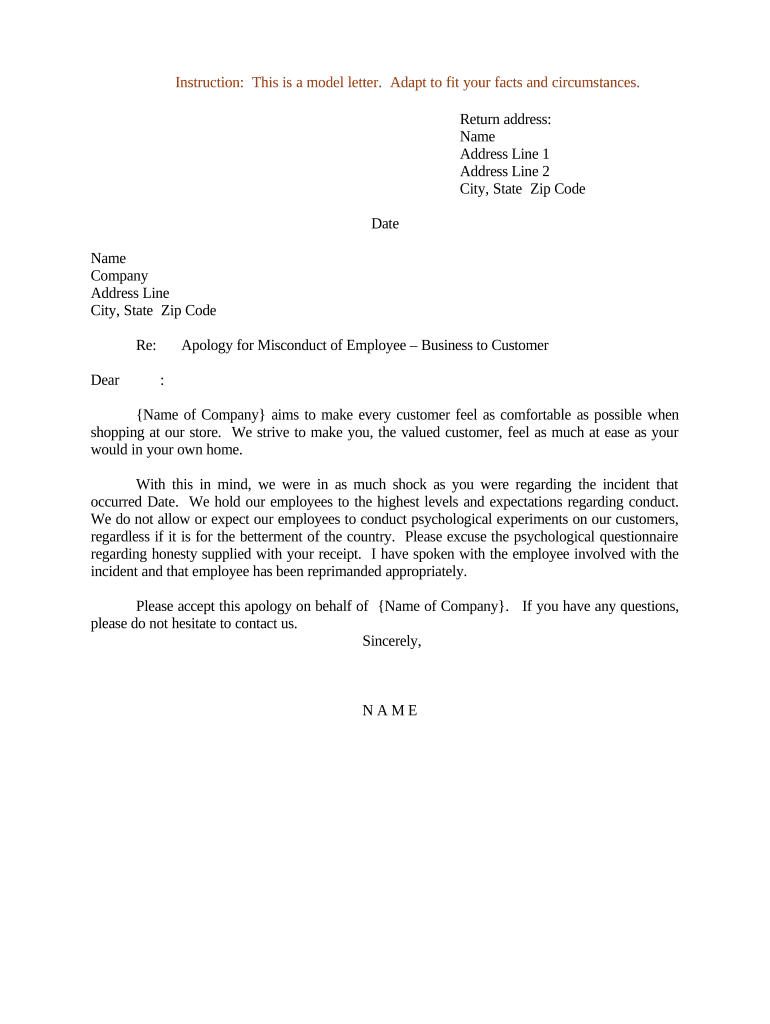
A concise apology documents accountability and creates a clear record of the individual’s response to misconduct.

This document is commonly prepared by individuals who have been found responsible for policy breaches and reviewed by HR or oversight offices.
Recipients should treat the letter as an official record and store it according to retention policy and applicable law.
The individual who committed the misconduct signs to acknowledge facts and express remorse. The narrative should be factual, avoid admissions beyond the investigation’s scope, and propose corrective steps to restore trust within the organization.
A Human Resources or compliance officer often countersigns or files the letter to confirm receipt, note any next steps, and maintain the document in the employee’s personnel or case record in compliance with policy.
State the signer’s full legal name, position, department, and the date of the letter so the record ties directly to personnel files and the relevant incident.
Briefly describe the conduct or incident being addressed, including date(s), location, and the specific policy or standard that was breached.
Use unambiguous language that accepts responsibility without speculative or evasive phrasing; avoid new factual claims that contradict investigation findings.
Offer a concise statement of regret focusing on impact rather than legalities; avoid language that could be construed as admission of civil or criminal liability beyond the organizational context.
List concrete steps the signer will take to remedy harm and prevent recurrence, with reasonable timelines and measurable actions where appropriate.
Signer must sign and date the letter; include printed name and contact details. If required, HR or a witness may also sign and date to confirm receipt.
| Field | Configuration |
|---|---|
| Template Name | Use a consistent template titled 'Letter of Apology for Misconduct'. |
| Authentication | Require email verification or SMS code for signer identity confirmation. |
| Routing | Auto-route signed copies to HR and the signer for records. |
| Storage | Save signed PDF and audit trail in secure document repository. |
Use secure eSignature tools and document storage that meet organizational compliance requirements.
Choose an eSignature provider that supports audit trails, access controls, and the storage options your compliance team requires.
Often issued within 48–72 hours after investigatory findings are communicated.
HR commonly reviews submissions within 3 business days of receipt.
A meeting to discuss corrective action is typically scheduled within 7 calendar days.
Organizations often require return within 10–14 calendar days of the request.
Case notes and the letter are usually archived after disciplinary action completes.
Investigation record created and evidence assembled for review.
Formal determination communicated and request for apology may be issued.
Employee provides letter and proposed corrective actions.
Finalized letter placed in personnel file and retained per policy.
Save as PDF/A for archival and as standard PDF for sharing; preserve a copy of the audit trail showing timestamps and signer authentication.
Keep finalized signed versions only; avoid multiple active versions to reduce confusion in dispute resolution.
Store in encrypted HR or compliance repositories with role-based access to protect confidentiality.
Provide the signer and HR with copies; limit circulation to necessary parties and note any retention or redaction requirements.
| signNow | DocuSign | Adobe Sign | PandaDoc | HelloSign | |
|---|---|---|---|---|---|
| Starting Price | $8/user/mo | $15/user/mo | $14/user/mo | $19/user/mo | $15/user/mo |
| Free Trial | Yes, 7-day trial | No | No | Yes, limited | Yes, limited |
| Bulk Send | Yes | Yes | Yes | Yes | No |
| Audit Trail | Yes | Yes | Yes | Yes | Yes |
| HIPAA Compliant | Yes | Yes | Yes | No | No |
A nurse submits a written apology after a patient privacy breach is confirmed
A student provides an apology after violating conduct code terms