Establishing secure connection…Loading editor…Preparing document…

Letter Regarding Court Pleadings and Motions

This template is fully customizable. Edit the text, fill out the fields, and send it for signature. Give it a try!
Letter Regarding Court Pleadings and Motions

What a Letter Regarding Court Pleadings and Motions Is

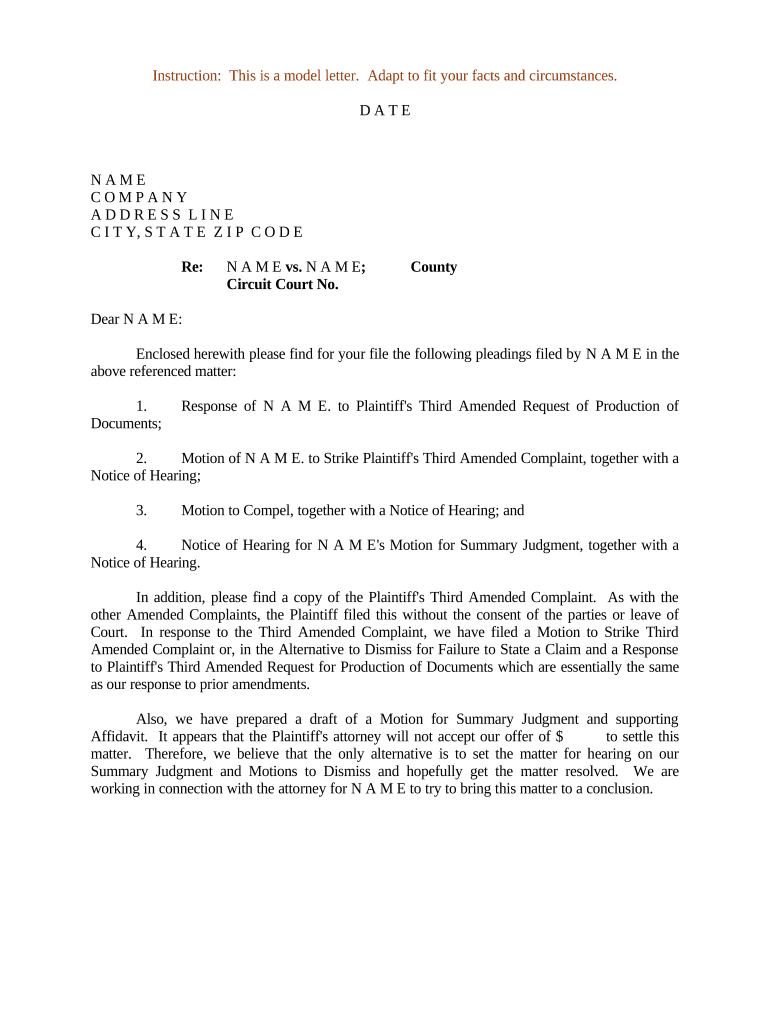
A Letter Regarding Court Pleadings and Motions formally notifies opposing parties, counsel, or the court about pleadings filed, motions submitted, or scheduled hearings. It summarizes the document type, identifies the case and docket number, states the filing or hearing date, outlines required responses or deadlines, and lists the attachments or exhibits served. The letter creates a clear paper trail for service and can document efforts to comply with local rules, meet meet-and-confer obligations, or preserve rights ahead of contested procedural deadlines.

Why This Letter Matters for Case Management

A clear letter reduces procedural risk by documenting service, clarifying deadlines, and focusing recipient attention on required actions; it also helps establish the record if disputes over notice or timeliness arise.

Why This Letter Matters for Case Management

Who Typically Prepares and Receives These Letters

Use clear formatting, cite the docket number, and attach copies of the filing to avoid confusion and delay.

  • Private litigation counsel serving opposing counsel and pro se parties with case updates or motion notices.
  • In-house legal teams notifying internal stakeholders and external counsel about filed motions and upcoming hearings.
  • Court clerks or administrative staff acknowledging filings and providing scheduling or filing confirmations.

Core Elements to Include in Every Letter

A professional letter about pleadings and motions should be concise, reference the court and case number, state what was filed, list key dates, and explain any requested action or deadline.

Case ID

Include the full case caption and docket number so recipients can immediately locate the filing in court records and electronic case management systems.
Document Type

State whether the attachment is a complaint, answer, motion to dismiss, motion for summary judgment, or other pleading and include the treatment requested from the court.

Filing Date

Provide the date and time the document was filed or lodged with the court and, if applicable, the date of service on opposing parties.

Hearing Status

Indicate any scheduled hearing date, the assigned department or judge, and whether a hearing is set or the matter is submitted on papers.

Response Deadline

Specify applicable response or opposition deadlines and the legal basis for those timelines where known (for example, Fed. R. Civ. P. 12(a) or local rules).

Attachments

List attachments (notice of motion, memorandum, exhibits) and include a compact exhibit index to help recipients review filings efficiently.

Required Information to Include in the Letter

Case Caption: Full case caption
Docket Number: Court docket number
Filing Date: MM/DD/YYYY
Document Title: Title of filing
Service Method: How documents were served
Contact Info: Sender name and phone

Step-by-Step: Drafting and Sending the Letter

Follow a short, repeatable process to prepare the letter, attach filings, confirm service method, and retain proof of delivery.

  • 01
    Prepare: Draft letter referencing case caption and filings.
  • 02
    Attach: Attach the filed pleading and exhibit list.
  • 03
    Serve: Serve per local rules and record the method.
  • 04
    Retain: Save proof of service and signed copies.

Customizing an Online Workflow for This Letter

When sending electronically, configure fields and routing to capture signer identity, delivery receipt, and retention of proof of service.

Field Configuration
Case Caption Field Required text field, validated format
Docket Number Field Short numeric field, no spaces
Attachment Upload Allow PDF/DOCX, require filename pattern
Proof of Service Auto-store delivery receipt and audit trail

Where to File, Send, and Record Service

Identify the correct filing destination and the parties who must receive the letter; follow court and local rules for electronic filing and service.

  • Court Filing: File through the court’s e-filing portal.
  • Opposing Counsel: Serve counsel via permitted methods.
  • Pro Se Parties: Mail or email as local rules allow.
  • Clerk’s Office: Provide courtesy copy when required.

Digital Signing and eSubmission Considerations

Ensure the chosen provider supports retention and export formats compatible with court e-filing systems and your records policy.

  • Integrations: Connects to case management
  • Authentication: Email, SMS, or stronger
  • Formats: PDF and DOCX supported

Key Deadlines and Typical Response Times

Deadlines vary by jurisdiction and the type of pleading; always confirm local rules and the governing federal or state rules that set response periods.

Response to Complaint:

21 days under Fed. R. Civ. P. 12(a)(1)(A)(i)

If Service Waived:

60 days to respond after waiver under Fed. R. Civ. P. 12(a)(1)(A)(ii)

Opposition to Motion:

Often 14 days; check local rule

Reply to Opposition:

Often 7–10 days; local rule dependent

Hearing Scheduling:

Court sets date; give notice per local rules

Typical Milestones from Filing to Hearing

Track major milestones and preserve proof of each step to support compliance and later verification if service or timing is contested.

01

Filing Completed

Court accepts and assigns a docket number.

02

Service Completed

Proof of service is generated and stored.

03

Opposition Filed

Opposing party files any response per rule.

04

Hearing or Submission

Court hears matter or rules on papers.

Common Mistakes to Avoid When Preparing the Letter

  • Omitting the docket number, which leads to misfiling or delayed notice and increases dispute risk over timeliness.
  • Failing to attach the actual filing or exhibit list, causing the recipient to receive incomplete information and request resubmission.
  • Using an incorrect service method that does not comply with the court’s local rules, which can result in invalid service.
  • Neglecting to retain proof of service or an audit trail, hindering your ability to demonstrate timely notice if challenged.

Consequences of Errors or Late Service

Default: Default judgment possible
Sanctions: Court may impose sanctions
Motion Denial: Relief may be denied
Evidence Excluded: Exhibits may be excluded
Fee Liability: Cost-shifting or fines
Reputational Risk: Adverse professional impact

Practical Examples: How Letters Are Used

Two brief scenarios illustrate common uses of a pleading-and-motion letter in practice.

Court Notice Example

A small civil firm files a motion for summary judgment and sends a letter to opposing counsel and the clerk summarizing the filing

  • The letter states the hearing date and lists exhibits
  • The preserved proof of service prevented a later dispute about timely notice and facilitated efficient case scheduling.

Administrative Proceeding Example

An in-house counsel files a motion with an agency and informs listed parties by letter and certified email

  • The letter included regulatory references and an exhibit index
  • The organized attachments and audit trail satisfied the agency’s submission requirements and avoided a procedural rejection.

Select eSignature Pricing and Feature Snapshot

Basic pricing and feature availability for common eSignature providers. signNow is listed first for direct comparison; verify plan details with each vendor before purchasing.

signNow DocuSign Adobe Sign PandaDoc HelloSign
Starting Price $8/user/mo $15/user/mo $14/user/mo $19/user/mo $15/user/mo
Free Trial Yes, 7-day trial Varies by vendor Varies by vendor Varies by vendor Varies by vendor
Bulk Send Yes Yes Yes Yes No
Audit Trail Yes Yes Yes Yes Yes
HIPAA Compliant Yes Varies by plan Varies by plan Varies by plan Varies by plan

Security and Compliance Points for Electronic Letters

Encryption: TLS 1.2/1.3
Data At Rest: AES-256 encryption
Certifications: SOC 2 Type II
Regulatory: HIPAA BAA available
Legal Framework: ESIGN and UETA compliance
Audit Trail: IP, timestamp, action log

Frequently Asked Questions About Letters for Pleadings and Motions

Answers to frequent questions about service, electronic signatures, timing, and recordkeeping for letters that accompany pleadings and motions.


Need help? Contact support

be ready to get more
Join over 28 million airSlate SignNow users