Establishing secure connection…Loading editor…Preparing document…

Sample Letter Release

This template is fully customizable. Edit the text, fill out the fields, and send it for signature. Give it a try!
Sample Letter Release

What a Sample Letter Release Is and When It Applies

The Sample Letter Release is a concise written instrument used to confirm that one party releases another from specified claims, obligations, liens, or liabilities related to a particular transaction or event. It typically identifies the parties, describes the obligations being released, sets an effective date, and records any consideration. In the United States, properly executed releases can be created and signed electronically under the ESIGN Act and UETA where applicable. When completed accurately, a Sample Letter Release documents the scope of rights surrendered and reduces future disputes over the matters it addresses.

Why a Clear Release Matters for Risk and Records

A Sample Letter Release provides clear evidence that specified obligations or claims have been settled or waived, reducing legal uncertainty and supporting recordkeeping. It simplifies dispute prevention, creates a dated record of consent, and can be executed electronically to accelerate processing.

Why a Clear Release Matters for Risk and Records

Who Typically Prepares and Signs These Releases

Sample Letter Releases are used by organizations and individuals who need a formal record of release or settlement of obligations.

  • Real estate owners and agents resolving liens or tenant claims.
  • Healthcare providers confirming release of liability after treatment or transfer.
  • Businesses and finance teams documenting settlement of invoices, loans, or guarantees.

Core Elements Every Professional Release Should Include

Core elements that make a Sample Letter Release enforceable and clear for all parties involved, and reduce future disputes when drafted with precision.

Parties

Clearly identify the releasing and released parties with legal names, roles, and contact details to avoid ambiguity in enforcement and to support service of process if disputes arise.
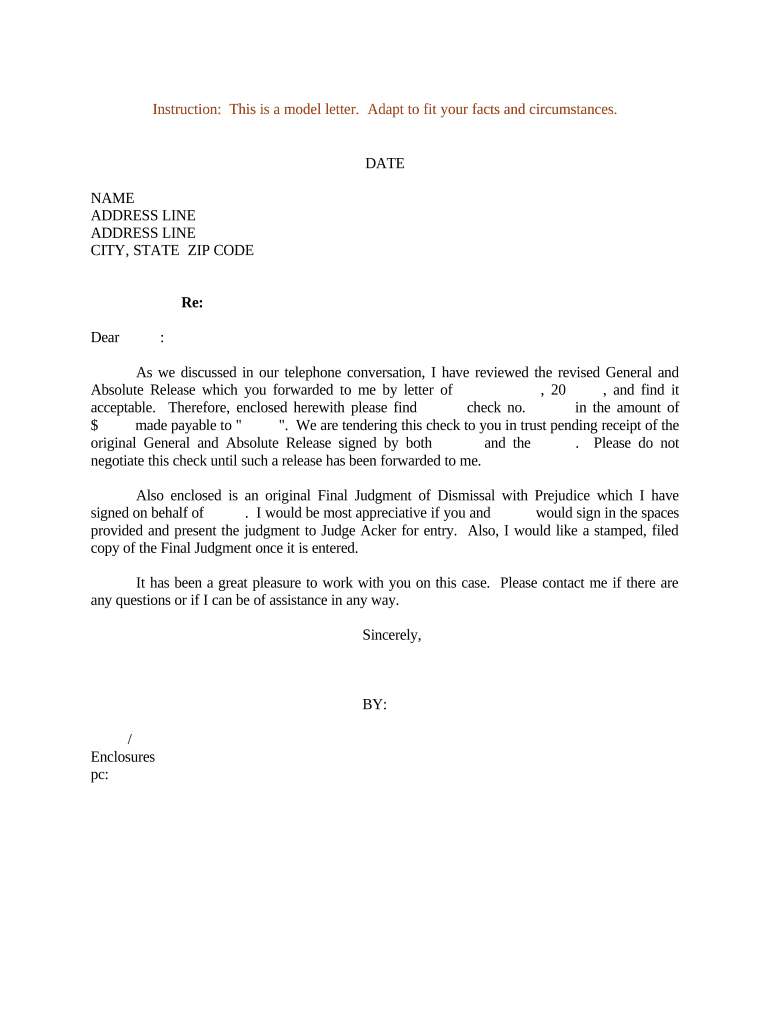
Scope

Define the exact claims, obligations, dates, and transactions covered. Limit scope to identified matters to prevent unintended waiver of unrelated rights. Include references to agreement sections or account numbers where possible.

Consideration

State specific consideration or mutual promises exchanged. Courts may refuse to enforce a release lacking clear consideration or evidence of bargained-for exchange. Provide dollar amounts or explicit covenants to strengthen enforceability.

Effective Date

Record the effective date and any retroactive terms. The date governs obligations, limitation periods, and the starting point for retention schedules, and notice periods for any conditional releases.

Signatures

Provide signature lines for all parties, printed names, titles when applicable, and signature dates. Specify who signs first if sequential execution is required and whether electronic signatures are accepted.

Notary/Witness

Indicate whether notarization or witnesses are required and include a notary block if applicable. For interstate matters, consider remote notarization where authorized by state law.

Step-by-Step: Complete and Finalize a Sample Letter Release

Follow these steps to complete a Sample Letter Release accurately, whether signed on paper or electronically.

  • 01
    Identify Parties: Enter full legal names and addresses for each party involved.
  • 02
    Describe Release: Specify claims released, scope, limits, and any retained rights.
  • 03
    Set Effective Date: Use MM/DD/YYYY and confirm mutual agreement on the date.
  • 04
    Sign and Date: All parties sign in signature blocks; notarize or witness if required.

Typical Workflow from Draft to Execution

Overview of the typical workflow to create, approve, and finalize a Sample Letter Release electronically.

  • Prepare Draft: Draft the release and attach supporting documents.
  • Review Internally: Legal or stakeholders review for scope and consideration.
  • Sign Online: Use eSignature or print-sign-notarize as required.
  • Distribute Completed: Share executed copies and update recordkeeping systems.

Digital Configuration Checklist for Electronic Completion

Typical digital workflow settings to configure when sending a Sample Letter Release for signature.

Field Configuration
Signature Field Required; add signature and date fields for each signer.
Authentication method and verification level Email link standard; add SMS or KBA for higher assurance.
Conditional fields and field validation rules Show or hide clauses based on answers to key questions.
Delivery options, reminders, and expiration Set reminders, expiration, and copy recipients for audit trail.

Platform Capabilities to Support Electronic Releases

Platform and integration requirements for electronically executing and distributing the Sample Letter Release securely at scale.

  • Formats: PDF, DOCX, and HTML supported.
  • Integrations: Salesforce, Google Workspace, NetSuite supported.
  • Authentication: Email, SMS, SSO options available.

Comparing eSignature Vendors for Sample Letter Releases

Quick vendor comparison for common eSignature features and pricing when preparing a Sample Letter Release.

signNow DocuSign Adobe Sign PandaDoc HelloSign
Starting Price $8/user/mo $15/user/mo $14/user/mo $19/user/mo $15/user/mo
Free Trial 7-day free trial Varies by plan Varies by plan Varies by plan Varies by plan
Bulk Send Yes Yes Yes Yes No
Audit Trail Yes Yes Yes Yes Yes
HIPAA Compliant Yes Yes Yes No No

Security and Compliance Considerations for Electronic Execution

Encryption in Transit: TLS 1.2 and 1.3 in transit.
Encryption at Rest: AES-256 encryption for stored data.
Audit Trail: Tamper-evident logs capture signer events.
Certifications: SOC 2 Type II, ISO 27001, PCI DSS.
HIPAA: BAA available to support HIPAA compliance.
21 CFR Part 11: Controls for electronic records and signatures.

Key Risks and Potential Legal Consequences

Invalid Execution: May render release unenforceable.
Tax Penalties: Backup withholding or IRC §6721 exposure.
Fraud Claims: Court may rescind for fraud.
I-9 Issues: Employment verification fines possible.
Notarization Failure: State refusal to record.
Data Privacy: HIPAA or state privacy violations.

Common Preparation Mistakes to Avoid

  • Using ambiguous language that fails to specify particular claims, leading to disputes about whether a matter was actually released.
  • Failing to match signer names to legal entity records or IDs, producing inconsistencies that undermine enforcement or tax reporting.
  • Omitting consideration details or using boilerplate phrases without factual support, which can cause courts to deem the release illusory.
  • Neglecting required notarization, witnesses, or state-specific formalities before filing or recording releases tied to real property.

Timing and Deadline Considerations

Key timing considerations and common regulatory deadlines to check when issuing a Sample Letter Release.

Confirm effective date and timing:

Establishes when obligations are discharged.

Agree signature deadlines and execution order:

All parties must sign by stated date.

Allow time for notarization and RON:

Schedule notarization before filing or recordation.

Confirm any required filings or recordings:

Some releases attached to deeds require county recording.

Start retention period on effective date:

Retention schedules begin on effective date or filing date.

Practical Examples: How Releases Work in Real Situations

Real-world examples showing how releases resolve claims and simplify recordkeeping across sectors for closing transactions.

Martin Properties

A regional brokerage replaced paper releases with an electronic template to speed closings and reduce manual errors across transactions.

  • Signatures completed on mobile at point of sale.
  • Using an e-signed release preserved a clear audit trail, eliminated scanning delays, and reduced turnaround time for final settlement; legal counsel confirmed the releases were enforceable under state contract law.

Fertility Centers of Illinois

A healthcare network standardized release forms to document patient consent and data-sharing permissions across multiple clinics and providers.

  • Consent obtained before data transfer.
  • The standardized releases included HIPAA-compliant language and retention instructions so records met 45 CFR §164.530(j). Centralized storage simplified audits and auditors reported faster retrieval during compliance reviews.

Practical Best Practices for Reliable Releases

Practical tips to reduce errors, accelerate execution, and improve enforceability of Sample Letter Releases in practice.

Use precise, specific release language and identifiers
Avoid generic phrases. Specify accounts, dates, contract sections, and transaction identifiers. Explicit language reduces interpretation disputes. Attach exhibits for detailed schedules or account statements to provide context and evidentiary support for the waived claims.
Confirm party legal names and signing titles
Match the legal name to government ID and business registration records. Include official titles for corporate signatories and add capacity language when an agent signs on behalf of an entity.
Document consideration or mutual promises clearly
Specify monetary amounts, repayment schedules, or mutual covenants. Absent consideration, include clear recitals describing the exchange to bolster enforceability under contract law and reference any prior agreements or release negotiations for context.
Preserve audit trail and executed copies
Store signed originals, electronic copies, and metadata such as signer IP, timestamps, and certificate of completion. Keep records pursuant to retention policies and make copies available for audits or dispute resolution.

Frequently Asked Questions About Sample Letter Releases

Answers to common questions about completing, signing, and preserving a Sample Letter Release for legal and administrative use.


Need help? Contact support

be ready to get more
Join over 28 million airSlate SignNow users