Case Caption
Full plaintiff v. defendant caption matching the complaint and court docket to ensure the notice is associated with the correct matter.
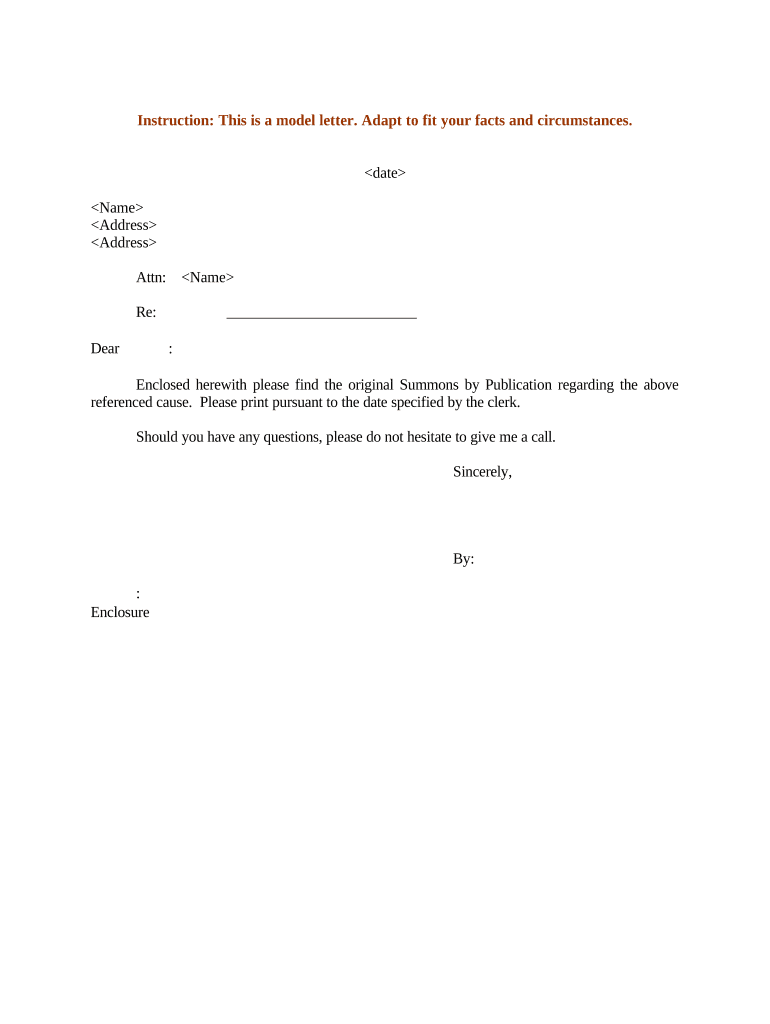
A properly drafted letter preserves due process by notifying unknown defendants, fulfills court-ordered notice requirements, and creates a record required for default or other relief. Clear letters reduce the risk of service challenges and ensure the court has the factual basis to accept publication as effective notice.

Parties who file or serve a Summons by Publication include plaintiffs, plaintiff attorneys, and court clerks handling service of process.
Small claims, family law exceptions, or tenant/landlord matters may have specific local practice; check the local rules or clerk for jurisdictional nuances before filing.
A licensed attorney who prepares the summons, affidavit of due diligence, and motion for publication; coordinates publication with the court-ordered newspaper and ensures deadlines and proof of service are filed to protect the client's procedural rights.
Court staff who issues docket entries, accepts filings, and receives the affidavit of publication; they note compliance with the court order, provide information on approved newspapers, and advise on local filing timelines and format requirements.
Full plaintiff v. defendant caption matching the complaint and court docket to ensure the notice is associated with the correct matter.
Name and division of the court, including county and address where filings are maintained so readers can locate case records.
Exact docket or index number as issued by the clerk; incorrect numbers can impede docketing and service recognition.
A concise description of the nature of the claim so the recipient understands the subject without reproducing the full complaint.
Date by which the defendant must respond or appear, stated in clear MM/DD/YYYY format and consistent with the court order.
Instructions on how to access the full complaint or case file, including clerk contact information or online case portal details.
| Field | Configuration |
|---|---|
| Template | Pre-fill case metadata and boilerplate notice. |
| Signatures | Judge or clerk signature capture as required. |
| Authentication | Email link or SMS code for attorney confirmation. |
| Storage | Save PDF and retain audit trail for court. |
Use e-signature platforms to prepare, route, and store letter PDFs, ensuring audit trails and access controls for court compliance.
Platforms should support audit trails, time-stamped signatures, and secure storage consistent with ESIGN and UETA; check whether a Business Associate Agreement or additional protections are required for sensitive filings or health-related matters.
File before publication; judge issues order granting permission.
Begin on court-ordered date or as directed by clerk.
Typically weekly for several consecutive issues per order.
Date by which defendant must answer or appear.
Affidavit of publication filed after final issue runs.
| Service Method Comparison for Process | Summons by Publication | Service by Mail |
|---|---|---|
| Typical circumstances and triggers for use | unknown defendant | known address |
| Requirement for court authorization or order | required | often required |
| Evidence needed to prove service | affidavit of publication | return receipt or affidavit |
| Expected timeline from start to proof | weeks to months | days to weeks |
| signNow | DocuSign | Adobe Sign | PandaDoc | HelloSign | |
|---|---|---|---|---|---|
| Starting Price | $8/user/mo | $15/user/mo | $14/user/mo | $19/user/mo | $15/user/mo |
| Free Trial | 7-day free trial | Varies by vendor | Varies by vendor | Varies by vendor | Varies by vendor |
| Bulk Send | Yes | Yes | Yes | Yes | No |
| Audit Trail | Yes | Yes | Yes | Yes | Yes |
| HIPAA Compliant | Yes | Yes | Yes | No | No |
| Envelope Cap | No envelope cap | 100 envelopes/user/year | Varies by plan | Varies by plan | Varies by plan |
Plaintiff files motion demonstrating due diligence and requests publication order.
Judge reviews facts and signs an order specifying publication terms and deadlines.
Publisher runs the notice according to the schedule required in the order; retain copies.
Publisher or plaintiff files the affidavit proving publication to the court docket.