Establishing secure connection…Loading editor…Preparing document…

Sample Letter Waiver

This template is fully customizable. Edit the text, fill out the fields, and send it for signature. Give it a try!
Sample Letter Waiver

What a Sample Letter Waiver Is and When it's Used

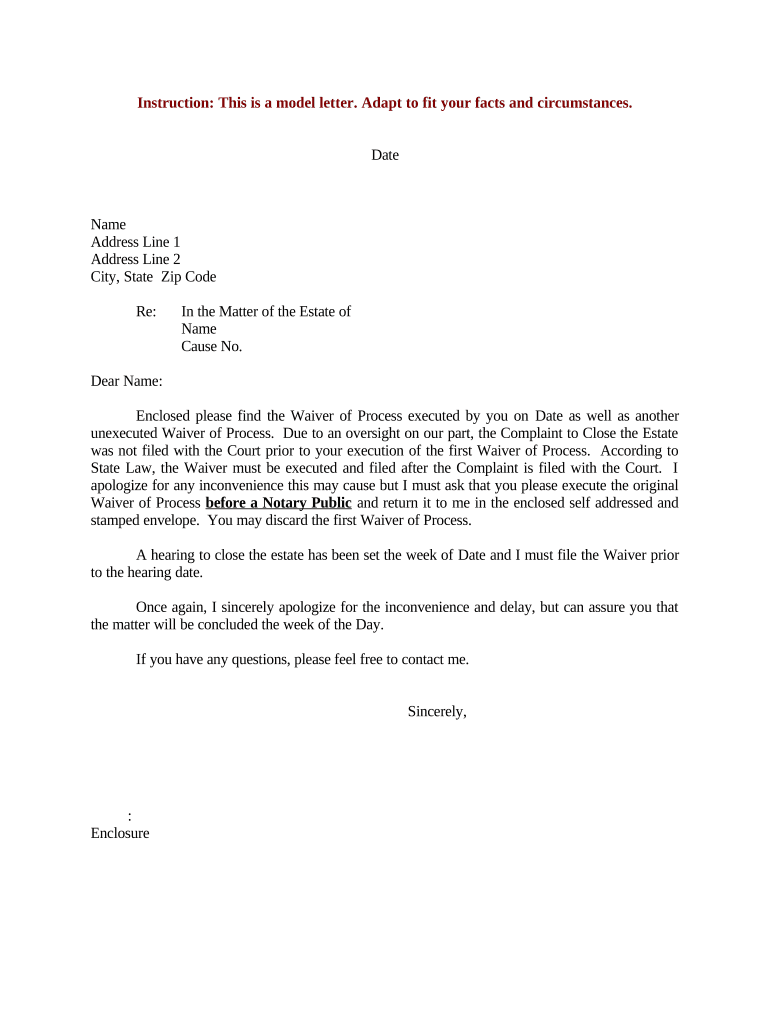
A Sample Letter Waiver is a written statement in which one party voluntarily relinquishes a specific right, claim, or requirement against another party. Commonly used in contract settlements, lien waivers, insurance claims, and administrative waivers, the document defines the scope of the waiver, the parties involved, effective date, and any conditions or limitations. When properly executed it creates an enforceable record; whether it must be notarized or witnessed depends on subject matter and state law. Electronic execution under ESIGN and UETA is generally permitted where no statutory exception applies.

Why a Clear, Signed Waiver Matters

A precise waiver reduces uncertainty by documenting the exact rights being surrendered, who consents, and when consent takes effect. This clarity lowers dispute risk, simplifies processing, and provides evidence of mutual agreement in litigation or administrative review.

Why a Clear, Signed Waiver Matters

Who Typically Prepares and Signs a Waiver

The Sample Letter Waiver is used across legal, financial, and operational teams where formal release or consent is required.

  • Claims administrators and adjusters who settle insurance matters and need a clear release of liability.
  • Contract managers and procurement teams resolving payment disputes or accepting modified delivery terms.
  • Property managers and real estate agents issuing lien or tenant-related waivers to close transactions.

Matching the signer role to the authority named in the waiver is critical; unauthorized signatures can void the document.

Typical Signatories and Their Roles

Claims Manager

A Claims Manager normally has delegated authority to accept settlements and sign releases on behalf of an insurer. Their signature should be accompanied by an internal approval reference and a printed name and title to demonstrate authority and chain of custody.

General Counsel

General Counsel or an authorized corporate officer often reviews legal language and signs waivers that affect corporate rights. Their execution is typically combined with a corporate resolution or delegated authority statement to prevent later challenges.

Essential Elements to Include in a Professional Waiver

A robust Sample Letter Waiver contains clear identification of parties, an unambiguous statement of waived rights, supporting facts, any consideration, effective date, signature blocks, and revocation or survival language where appropriate.

Parties

Full legal names and business entity types for each party, including mailing address and a point of contact for notices; avoid acronyms that could cause ambiguity.
Scope of Waiver

A precise description of the right or claim being waived (dates, contract clauses, claim numbers); avoid broad or vague phrasing that could be contested later.

Consideration

If the waiver is part of a settlement, state the consideration (dollar amount or other benefit) clearly to support enforceability under contract law.

Effective Date

Specify when the waiver takes effect (MM/DD/YYYY) and whether retroactive application is intended; effective date can affect statute of limitations.

Signature Block

Include printed name, title, corporate capacity, date, and space for witness/notary details as required by jurisdiction or document type.

Revocation/Survival

State whether the waiver is irrevocable and which provisions, if any, survive termination; include a clause for revocation only if permitted and clearly defined.

Step-by-Step: Filling Out a Sample Letter Waiver

Follow these sequential steps to complete a waiver accurately and minimize legal or processing problems.

  • 01
    Identify Parties: Enter complete legal names, addresses, and contact details for all parties.
  • 02
    Describe Rights: Clearly describe the specific right, claim, or obligation being waived with reference numbers.
  • 03
    State Consideration: Document consideration or reason for the waiver and any conditions attached.
  • 04
    Execute Properly: Have authorized signers sign, date, and add witness or notary details if required by law.

Typical Processing Flow for a Waiver

A predictable routing and logging process reduces cycle time and preserves an auditable record for compliance or disputes.

  • Draft: Prepare the waiver with complete party and scope details.
  • Internal Approval: Obtain required internal approvals and authority confirmations.
  • Signature: Execute signatures and any witness or notary steps.
  • Archive: Store final signed copy with retention metadata and audit trail.

Configuring an Online Waiver Workflow

Set up fields and authentication to match legal requirements and internal controls before sending the waiver for signature.

Field Configuration
Signer Authentication Email link by default; add SMS OTP or KBA when higher assurance required.
Conditional Fields Show witness/notary fields only when jurisdiction or document type requires them.
Template Controls Lock key clauses and required fields to prevent unauthorized edits.
Integrations Connect to CRM or document management systems like Salesforce, NetSuite, or Microsoft 365 for routing and storage.

Technical Options for eSigning and Delivery

Choose a platform and settings that meet authentication, audit trail, and file-format needs for the waiver.

  • File Formats: PDF and DOCX are standard; export signed copies as PDF/A for long-term retention.
  • Authentication: Use email, SMS OTP, or advanced signer authentication when legal certainty is required.
  • Integrations: Link to cloud storage and enterprise systems for automated archival and lifecycle management.

Ensure the chosen platform supports tamper-evident audit trails, exportable audit reports, and storage controls aligned with your retention policy.

Saving, Exporting, and Supporting Documents to Include

Final signed waivers should be exported in stable formats and filed with supporting evidence to preserve context and proof.

PDF/A Export

Save the executed waiver as PDF/A to preserve formatting, embedded fonts, and long-term accessibility.

Native DOCX

Keep an editable DOCX master in a secure archive for future controlled amendments or reference by legal counsel.

Audit Report

Retain the platform-generated audit report showing signer IP, timestamps, and authentication steps as contemporaneous evidence.

Supporting Attachments

Attach relevant invoices, claim summaries, or correspondence that establish the factual basis for the waiver.

Common Preparation Errors to Avoid

  • Vague scope language failing to specify what is waived and when, which invites legal challenge and reinterpretation.
  • Mismatched signer names or lacking authority documentation, causing parties to dispute the signer's capacity to waive rights.
  • Omitting consideration or using ambiguous consideration language, undermining contract formation and enforceability.
  • Skipping required notarization or witness steps for jurisdictions or document types that mandate them, risking invalidation.

Key Risks If a Waiver Is Incorrect or Incomplete

Voidable Waiver: Court may find waiver unenforceable.
Contract Dispute: Further litigation and costs.
Regulatory Risk: Fines or sanctions may follow for statutory violations.
Loss of Rights: Unintended surrender of critical claims.
Reputational Harm: Stakeholder trust may erode.
Document Retention Failures: Noncompliance with retention rules.

Typical Timelines and Processing Expectations

Set expectations for turnaround and internal deadlines to keep waiver processing predictable and auditable.

Response Window:

Provide waiver within 14 calendar days of request unless contract specifies otherwise

Effective on Receipt:

Unless specified, waiver becomes effective on the signed effective date

eSignature Completion:

Signed electronically and returned within 24–72 hours for routine matters

Notarization Lead Time:

Allow 3–7 business days when in-person notarization or RON scheduling is required

Record Filing:

Archive executed waiver immediately with audit trail and metadata

Real-World Examples of Waiver Usage

The following short case notes show how organizations implement waivers and digital signing to reduce friction.

Optica Ventures — Operations

Their team streamlined customer releases using standard waiver templates and e-signatures.

  • The interface simplified remote acceptance and recordkeeping.
  • The result was faster turnarounds and clearer audit trails for customer-facing releases while preserving compliance controls.

Fertility Centers of Illinois — Healthcare

They adopted digital waivers for patient authorizations and administrative releases.

  • HIPAA controls were integrated into workflows.
  • This reduced in-person visits for paperwork, maintained PHI protections, and preserved signed records with built-in audit logs.

Practical Tips for Accurate and Efficient Completion

Follow these practices to reduce errors and protect enforceability when preparing waivers.

Use Precise Language
Define the exact right being waived and avoid open-ended or ambiguous phrases that invite litigation.
Verify Signer Authority
Confirm corporate signatory authority with a resolution or power of attorney when applicable.
Record Evidence
Attach supporting documents such as invoices, claim summaries, or settlement agreements to provide context.
Preserve Audit Trail
Keep the platform audit report, timestamps, and authentication records to demonstrate intent and attribution.

eSignature Vendor Pricing Snapshot for Signing a Waiver

Comparison of entry-level published starting prices and common enterprise features relevant to waiver workflows; signNow appears first per platform comparison conventions.

signNow DocuSign Adobe Sign PandaDoc HelloSign
Starting Price $8/user/mo $15/user/mo $14/user/mo $19/user/mo $15/user/mo
Free Trial 7-day free trial Varies Varies Varies Varies
Bulk Send Yes Yes Yes Yes No
Audit Trail Yes Yes Yes Yes Yes
Envelope Cap No cap 100 envelopes/user/year No cap No cap No cap

Frequently Asked Questions About Sample Letter Waivers

Answers to common questions about validity, execution, and practical issues when using waivers in the United States.


Need help? Contact support

be ready to get more
Join over 28 million airSlate SignNow users