Establishing secure connection…Loading editor…Preparing document…

Letter Requesting Extension of Time for Loan

This template is fully customizable. Edit the text, fill out the fields, and send it for signature. Give it a try!
Letter Requesting Extension of Time for Loan

What a Letter Requesting Extension of Time for Loan Is

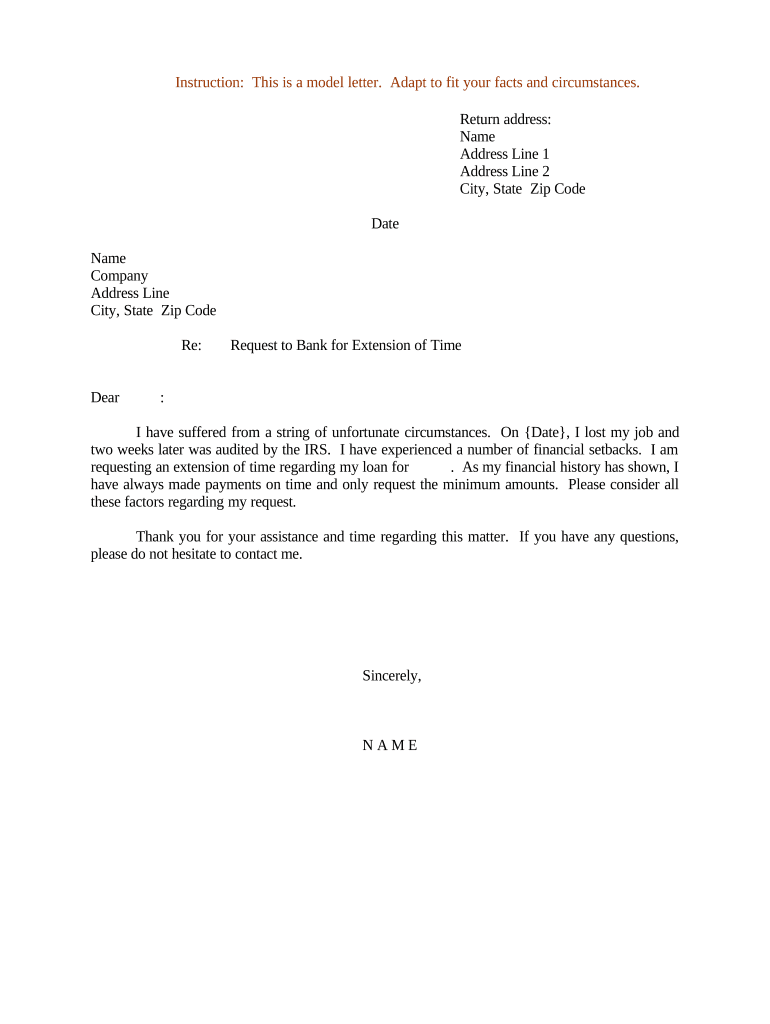
A Letter Requesting Extension of Time for Loan is a written request from a borrower to a lender asking for more time to meet a loan obligation, such as a payment, closing, or documentation deadline. It explains the reason for the delay, proposes a specific new deadline or repayment plan, and includes identifying loan details so the lender can evaluate the request efficiently. The letter can be delivered by mail, courier, or electronically and should be clear, factual, and supported with any relevant documentation that demonstrates cause and ability to comply under the proposed schedule.

Why a Clear Extension Letter Matters

A concise, well-documented extension letter reduces misunderstandings, documents the borrower’s good-faith efforts, and creates a record for both parties to rely on if terms are adjusted. It can prevent default notices and preserve negotiation options while giving the lender the information needed to make a timely decision.

Why a Clear Extension Letter Matters

Who Prepares and Receives These Letters

Borrowers, guarantors, loan officers, and legal or accounting advisors commonly prepare or review these requests before submission.

  • Individual borrowers seeking extra time to make a scheduled payment or meet underwriting conditions
  • Small businesses requesting deadline relief for loan closings, draws, or covenant cure periods
  • Loan servicers or originators evaluating borrower requests and documenting lender responses

Clear identification of roles helps ensure the letter reaches the appropriate decision-maker and is logged in loan records.

Typical Signatories and Their Roles

Borrower

The primary party requesting the extension. Must state loan account information, the reason for delay, the requested new deadline, and sign the letter to establish intent and consent.

Authorized Officer

For entities, an officer or authorized agent signs on the company’s behalf, certifies corporate authority, and may attach board resolutions or authorization documentation if required by the lender.

Step-by-Step: Preparing Your Extension Letter

Follow these four practical steps to prepare a complete, lender-ready extension letter.

  • 01
    Collect loan data: Gather loan number, outstanding balance, maturity date, and contact details.
  • 02
    Explain reason: State the cause of delay and attach supporting documents or timelines.
  • 03
    Propose solution: Offer a specific new date, partial payment, or payment schedule proposal.
  • 04
    Deliver and document: Send via tracked delivery or secure electronic channel and keep proof of transmission.

How to Follow Up After Sending the Letter

These steps guide your post-submission actions to keep the request moving toward resolution.

01

Wait for acknowledgment:

Allow 3–5 business days for lender acknowledgment.
02

Confirm receipt:

Call or email loan servicing to confirm the file location.
03

Respond to inquiries:

Provide requested documents promptly.
04

Get written response:

Request any approval in writing and save records.
05

Record changes:

Update calendars and accounting systems with revised dates.
06

Seek counsel:

Consult an attorney if lender denies or proposes adverse terms.

Digital Workflow Settings for Online Submission

Configure a secure eSubmission workflow so the extension letter is delivered, tracked, and archived.

Field Configuration
Signer Authentication Email link plus optional SMS code for added verification
Document Attachment Attach supporting PDFs (pay stubs, appraisal, correspondence)
Delivery Method Use tracked email or RON-notarized packet where required
Audit Trail Enable IP, timestamp, and certificate of completion recording

Typical Submission Flow for an Extension Request

The common routing path ensures the lender receives all necessary information and records the request properly.

  • Draft letter: Compose and attach supporting documents
  • Submit to lender: Send via secure email, portal upload, or certified mail
  • Lender reviews: Underwriting or servicing evaluates the request
  • Response issued: Lender approves, denies, or counters in writing

Technical Options for Electronic Delivery

Choose a delivery method that preserves evidence of receipt and signer intent.

  • Email with read receipt: Simple, but less proof than tracked portals
  • Secure portal upload: Preferred for loan servicing integration
  • Remote notarization: Use when notarized signature is required

Document the chosen channel and retain audit data to show timing, consent, and transmission details.

Key Elements to Include in the Letter

Ensure the letter contains specific items so the lender can quickly assess and respond to the extension request.

Account details

Loan number, property or collateral identifiers, borrower contact details, and current payment status for precise file retrieval.
Clear request

State the exact extension requested, including new target date or duration and any conditional triggers for the extension.

Reason and facts

Provide concise factual explanation for the delay and list supporting attachments such as invoices, notices, or medical documentation.

Repayment proposal

If applicable, offer an interim payment, revised schedule, or forbearance terms to show how obligations will be met.

Authority statement

If signing for a business, include a statement of authority and reference any corporate resolution or delegation.

Signature and date

A handwritten, electronically signed, or notarized signature with printed name and title to demonstrate intent and consent.

Supporting Documents Usually Attached

Attach concise supporting documents that corroborate the reason for the request and the borrower’s ability to comply with a revised schedule.

Income proof

Recent pay stubs, bank statements, or profit-and-loss statements that validate income and ability to resume payments under new terms.

Third-party notices

Appraisal reports, contractor estimates, insurance claims, or delay notices from counterparties that explain cause of delay.

Repayment plan

A one- to two-page schedule showing proposed payments, dates, and how the plan resolves the missed obligation.

Authorization docs

Board resolutions, power of attorney, or corporate authorization when a representative signs on behalf of the borrower.

Timing Considerations and Typical Deadlines

Understand common timing expectations so your request is considered timely and avoids triggering default remedies.

Immediate acknowledgement:

Expect an initial lender receipt or acknowledgment within 3–5 business days of submission.

Underwriting review window:

Lenders frequently take 7–21 business days to evaluate supporting documentation and seek internal approvals.

Interim payment dates:

If proposing partial payments, specify exact dates to avoid confusion or late fees.

Formal response:

A written approval or denial typically follows the review; request a written decision to keep records.

Document retention:

Keep copies of all correspondence until the loan is closed or the matter resolved, in line with retention policy.

Key Processing Milestones

Track the main stages from submission to formal resolution so you can follow up at appropriate times.

01

Submission

You send the letter and attachments; obtain proof of delivery and record the transmission.

02

Acknowledgment

Lender confirms receipt and provides a reference or case number for the request.

03

Underwriting decision

Lender reviews documents and evaluates credit and collateral impact.

04

Final determination

Lender issues written approval, denial, or counteroffer and records changes to the loan file.

Representative eSignature Pricing Comparison Relevant to Loan Letters

This table summarizes common pricing and capability dimensions for eSignature vendors; signNow appears first per comparison conventions.

signNow DocuSign Adobe Sign PandaDoc HelloSign
Starting Price $8/user/mo $15/user/mo $14/user/mo $19/user/mo $15/user/mo
Free Trial Yes, 7-day free trial Varies Varies Varies Varies
Bulk Send Yes Yes Yes Yes No
Audit Trail Yes Yes Yes Yes Yes
HIPAA Compliant Yes Yes Yes No No

How Electronic and Digital Signatures Differ for Loan Documents

Understand the technical and legal differences when choosing a signature method for an extension letter.

Criteria Electronic Signature Digital Signature
Definition any electronic mark indicating intent pki-based cryptographic signature
Legal Basis esign/ueta acceptance esign/ueta plus technical standards
Non-repudiation audit trail dependent strong cryptographic guarantees
Typical Use loan letters, consents, acknowledgments high-assurance compliance or regulated records

Common Mistakes to Avoid When Preparing an Extension Letter

  • Omitting the loan or account number, which delays lender file retrieval and slows decision-making.
  • Failing to attach supporting documents; unsubstantiated statements often lead to denial or requests for more information.
  • Requesting an indefinite or vague extension without a specific date or repayment plan, reducing lender confidence.
  • Delivering the request via unsecured email without proof of receipt or audit trail, increasing dispute risk.

Security and Compliance Considerations for Electronic Submission

Encryption: TLS 1.2/1.3 in transit; AES-256 at rest
Compliance: ESIGN and UETA accepted for e-signature validity
HIPAA: HIPAA-compliant workflows require a BAA
Audit Trails: IP, timestamp, and action logs retained
Access Controls: Role-based permissions and SSO available
Long-term Integrity: Tamper-evident PDF and archival options

Risks and Consequences of an Incorrect or Late Request

Default Risk: Increased chance of default
Fees: Late fees or penalty interest
Credit Impact: Potential negative reporting
Legal Exposure: Acceleration or foreclosure actions
Rejection: Request may be denied without documentation
Dispute: Higher likelihood of contested terms

Real-World Examples of Extension Letters

Two concise case examples showing common reasons and lender responses.

Small Business Cashflow Delay

A small retailer missed a receivable due to a supply delay and requested a 30-day extension.

  • Lender requested bank statements and a short repayment plan summary.
  • The lender approved a one-month deferral with a documented fee, and both parties signed an amendment to the loan schedule to avoid default.

Mortgage Closing Postponement

A borrower requested extra time after an appraisal discrepancy delayed closing.

  • Borrower provided updated appraisal and extension rationale.
  • The servicer granted a two-week extension with written confirmation and conditions tied to the revised appraisal and funding timeline.

Frequently Asked Questions About Extension Letters

Answers to common questions borrowers and lenders raise about preparing and submitting an extension request.


Need help? Contact support

be ready to get more
Join over 28 million airSlate SignNow users