Establishing secure connection…Loading editor…Preparing document…

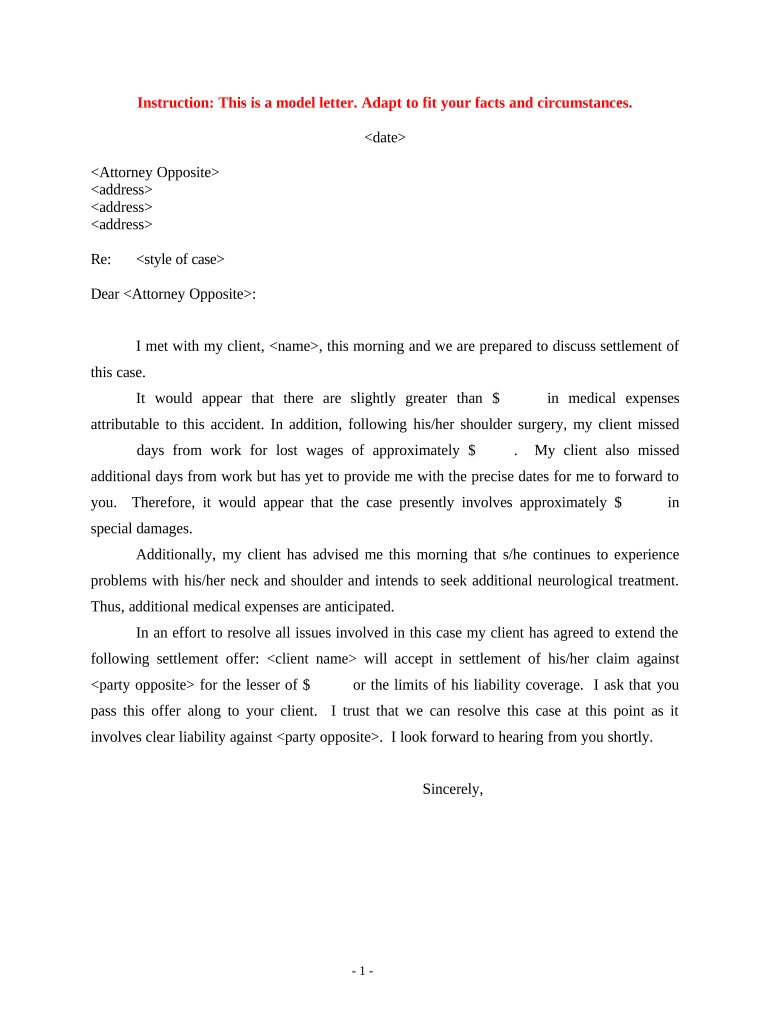
Sample Settlement Form

This template is fully customizable. Edit the text, fill out the fields, and send it for signature. Give it a try!
Sample Settlement Form

What the Sample Settlement Form Is and when it applies

The Sample Settlement Form documents the agreed terms, payments, and release language between parties resolving a dispute or claim. It typically records the settlement amount, payment schedule, mutual releases, confidentiality clauses, and any contingencies such as escrow or lien waivers. The form can serve as the operative agreement that disposes of claims between private parties, and it may be filed with a court if the settlement resolves litigation. Ensure all parties and authorized signers are identified, dates are precise, and related exhibits are attached to avoid ambiguity or enforcement issues.

Why using a clear Sample Settlement Form matters

A well-prepared settlement form reduces future disputes by recording payment terms, releases, and obligations in writing; it clarifies who receives funds and who grants releases; and it preserves evidence for enforcement or tax reporting. Precise language limits ambiguity that can trigger litigation or collection conflicts.

Why using a clear Sample Settlement Form matters

Who commonly prepares or signs a Sample Settlement Form

Typical preparers and signers include attorneys, claims managers, plaintiffs/defendants, corporate legal representatives, and settlement administrators.

  • Litigants and defendants — Formalize release terms and payment schedules to conclude litigation and avoid future claims.
  • Corporate counsel and claims teams — Record approvals, reserve accounting entries, and routing for payments and confidentiality clauses.
  • Settlement administrators — Manage funds disbursement, tax reporting, and distribution lists for multiple claimants.

The exact roles vary by case complexity and jurisdiction; authorized signers should be identified and, when required, sign under the correct corporate or personal capacity.

Representative signers and who can bind a party

Corporate Authorized Signer

An officer or agent with explicit corporate authority to settle and sign contracts on behalf of the entity; verify board resolutions or delegation documents to confirm authority and avoid later challenges to enforceability.

Individual Party

The named plaintiff or defendant signing personally must use their full legal name as on government ID; if signing for a minor or incapacitated person, include guardian or conservator documentation showing legal capacity.

Step-by-step: completing the Sample Settlement Form

Follow the sequence below to prepare, review, and finalize a enforceable settlement agreement.

  • 01
    Draft Core Terms: Record parties, amount, and release provisions clearly.
  • 02
    Add Payment Details: Specify method, timing, and conditions for disbursement.
  • 03
    Confirm Authority: Obtain evidence that signers have legal authority to bind parties.
  • 04
    Execute and Retain: Have parties sign, notarize if required, and save executed copies.

Typical document flow for settling and closing

A standard workflow moves from draft through approvals to signature and distribution; include steps to preserve audit history.

  • Prepare Draft: Compose terms and attach exhibits for review.
  • Internal Review: Legal and finance confirm language and tax effects.
  • Signatures: Parties sign, with witness or notary if required.
  • Distribution: Send executed copies to all parties and relevant agencies.

Recommended electronic workflow settings

Configure your digital signing workflow to capture identity, consent, and an audit trail to support enforceability under U.S. law.

Field Configuration
Signer Authentication Use email + SMS code or stronger KBA for higher-risk settlements
Signature Order Set sequential signing when execution order matters for conditional payments
Audit Trail Capture IP, timestamps, and action logs for evidentiary support
Document Versioning Lock final PDF before signing to prevent post-signature edits

Technical delivery and format considerations

Use PDF or DOCX with flattening enabled to preserve final signed text prior to distribution.

  • File Formats: PDF, DOCX accepted
  • Integrations: Salesforce, NetSuite available
  • Storage: Cloud or local vault

Ensure the chosen platform supports tamper-evident final documents, audit trails, and export in standard formats for e-discovery and recordkeeping.

Essential components of a professional Sample Settlement Form

Include these six elements to improve clarity, enforceability, and administrative efficiency in most U.S. settlements.

Parties

Full legal names and contact details for each party, including entity type and state of formation where applicable, to ensure correct identification and serviceability.
Recitals

Concise background facts identifying the claim, dispute, or litigation that the settlement resolves and the context for the agreed terms.

Payment Terms

Detailed schedule, amounts, payment method, escrow conditions, and remedies for missed payments to reduce collection disputes.

Releases

Clear, specific release text describing claims being waived, any reservations, and whether releases are mutual or one-way.

Confidentiality

If confidentiality applies, state scope, permitted disclosures, and exceptions such as legal obligations or tax reporting requirements.

Enforcement

Governing law, dispute resolution forum, and prevailing party fee provisions to guide enforcement and venue for future disputes.

Practical tips to reduce post-settlement disputes

Adopt these practices when preparing and executing settlements to minimize ambiguity and administrative overhead.

Use unambiguous monetary language
Spell out amounts in numerals and words, specify currency, and indicate whether amounts are inclusive of taxes or fees to avoid differing interpretations.
Document supporting calculations
Attach exhibits showing how payments or pro rata distributions were calculated so parties can verify amounts without reopening negotiations.
Confirm tax treatment explicitly
State whether payments are considered compensatory, punitive, or for attorney fees; advise parties to consult tax counsel to manage reporting risks.
Preserve execution evidence
Retain signed PDFs with audit trails, notarizations, or witness affidavits as applicable to support enforceability in future challenges.

Key timing and tax reporting deadlines to note

Settlement-related filings and tax forms have established deadlines; missing them can trigger penalties or backup withholding.

W-9 provision timing:

No fixed deadline — provide W-9 upon request from payer

1099-NEC recipient filing:

January 31 to recipient and IRS for nonemployee compensation

1099-MISC recipient filing:

January 31 to recipient for most nonemployee payments

1099-MISC IRS filing (paper):

February 28 for paper filings to the IRS

1099-MISC IRS filing (electronic):

March 31 for electronic filings to the IRS

Typical milestones from negotiation to final accounting

Sequential milestones help track obligations from agreement to final payment and record retention.

01

Draft Agreement

Prepare and circulate draft settlement terms for review and redlines.

02

Approvals and Authority

Obtain internal sign-offs, board or claims approvals, and evidence of signer authority.

03

Execution

Signatures obtained, notarization or witness steps completed if required.

04

Payment and Closeout

Funds disbursed, releases executed, and files closed with retained evidence.

Security and compliance checkpoints for electronic settlement documents

Encryption in Transit: TLS 1.2/1.3
Encryption at Rest: AES-256
Key Certifications: SOC 2 Type II
Health Compliance: HIPAA (BAA required)
Regulatory Support: 21 CFR Part 11 ready
Privacy Standards: GDPR, CCPA

Penalties and risks of incorrect or late settlement reporting

1099 Late Fees: $60 per form
1099 Late Higher: $130 per form
1099 Severe Late: $330 per form
Intentional Disregard: $660+ per form
I-9 Paperwork: $281–$2,789 per violation
Backup Withholding: 24% withholding rate

Common preparation errors to avoid

  • Incomplete signer capacity details — failing to state officer title or authority can render a corporate signature vulnerable to challenge in enforcement proceedings.
  • Vague release language — overly broad or unspecific release clauses leave room for later litigation about the scope of waived claims.
  • Incorrect payment mechanics — unspecified payment method or timeline creates disputes over compliance and potential acceleration of obligations.
  • Missing tax reporting provisions — omitting whether amounts are taxable or indicating payer responsibility can trigger surprise withholding or penalties.

Real-world examples where a settlement form closed matters efficiently

Summaries below show how organizations used settlement forms with clear terms to reduce follow-up disputes and administration time.

Optica Ventures LLC

Optica used a precise settlement form to document release and payment schedules, reducing ambiguity during disbursement.

  • The form included escrow instructions.
  • By attaching calculation exhibits and specifying governing law, Optica reduced follow-up collection queries and shortened the closeout timeline.

Martin Properties

Martin Properties executed settlements online with notarization when required to speed closings and tenant releases.

  • Remote signing was used for out-of-state parties.
  • Clear signature blocks and notarization steps enabled faster fund distribution and avoided repeated verification calls between parties.

Comparing eSignature vendors for settlement execution

Basic pricing and feature comparisons for common eSignature providers. signNow is listed first; confirm features and plan limits with each vendor before purchase.

signNow DocuSign Adobe Sign PandaDoc HelloSign
Starting Price $8/user/mo $15/user/mo $14/user/mo $19/user/mo $15/user/mo
Free Trial 7-day free trial Varies by vendor Varies by vendor Varies by vendor Varies by vendor
Bulk Send Yes Yes Yes Yes No
Audit Trail Yes Yes Yes Yes Yes
Envelope Cap No envelope cap 100 envelopes/user/year Varies by plan Varies by plan Varies by plan

Frequently asked questions about the Sample Settlement Form

Answers to common issues that arise when preparing, signing, or storing settlement documents in the United States.


Need help? Contact support

be ready to get more
Join over 28 million airSlate SignNow users