Establishing secure connection…Loading editor…Preparing document…

South Carolina Order and Certificate of Name Change

This template is fully customizable. Edit the text, fill out the fields, and send it for signature. Give it a try!
South Carolina Order and Certificate of Name Change

What the South Carolina Order and Certificate of Name Change Is

The South Carolina Order and Certificate of Name Change is a signed court document that officially changes an individual’s legal name within South Carolina jurisdiction. It records the court’s findings, the effective new name, and authorization to update government and private records. The order is typically issued after a petition is filed in the appropriate county court, any notice or hearing requirements are met, and a judge signs the final decree. Once entered, the certificate provides proof of the change for agencies, financial institutions, and record custodians.

Why this document matters for identity and records

A court-issued order and certificate formalizes a name change for legal, financial, and administrative purposes and creates a clear record that agencies and businesses can rely on.

Why this document matters for identity and records

Who typically completes or relies on this form

Individuals changing their legal name and the court staff who process petitions commonly use the order and certificate.

  • Petitioners seeking a legal name change after marriage, divorce, or personal reasons — file the petition and attend required hearings.
  • Clerks of court and judges — review petitions, confirm identity and notice requirements, and sign the order.
  • Third parties (banks, DMV, Social Security) — accept the certificate to update names on accounts and records.

After entry, the petitioner should use certified copies to update records with federal, state, and private entities.

Typical signers and authorities

Petitioner — Individual

The petitioner is the person requesting the name change and must provide identifying information, evidence, and sworn statements. The petitioner signs the petition and any verification or consent documents required by the court.

Judge — County Court

A presiding judge or authorized judicial officer signs the final order and certificate to effect the name change; the judge’s signature creates the legal basis for updating public and private records.

Required data elements in the order and certificate

Petitioner Name: Full legal name as currently used
Current Name: Name to be replaced
New Name: Requested legal name
Case Number: Court docket identifier
Court Name: County and court of record
Date of Birth: Used to verify identity

Key parts of a professional Order and Certificate

A clear, well-structured order and certificate helps courts and third parties verify the change quickly and reduces downstream questions about identity and record updates.

Caption

Court caption showing county, court name, and case number so the document is clearly linked to the underlying petition and docket.
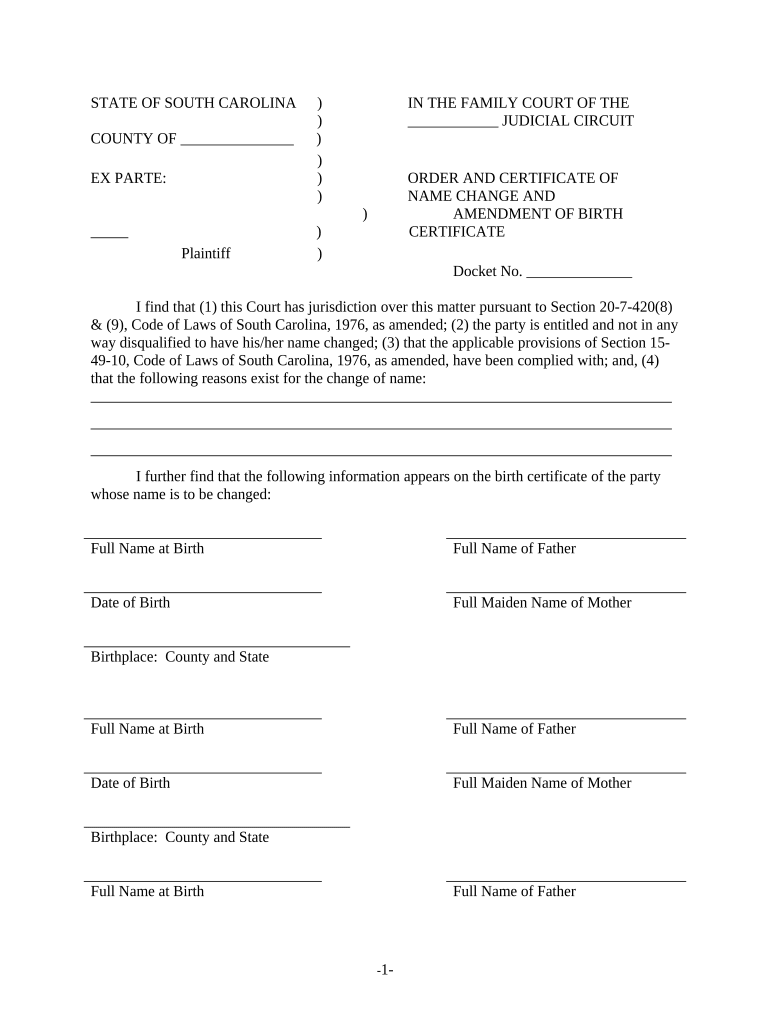
Petitioner Details

Full identifying information including current legal name, date of birth, residence, and any required statutory statements about reasons for the change.

Findings of Fact

The court’s factual findings (e.g., notice provided, no fraud evident) that support the judge’s legal authority to order the change.

Order Language

Explicit directive that the petitioner’s name is changed to the new legal name and that agencies shall accept the order as proof.

Certificate Entry

A concise certificate block summarizing the new name, order date, judge’s signature, and clerk’s attestation for certified copies.

Seal and Signature

Judge or clerk signature and court seal or stamp to authenticate the order and permit acceptance by third parties.

Step-by-step: completing and getting the order issued

Follow these core steps to prepare, file, and obtain a certified Order and Certificate of Name Change without unnecessary delays.

  • 01
    Prepare Petition: Complete petition forms and attach identification.
  • 02
    File with Court: Submit petition and pay filing fee at county court.
  • 03
    Attend Hearing: Appear or provide required notice if a hearing is scheduled.
  • 04
    Obtain Certified Copies: Request certified order copies from the clerk for agencies.

Where to file and how the document travels

The petition and final order are processed through county-level courts and the clerk’s office; certified copies are distributed to agencies and record holders as needed.

  • County Court Filing: File petition in the county court where you reside.
  • Clerk Processing: Clerk assigns docket number and schedules actions.
  • Judge Signature: Judge signs final order if statutory conditions are met.
  • Certified Copies: Obtain certified copies from the clerk for agencies.

Digital signing and technical requirements for e-submission

Electronic preparation and submission require compatible file types, reliable signer authentication, and retention of an audit trail for legal validity.

  • Accepted Formats: PDF, PDF/A, DOCX typically accepted
  • Authentication: Email, SMS codes, or multi-factor methods
  • Audit Trail: Timestamps, IP, signer attribution

Check local court e-filing rules before electronic submission and retain a tamper-evident copy along with the signing audit trail for recordkeeping.

Setting up an online workflow for petitions and orders

Configure an online workflow to collect petitioner data, attachments, and signatures in the right order to match court filing requirements.

Field Configuration
Signature Field eSign field for petitioner and clerk
Authentication Email verification + optional SMS code
Attachments Upload ID, birth certificate, and supporting docs
Routing Order Petitioner → Clerk → Judge

Consequences of errors or incomplete orders

Delays: Case processing delayed
Rejection: Clerk may reject defective filings
Identity Mismatch: Third parties may refuse updates
Fraud Allegations: False statements can trigger sanctions
Costs: Additional fees for re-filing or counsel
Privacy Risk: Sensitive data exposed if mishandled

Common mistakes to avoid when preparing your petition

  • Using inconsistent name formats between petition and ID leads to verification failure and delays with the clerk.
  • Failing to attach required identity documents or certified vital records can result in immediate rejection or a request for more information.
  • Neglecting local notice or publication requirements causes missed deadlines or additional court appearances.
  • Assuming all courts accept remote notarization — verify RON availability before relying on an online notary service.

Tips for accurate, efficient completion

Follow these practical steps to reduce friction and ensure the order and certificate are accepted by courts and agencies.

Verify name spellings
Confirm the petitioner’s current and requested names exactly match all attachments and identification. Consistent spellings prevent report delays with SSN, DMV, and financial institutions.
Collect certified copies
Order multiple certified copies of the signed order from the clerk at the time of entry so you can update federal, state, and private records without returning to court.
Preserve audit trails
If signing electronically, keep the full audit trail including timestamps, IP addresses, and signer authentication evidence to support the validity of e-signed petitions.
Confirm local rules
Check county-specific filing rules and fees with the clerk’s office in advance. Local variations often affect notice, forms required, and acceptable attachments.

How to save and share the signed order

After the court signs the order, obtain certified copies and save robust electronic versions for submission to agencies and record custodians.

Certified PDF

Download or scan certified copies as PDF/A to preserve formatting and support long-term retention and reproducibility for agencies.

Signed Certificate

Keep the clerk-signed certificate as a single-page proof to present to banks, DMV, Social Security, and employers.

Electronic Archive

Store a tamper-evident electronic copy with an audit trail and restricted access to protect privacy and meet retention policies.

Supporting Documents

Attach certified birth certificate, photo ID, and proof of residence when submitting to third parties to expedite updates.

Typical scenarios illustrating how the order is used

These short examples show practical uses and outcomes after a court enters the Order and Certificate of Name Change.

Adult name change after marriage

A petitioner files a standard petition and provides ID and a marriage certificate

  • Court issues the order at the hearing
  • The petitioner uses certified copies to update Social Security, driver’s license, bank accounts, and employment records without further court contact.

Legal change for personal reasons

An individual requests a name change for personal identity alignment and submits required notice

  • Judge reviews and signs the decree
  • Certified copies serve as legal proof enabling updates across medical records, financial accounts, and professional licenses.

eSignature vendor comparison for preparing and signing petitions

Compare basic vendor pricing and capabilities for electronically preparing and signing court petitions and orders. signNow is listed first for consistent comparison.

signNow DocuSign Adobe Sign PandaDoc HelloSign
Starting Price $8/user/mo $15/user/mo $14/user/mo $19/user/mo $15/user/mo
Free Trial Yes, 7-day free trial Varies by vendor Varies by vendor Varies by vendor Varies by vendor
Bulk Send Yes Yes Yes Yes No
Audit Trail Yes Yes Yes Yes Yes
Envelope Cap No cap 100 envelopes/user/year Varies by plan Varies by plan Varies by plan

Frequently asked questions about South Carolina name-change orders

Answers to common questions about filing, authentication, notarization, and post-order updates for the South Carolina Order and Certificate of Name Change.


Need help? Contact support

be ready to get more
Join over 28 million airSlate SignNow users