Establishing secure connection…Loading editor…Preparing document…

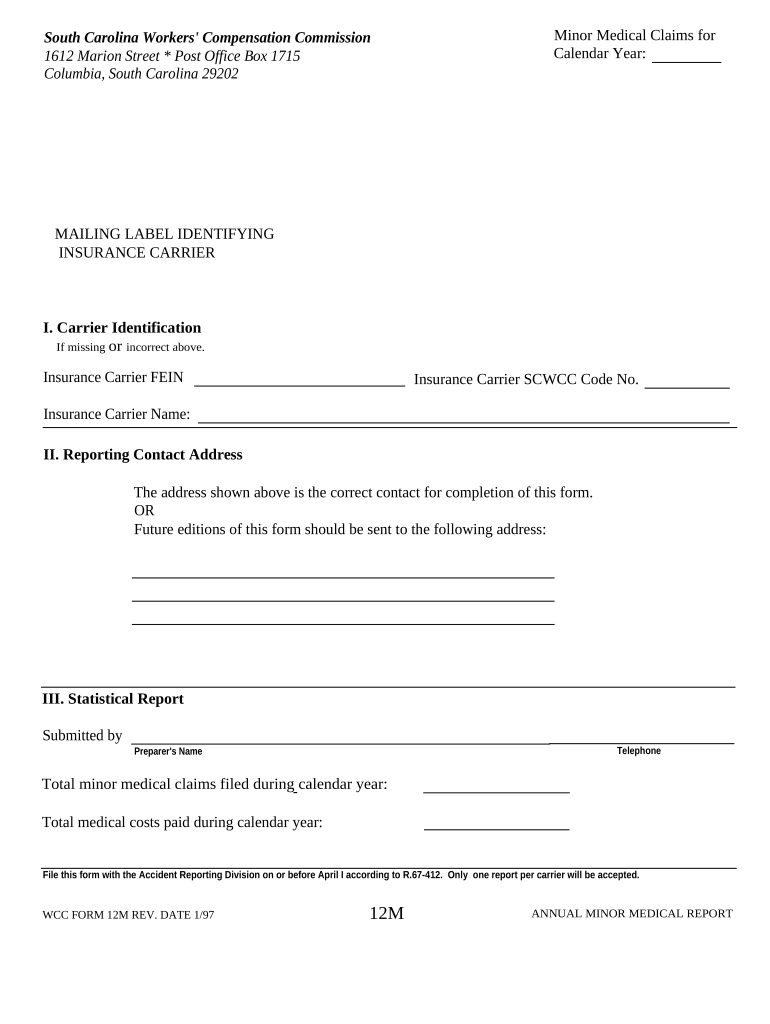
South Carolina Annual Minor Medical Report

This template is fully customizable. Edit the text, fill out the fields, and send it for signature. Give it a try!
South Carolina Annual Minor Medical Report

What the South Carolina Annual Minor Medical Report Is

The South Carolina Annual Minor Medical Report is a standard form used to document yearly health information, medication authorizations, immunizations, and provider instructions for minors participating in school, camp, or extracurricular programs. It centralizes emergency contacts, known conditions, and treatment authorizations so caregivers and institutions hold a consistent medical record for the reporting year. When submitted electronically, the report must meet federal and state electronic record requirements (ESIGN and applicable state rules) and include appropriate consent language and record-retention procedures.

Why maintaining this annual report matters

Completing an annual minor medical report documents authority to treat, updates critical health details, and reduces care delays. Accurate reports support compliance with HIPAA privacy obligations and help institutions meet their duty of care.

Why maintaining this annual report matters

Who typically completes and relies on the report

School nurses, camp administrators, youth program coordinators, and parents or legal guardians are the primary users who complete and manage this report.

  • School nurses and district health staff manage medication administration and maintain student medical files for each school year.
  • Parents or legal guardians complete the form, provide medical history and consent, and must sign for treatment authorizations.
  • Camp and extracurricular program leaders use the report for on-site treatment decisions and emergency response planning.

Core sections to expect in the South Carolina Annual Minor Medical Report

A complete report includes identifying information, clinical history, medication instructions, provider orders, emergency contacts, and signature blocks; each section supports clear decision-making in routine and emergency care.

Report Header

Contains child name, date of birth, school or program name, and report effective date to ensure accurate identification for the reporting year.
Medical History

Captures chronic conditions, allergies, recent illnesses, and pertinent past surgeries so caregivers understand baseline risks before providing treatment.

Current Medications

Lists prescription and over-the-counter medicines, dosing schedules, and administration instructions so staff follow provider guidance and avoid drug interactions.

Provider Orders

Space for physician instructions, emergency procedures, and special treatment authorizations that must be followed by school or program personnel.

Emergency Contacts

Primary and secondary caregiver names, phone numbers, and authorized alternate contacts for emergency notifications and consent pathways.

Signature Block

Designated areas for parent/guardian signature, date, and clinician or authorized provider verification where required, establishing legal consent and authorization.

Step-by-step: filling and submitting the report

Follow a linear process: collect data, confirm provider orders, obtain signatures, then submit to the designated school or program contact.

  • 01
    Gather records: Collect immunization and recent clinical notes.
  • 02
    Complete form: Enter all required fields and double-check accuracy.
  • 03
    Obtain signatures: Get parent/guardian and clinician signatures as required.
  • 04
    Submit: Deliver signed copy to the school or program administrator.

Typical electronic submission workflow

When permitted, electronic completion and signing streamline distribution: upload, tag fields, sign, and route to recipients with an audit trail capturing each action.

  • Upload document: Add the PDF or form file to the platform.
  • Place fields: Insert signature, date, and data entry fields.
  • Sign: Parent and provider apply electronic signatures.
  • Route: Send to school nurse or program coordinator.

Common digital workflow settings for eSubmission

Typical configuration options control authentication, routing order, and notifications to meet institutional policies and consent requirements.

Field Configuration
Authentication method Email link or SMS code
Routing order Parent, clinician, then administrator
Reminder schedule Automated reminders at set intervals
Document retention Auto-archive signed copy for records

Technical considerations for eSubmission and signing

Ensure the chosen platform supports secure file types, reliable signing methods, and an auditable completion certificate.

  • File formats: PDF and DOCX accepted
  • Authentication: Email, SMS, or stronger
  • Audit trail: Captures IP, timestamp

Recommended security and compliance features for electronic handling

Encryption: TLS 1.2/1.3 in transit
Data at rest: AES-256 encrypted storage
Audit logs: Detailed signer activity trail
Access control: Role-based permissions
HIPAA support: BAA available when required
Standards: SOC 2, ISO 27001 readiness

Key risks of incomplete or incorrect reports

HIPAA noncompliance: Civil penalties possible
Invalid consent: Treatment may be delayed
Medical errors: Incorrect dosing or contraindications
Liability exposure: Institutional legal risk
Regulatory fines: State or federal enforcement
Lost records: Difficulty proving authorization

Common preparation mistakes to avoid

  • Using nicknames or initials for the minor rather than the full legal name, causing mismatches with school or medical records and delaying treatment authorization.
  • Omitting provider contact information or failure to attach required physician orders, which can prevent staff from following clinically authorized treatments in an emergency.
  • Entering ambiguous medication instructions such as 'as needed' without specifying dosing limits, creating risk of underdosing or overdosing by staff administering care.
  • Failing to update the report after significant medical events or new allergies, leaving caregivers unaware of changes that affect safe treatment decisions.

Typical eSignature vendor comparison for annual medical form workflows

The table compares common capability and pricing dimensions among eSignature vendors; signNow is listed first per platform comparison conventions.

signNow DocuSign Adobe Sign PandaDoc HelloSign
Starting Price $8/user/mo $15/user/mo $14/user/mo $19/user/mo $15/user/mo
Free Trial 7-day free trial Yes Yes Yes Yes
Bulk Send Yes Yes Yes Yes No
Audit Trail Yes Yes Yes Yes Yes
HIPAA Compliant Yes Yes Yes No No

Frequently asked questions about the South Carolina Annual Minor Medical Report

Questions below address common points of confusion — completion, signatures, electronic filing, notarization, and record retention.


Need help? Contact support

be ready to get more
Join over 28 million airSlate SignNow users