Caption
Court caption showing county, court name, case number, and parties so the order attaches unambiguously to the correct criminal file and supports accurate docketing.
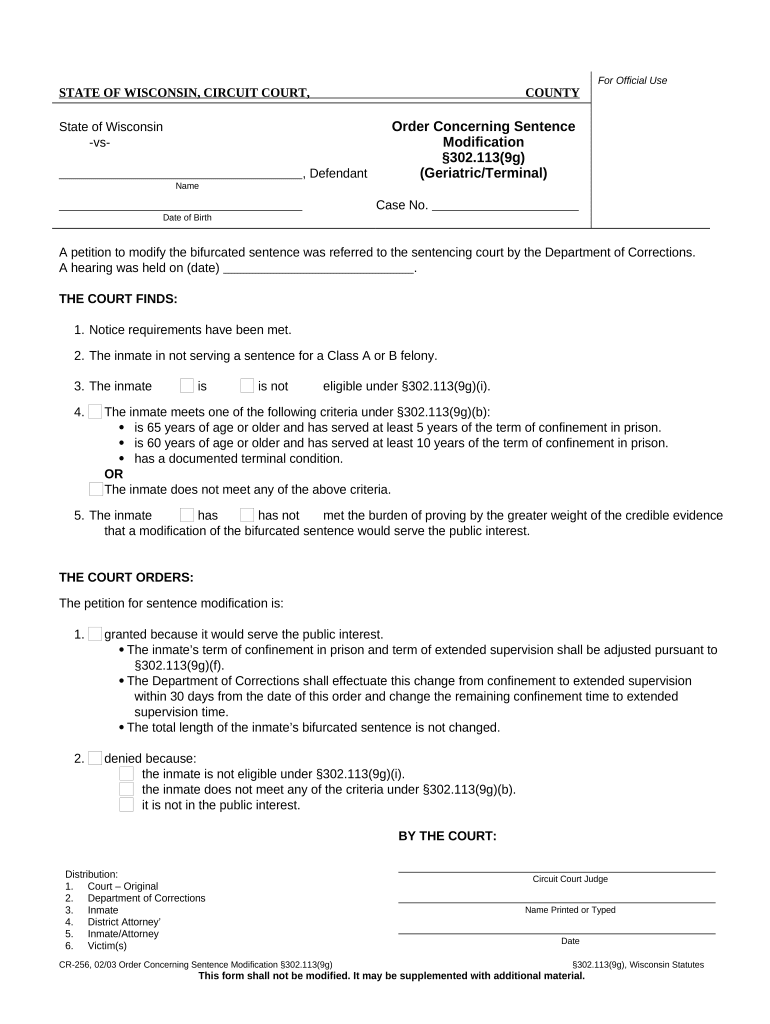
A precise, properly entered order creates an enforceable record of any sentence change, reduces uncertainty for defendants and supervising agencies, protects due process rights, and enables corrections and probation to implement adjustments accurately and promptly.

Typical users include defense attorneys, prosecutors, probation officers, judges, and corrections administrators involved in sentencing or supervision.
The sentencing judge evaluates legal and factual grounds for modification, signs the order, sets effective and retroactive dates if appropriate, and directs the clerk to notify corrections, probation, and victims' services to ensure implementation and administrative compliance.
Defense counsel prepares the motion and supporting evidence, articulates requested relief in precise terms, and handles service and procedural steps; accurate filings reduce delays and improve the likelihood of a favorable judicial determination.
Court caption showing county, court name, case number, and parties so the order attaches unambiguously to the correct criminal file and supports accurate docketing.
Concise factual background summarizing the original sentence, prior motions, and the factual basis for modification such as medical need, new evidence, or rehabilitation milestones.
Citation to the statutory or rule basis for modification that establishes the court’s jurisdiction and supports enforceability of the amended sentence.
Itemized changes listing custody limits, credit for time served, probation conditions, restitution adjustments, or community supervision with exact language and amounts where applicable.
A specific effective date and any retroactivity provision to avoid ambiguity about when the revised sentence takes effect and who is impacted.
Clear instructions for the clerk, sheriff, DOC, probation department, and victims' services regarding notification, docketing, and execution of the modified sentence.
No uniform statutory deadline; file promptly after grounds arise.
Clerk often schedules hearing within 30–90 days.
Decision may be issued immediately or after deliberation.
Official effective date appears on the clerk’s entry.
Appeal windows follow criminal appeal rules; consult counsel.
Draft motion, attach exhibits, and submit to clerk.
Set or waive hearing; parties receive notice per local rule.
Judge signs order stating precise modifications and dates.
Corrections, probation, and billing offices update records and implement changes.
| signNow | DocuSign | Adobe Sign | PandaDoc | HelloSign | |
|---|---|---|---|---|---|
| Starting Price | $8/user/mo | $15/user/mo | $14/user/mo | $19/user/mo | $15/user/mo |
| Free Trial | 7-day free trial | Varies | Varies | Varies | Varies |
| Bulk Send | Yes (Premium) | Yes | Yes | Yes | Yes |
| Audit Trail | Yes | Yes | Yes | Yes | Yes |
| HIPAA Compliant | Yes | Yes | Yes | No | No |
| Envelope Cap | No cap | 100 envelopes/user/year | Varies | Varies | Varies |
A defendant submitted comprehensive medical records demonstrating a terminal condition and requested compassionate early release.
A probationer petitioned for reduced reporting frequency after completing substance-abuse treatment and community service obligations.
Electronic submission and e-signature compatibility depends on court e-filing systems and jurisdictional rules; confirm local procedures before filing.