Court Identification
Full court name, county, case caption, and case number placed at the top for correct docketing and record linkage.
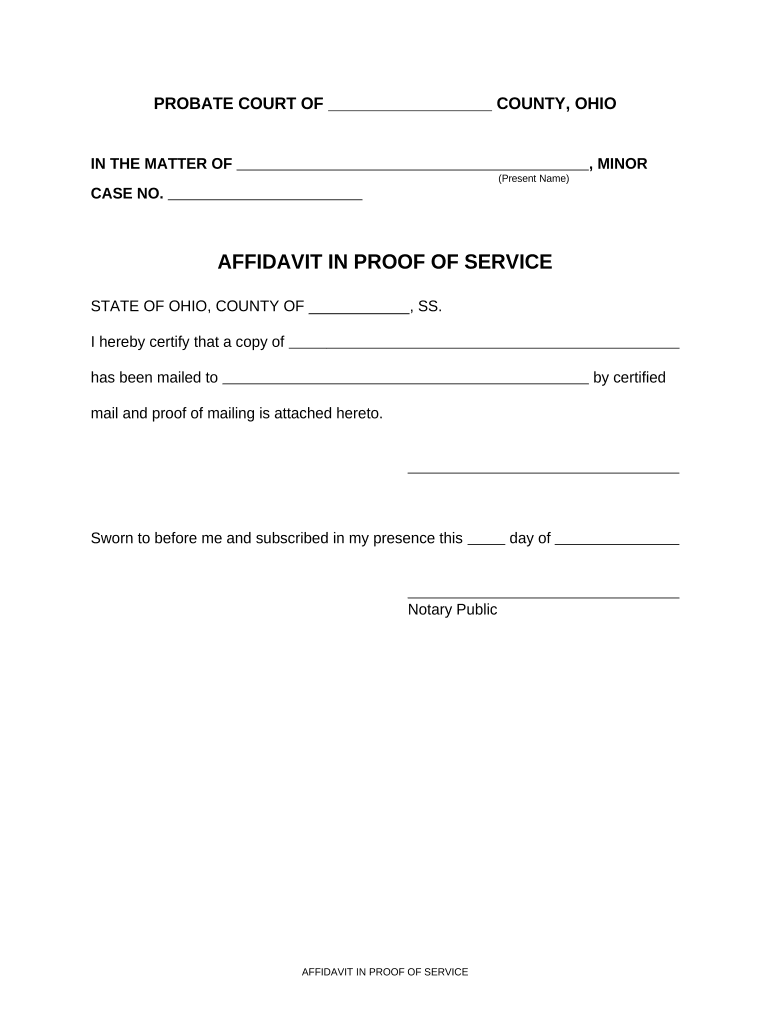
A complete affidavit establishes proof of service, reduces disputes over notice, and helps avoid delays or dismissal. It creates a sworn record the court can rely on when scheduling hearings or entering default judgments.

Several roles commonly prepare or file an affidavit in proof of service depending on case type and local rule.
Choose the preparer based on who performed service and the court's local rules; courts expect accurate, sworn statements that match the underlying service events.
Clerks review filed affidavits for completeness and accept them into the case record; they do not verify factual accuracy but will flag obvious deficiencies for correction before docketing.
The server who completed service must sign under oath, provide a factual narrative of how service occurred, and supply contact information; sworn statements from neutral servers carry weight for courts evaluating service validity.
Full court name, county, case caption, and case number placed at the top for correct docketing and record linkage.
A concise, chronological account of who was served, where, when, and how the document was delivered or mailed.
Recipient's full legal name and service address, including apartment or suite numbers and any identifying descriptors.
Name, company (if applicable), address, and contact information of the person who performed service; business or process server ID if used.
A sworn statement under penalty of perjury with space for the server's signature and notary or official verification.
Attachments such as delivery receipts, certified mail return cards, or photographs referenced in the affidavit for substantiation.
| Field | Configuration |
|---|---|
| Authentication | Email link, SMS code, or KBA |
| Signature Type | Electronic signature or wet sign |
| Notary Support | Enable RON or local notary block |
| File Format | PDF/A preferred for court filing |
Ensure platform capabilities match court and local rule requirements before submitting an electronic affidavit.
Verify that the chosen platform supports notarization workflows, preserves an audit trail, and stores a tamper-evident version for court use.
File prior to the scheduled hearing per court order.
Serve affidavit and file promptly to confirm notice.
Provide proof of service before seeking default judgment.
Observe local civil rule timeframes for service and filing.
Respond immediately if the clerk requests clarification.
| signNow | DocuSign | Adobe Sign | PandaDoc | HelloSign | |
|---|---|---|---|---|---|
| Starting Price | $8/user/mo | $15/user/mo | $14/user/mo | $19/user/mo | $15/user/mo |
| Free Trial | 7-day free trial | Varies by plan/vendor | Varies by plan/vendor | Varies by plan/vendor | Varies by plan/vendor |
| Bulk Send | Yes (Business Premium) | Varies by plan | Varies by plan | Varies by plan | Varies by plan |
| Audit Trail | Yes | Yes | Yes | Yes | Yes |
| HIPAA Compliant | Yes (BAA available) | Varies by plan | Varies by plan | Varies by plan | Varies by plan |