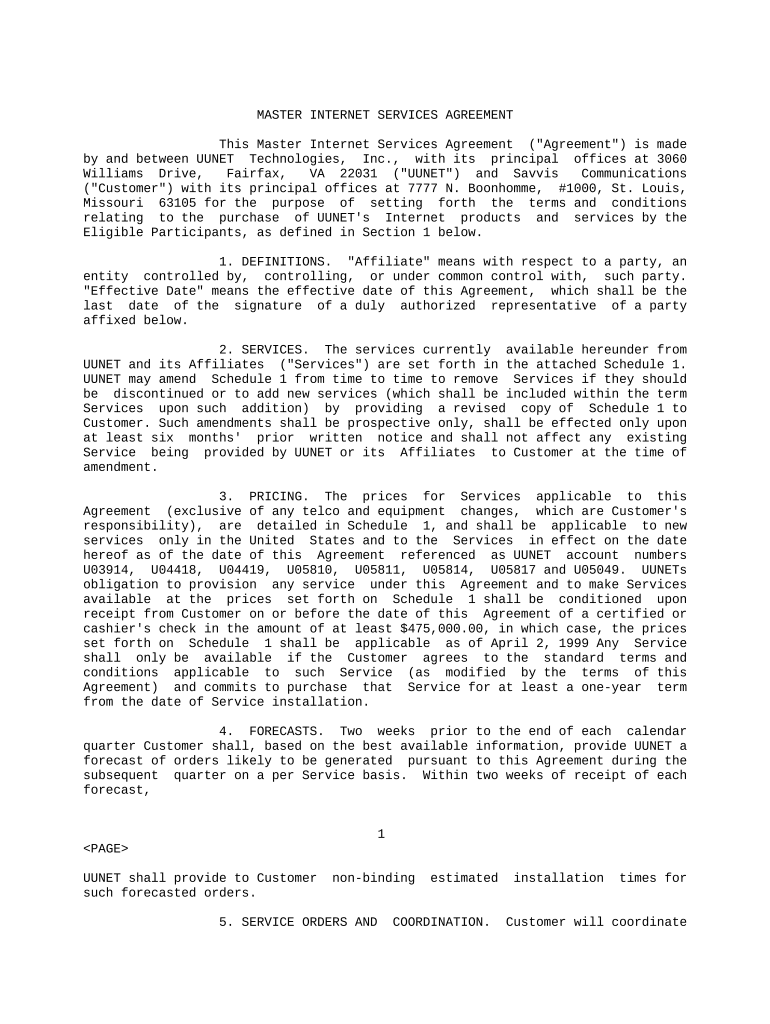
Master Internet Services Agreement
What a Master Internet Services Agreement Covers
Why organizations use a Master Internet Services Agreement
A MISA centralizes contractual terms to streamline procurement, clarify operational responsibilities, and reduce repetitive negotiations for each service ordering. It protects both parties by allocating risk, setting performance expectations, and providing standard change management and dispute-resolution processes.
Common parties and teams that work with this agreement
The MISA is used by vendors, enterprise buyers, and internal teams that manage connectivity, compliance, and vendor relationships.
- Internet service providers and resellers who supply connectivity and managed services to customers.
- Enterprise IT and procurement teams that need standard terms for multiple circuits or sites.
- Legal, compliance, and security teams that review SLAs, privacy, and indemnity clauses.
Large accounts, MSPs, and regulated organizations rely on a MISA to ensure consistent obligations, measurable SLAs, and documented escalation and remediation procedures.
Key signer roles and typical responsibilities
ISP Contract Manager
Responsible for drafting and operationalizing service schedules, coordinating installations, and tracking SLA credits. The manager ensures technical exhibits align with provisioning and escalation procedures and coordinates billing adjustments for outages.
Corporate Counsel
Reviews indemnity, limitation-of-liability, data handling, and regulatory language. Corporate counsel negotiates jurisdiction, dispute resolution clauses, and ensures the contract aligns with company policy and applicable laws.
How to complete a Master Internet Services Agreement
-
01Assemble documents: Gather SLAs, technical exhibits, pricing schedules.
-
02Populate parties: Enter full legal names and contact details.
-
03Define SLAs: Set metrics, credits, measurement windows.
-
04Execute: Sign electronically and distribute executed copies.
Digital workflow settings to configure before sending
| Field | Configuration |
|---|---|
| Authentication Method | Email link, SMS code, or KBA |
| Notification Settings | Reminders, expiry, and escalation |
| Retention Period | Specify storage duration and export format |
| Template Variables | Pre-fill parties, dates, service IDs |
Where to send and how to distribute the executed agreement
-
All signatories: Provide an executed PDF to every signer
-
Billing system: Upload pricing schedule and invoicing details
-
Operations team: Send technical exhibits and scheduling info
-
Contract repository: Store master copy in documented records
Digital signing and platform considerations
Choose eSignature settings that meet security, audit, and regulatory needs before sending the agreement.
- Authentication: SMS code or KBA options
- File formats: PDF and DOCX supported
- Integrations: CRM and cloud storage
Ensure the eSignature provider supports audit trails, retention, and any industry-specific compliance (for example, HIPAA BAAs or 21 CFR Part 11) before finalizing the workflow.
Key dates and notice periods to include
Effective Date:
MM/DD/YYYY when obligations begin
Service Commencement:
Target install and activation date
Billing Cycle:
Monthly, quarterly, or annual invoicing
Renewal Notice:
Typically 30–90 days before term end
Dispute Notice:
Specify notice period and cure window
Common drafting and execution mistakes to avoid
- Vague service descriptions that omit physical locations or circuit identifiers, which lead to provisioning and billing errors.
- Unclear SLA measurement methods or missing credit calculation, causing disputes about downtime or remedy eligibility.
- Missing exhibits or scope attachments, leaving technical responsibilities unspecified and increasing escalation incidents.
- Incorrect signer authority or mismatched legal names, which can invalidate execution or delay enforcement.
Potential consequences of an incomplete or incorrect agreement
How a Master Internet Services Agreement differs from a standard master services agreement
| Criteria | Master Internet Services Agreement | Standard Master Services Agreement |
|---|---|---|
| Primary focus | connectivity | general services |
| Technical specificity | high | moderate |
| SLA presence | yes, built-in | often separate |
| Termination terms | service-specific fees | broader commercial terms |
eSignature vendor pricing and feature comparison for executing this agreement
| signNow | DocuSign | Adobe Sign | PandaDoc | HelloSign | |
|---|---|---|---|---|---|
| Starting Price | $8/user/mo | $15/user/mo | $14/user/mo | $19/user/mo | $15/user/mo |
| Free Trial | 7-day free trial | Yes, trial available | Yes, trial available | Yes, trial available | Yes, trial available |
| Bulk Send | Yes | Yes | Yes | Yes | Yes |
| Audit Trail | Yes | Yes | Yes | Yes | Yes |
| HIPAA Compliant | Yes | Yes | Yes | No | No |
| Envelope Cap | No cap | 100 envelopes/user/year | Varies by plan | Varies by plan | Varies by plan |
Frequently asked questions about using and enforcing a MISA
-
Can this agreement be signed electronically?
Yes. Electronic signatures are enforceable under the ESIGN Act (15 U.S.C. ch. 96, 2000) and UETA in most states, provided the parties demonstrate intent, consent, attribution, and record retention.
-
Are there exceptions to e-signing?
Certain document types are excluded from electronic execution (for example, some wills, court filings, and specific statutory notices). Check state law and transaction-specific exceptions before relying solely on e-signatures.
-
Do I need a notary for this agreement?
Most commercial service agreements do not require notarization. If an attachment or local regulation requires notarization, use remote online notarization where permitted and follow state RON rules.
-
What if a signer lacks authority?
Obtain evidence of signatory authority (board resolution, POA, or officer certificate). Mismatched names or missing authority can delay enforcement or invalidate the agreement.
-
How should SLAs be measured and credited?
Define measurement windows, monitoring sources, credit calculation, and claim procedures in the SLA. Ambiguity in metrics or timelines is a frequent source of disputes.
-
How long must I keep the executed MISA?
Retain according to applicable laws: generally the contract term plus at least 3–7 years; HIPAA-related records require 6 years (45 CFR §164.530(j)), and tax-related records follow IRS guidance.