Establishing secure connection…Loading editor…Preparing document…

Share Exchange Agreement

This template is fully customizable. Edit the text, fill out the fields, and send it for signature. Give it a try!
Share Exchange Agreement

What a Share Exchange Agreement Is and when it applies

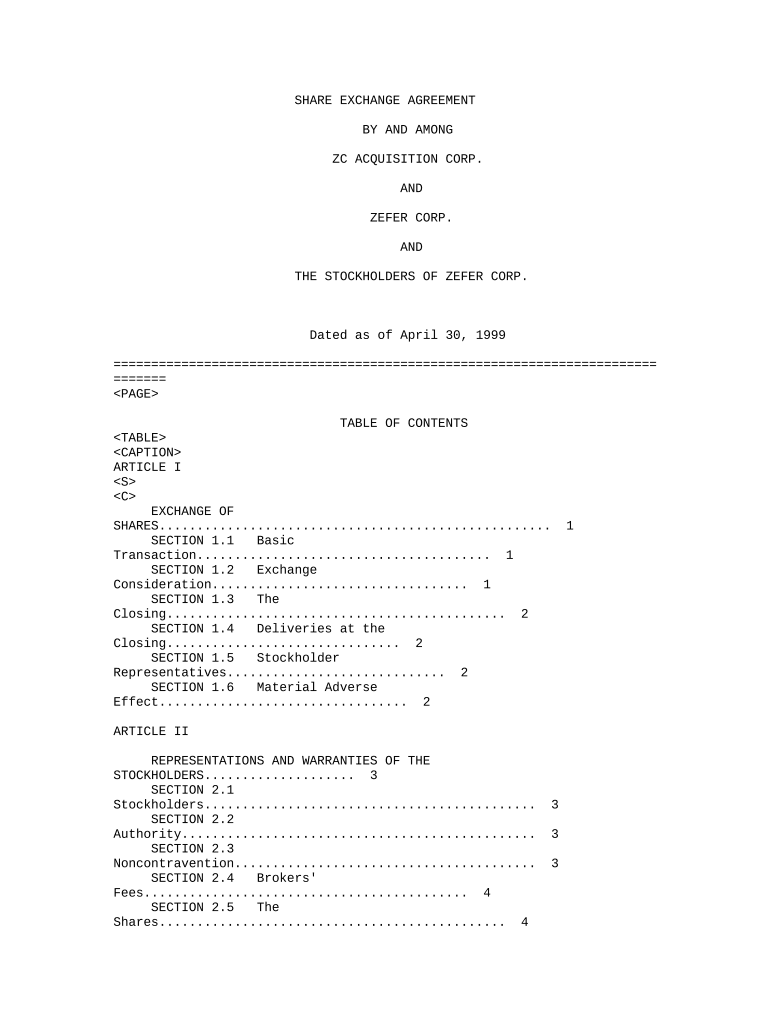
A Share Exchange Agreement is a legal contract that documents the exchange of equity interests between parties, typically one class of shares for another or shares of one company for shares of another. It sets out the identities of the parties, the number and class of shares being exchanged, consideration, conditions precedent, representations and warranties, closing mechanics, and any post-closing obligations. The agreement often requires corporate approvals, updated stock ledgers, and may trigger securities, tax, or regulatory filings depending on the transaction structure and jurisdiction.

Why a clear Share Exchange Agreement matters

A well-drafted Share Exchange Agreement clarifies transfer mechanics, allocates risk, documents approvals, reduces post-closing disputes, and provides evidence for tax and corporate recordkeeping. It helps ensure enforceability and consistent treatment of shareholders and stakeholders.

Why a clear Share Exchange Agreement matters

Who typically prepares and reviews this agreement

Corporate insiders, counsel, and financial advisors commonly draft and review share exchange agreements before board and shareholder approvals.

  • Corporate counsel and in-house legal teams — prepare terms, confirm corporate authority, and draft board resolutions.
  • Private equity and strategic investors — negotiate consideration, protections, and registration or exemption conditions.
  • Transfer agents and corporate secretaries — update ledgers and assist with certificate issuance or cancellations.

Final review should include securities counsel and tax advisors to confirm regulatory compliance and to document required corporate actions.

Primary signers and their roles

Board Representative

A director or authorized officer signs on the corporation's behalf after obtaining board approval and ensuring corporate formalities are satisfied; legal counsel typically certifies authority and minutes.

Shareholder

A registered shareholder or authorized agent signs to transfer shares; signatory identity must match corporate records to avoid transfer rejection or withholding obligations.

Core clauses found in a professional Share Exchange Agreement

A complete Share Exchange Agreement includes clear descriptions of the exchange mechanics, representations and warranties, conditions precedent, closing procedures, allocation of consideration, and dispute resolution provisions to reduce ambiguity and litigation risk.

Parties

Full legal names and entity types for each transferring and receiving party, with jurisdiction of formation and contact details for notices.
Exchange Mechanics

Precise share classes, numbers, conversion ratios, certificate surrender procedures, and treatment of fractional interests.

Consideration

Monetary amounts, newly issued shares, debt forgiveness, or other value exchanged, and mechanics for rounding or cash-outs.

Representations & Warranties

Statements about title to shares, corporate capacity, absence of encumbrances, and compliance with applicable laws.

Conditions Precedent

Board approvals, shareholder consents, regulatory clearances, and accuracy of representations required to close.

Closing and Post-Closing

Delivery of share certificates, ledger updates, tax allocation, indemnities, and any required filings or notices.

Step-by-step: completing a Share Exchange Agreement

Follow a structured sequence to document approvals, confirm details, and complete the exchange with minimal risk.

  • 01
    Assemble documents: Collect certificates, ledgers, and corporate minutes.
  • 02
    Draft terms: Define shares, ratios, and conditions.
  • 03
    Obtain approvals: Secure board and shareholder consents.
  • 04
    Close and record: Exchange certificates and update ledgers.

How electronic completion and exchange typically works

Electronic workflows shorten turnaround while preserving an audit trail, but must show intent, consent, attribution, and retention to meet legal requirements.

  • Prepare document: Upload the agreement as a PDF or DOCX.
  • Place fields: Add signature, date, and checkbox fields.
  • Send to signers: Use ordered or parallel routing as needed.
  • Archive record: Store signed copy and audit trail securely.

Typical e-signature workflow settings for a share exchange

Configure signer order, authentication, and templates to match corporate approval sequences and security expectations.

Field Configuration
Signer Order Sequential or parallel routing per corporate approvals
Authentication Email link, SMS code, or advanced ID verification
Conditional Fields Show fields only after prior approvals complete
Reminders Automated reminders and expiration settings

Technical requirements and common integrations

Use a platform that supports PDF/DOCX, audit trails, and integrations with corporate systems to maintain records and automate ledgers.

  • File Formats: PDF and DOCX supported
  • Integrations: Salesforce, NetSuite, Microsoft 365
  • Storage: Box, Google Drive, Egnyte

Ensure the chosen platform can produce a tamper-evident signed PDF and export a certificate of completion for corporate records and audit purposes.

Security and compliance elements to verify

Encryption in Transit: TLS 1.2/1.3
Encryption at Rest: AES-256
Standards: SOC 2 Type II
Regulatory: ESIGN and UETA compliance
Healthcare: HIPAA BAA available
Audit Trail: Timestamps, IP address, action log

Key legal and financial risks to avoid

Securities Liability: Civil or criminal penalties for unregistered offerings
Tax Consequences: Unintended tax events or reporting errors
Invalid Transfer: Failure to update stock ledger invalidates claim
Corporate Breach: Board action omissions may void the exchange
Withholding Risk: Missing TINs may trigger backup withholding
Contract Disputes: Vague terms lead to litigation exposure

Common mistakes when preparing a Share Exchange Agreement

  • Using informal or abbreviated party names that do not match formation documents, causing acceptance and transfer delays.
  • Failing to document required board or shareholder approvals before closing, which can render the transfer voidable.
  • Omitting precise share class, certificate numbers, or conversion ratios, producing ambiguity about what was exchanged.
  • Neglecting securities or tax reporting obligations that can trigger penalties or withholding requirements.

Typical e-signature vendor pricing and capability snapshot

Compare starting prices and core features for common e-signature providers; signNow appears first as a cost-effective option with enterprise features and optional usage pricing.

signNow DocuSign Adobe Sign PandaDoc HelloSign
Starting Price $8/user/mo $15/user/mo $14/user/mo $19/user/mo $15/user/mo
Free Trial 7-day free trial Varies by plan Varies by plan Varies by plan Varies by plan
Bulk Send Yes Yes Yes Yes No
Audit Trail Yes Yes Yes Yes Yes
HIPAA Compliant Yes Yes Yes No No
Envelope Cap No cap 100 envelopes/user/year Varies by plan Varies by plan Varies by plan

Frequently asked questions about Share Exchange Agreements

Answers to common questions about execution, approvals, e-signing, and recordkeeping for share exchange transactions.


Need help? Contact support

be ready to get more
Join over 28 million airSlate SignNow users