Establishing secure connection…Loading editor…Preparing document…

Unanimous Written Consent Regarding Resolution

This template is fully customizable. Edit the text, fill out the fields, and send it for signature. Give it a try!
Unanimous Written Consent Regarding Resolution

What the Unanimous Written Consent Regarding Resolution Is

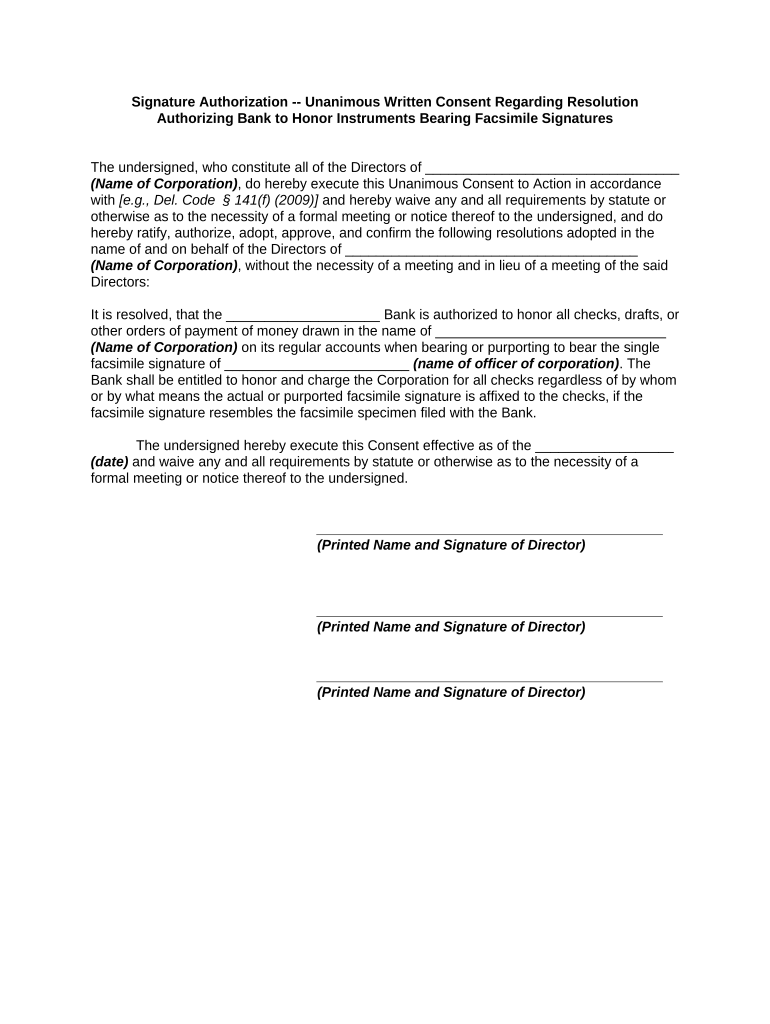
A Unanimous Written Consent Regarding Resolution is a corporate record documenting that all members of a board or all shareholders have agreed in writing to a specific corporate action without holding a meeting. It records the resolution text, the effective date, and signatures or electronic equivalents from every required signer. The document functions as the official corporate action log and becomes part of the minute book or corporate records; it is commonly used for actions such as officer appointments, mergers, authorization of bank accounts, or approval of contracts.

Why companies use a Unanimous Written Consent Regarding Resolution

It lets boards or shareholders take binding action quickly without convening a formal meeting, while preserving a clear, auditable record of unanimous approval for governance and compliance purposes.

Why companies use a Unanimous Written Consent Regarding Resolution

Typical users and stakeholders for this form

Unanimous written consents are used by small and large corporations, boards of directors, and managing members of LLCs to document unanimous approvals.

  • Corporate secretaries and general counsel who maintain corporate records and minutes
  • Board members and officers who must evidence approval for corporate actions
  • Shareholders or managing members when corporate action requires unanimous written consent

The document is an internal governance instrument; when properly executed it meets statutory recordkeeping requirements and supports later audits or due diligence.

Core elements included in a professional unanimous written consent

A well-formed consent contains precise resolution language, identification of parties, authority statements, signatures, date and effect timing, and a certification by the corporate secretary or authorized officer.

Resolution Text

Clear, specific language stating the board or shareholders' action and any operative terms that bind the company.
Parties Identified

Full legal names and capacities (director, shareholder, member) for each consenting party to ensure attribution.

Authority Clause

Reference to bylaws or operating agreement authorizing action and confirming that unanimous written consent is permitted.

Effective Date

Date the resolution takes effect, entered in MM/DD/YYYY format when possible for clarity.

Signatures

Signature blocks for all required signers with printed names, titles, and signature dates; electronic signatures acceptable under ESIGN/UETA.

Certification

Attestation by secretary or authorized officer certifying that all required parties signed and the consent is preserved in company records.

Step-by-step: executing a unanimous written consent

Follow these steps in order to create, circulate, and finalize the consent while keeping a complete audit trail.

  • 01
    Draft the resolution: Prepare exact operative language for the corporate action.
  • 02
    Confirm authority: Verify bylaws or operating agreement permit written consent.
  • 03
    Collect signatures: Obtain signatures from every required party or their authorized representative.
  • 04
    Record retention: File the signed consent in the corporate minute book and preserve the audit trail.

Typical execution workflow for electronic completion

A concise electronic workflow reduces friction while creating a verifiable audit trail for each signer and the document.

  • Prepare document: Upload PDF or DOCX and position signature fields.
  • Add signers: List all required signers with roles and emails.
  • Authenticate signers: Use email link, SMS code, or stronger authentication where required.
  • Complete and store: Capture signatures, timestamps, and archive the executed consent.

Recommended online configuration for a secure signing flow

Configure fields, authentication, and storage to meet governance and compliance expectations for corporate records.

Field Configuration
Signature Field Required signature, printed name, and date fields
Authentication Email link with optional SMS or KBA for higher assurance
Document Format PDF/A or DOCX to preserve layout and metadata
Archive Location Secure corporate repository with versioning

Technical considerations for digital signing and storage

Verify platform features, integrations, and security controls before e-signing corporate consents.

  • File formats: PDF, DOCX supported
  • Integrations: CRM, cloud storage, and ERP
  • Audit trail: Timestamped signature log

Ensure the selected platform supports required authentication, audit trails, and long-term storage to maintain the evidentiary value of the consent.

Security and compliance controls to look for

Encryption: TLS 1.2/1.3 in transit
Data at Rest: AES-256 encryption
Certifications: SOC 2 Type II available
HIPAA: BAA required for PHI
ESIGN / UETA: Legal compliance supported
21 CFR Part 11: Controls for FDA records

How a unanimous written consent compares to minutes and other records

Compare formality, speed, record type, and typical use to choose the right document for corporate governance needs.

Criteria Unanimous Written Consent Board Minutes
Formality less formal more formal
Execution Speed faster execution slower execution
Record Type written consent file minutes book
When used unanimous approvals without meeting full meeting record

Timing considerations and typical deadlines

While the consent itself has no federal filing deadline, timing affects effective dates, bank authorizations, and record retention requirements.

Effective Date Entry:

Enter MM/DD/YYYY to record when the action takes effect.

Bank Documentation:

Banks may require original or notarized consent before account changes.

Filing with State:

Internal corporate action usually not filed, except when amending formation documents.

Retention Start:

Retention typically begins on the effective date of the resolution.

Audit Availability:

Keep accessible records for at least the shorter of statute periods or internal audit requirements.

Key milestones from drafting to recordation

A typical timeline covers drafting, review, signature collection, certification, and archival steps to preserve governance integrity.

01

Drafting

Prepare resolution language and reference authorizing bylaws.

02

Legal Review

Counsel verifies authority and compliance.

03

Signature Collection

Collect signatures from all required parties, in person or electronically.

04

Recordation

Secretary certifies and archives the executed consent in the minute book.

Common pitfalls to avoid when preparing the consent

  • Failing to verify that the governing documents allow unanimous written consent can render the action invalid or vulnerable to challenge.
  • Using vague resolution language such as 'authorize actions' without specific delegated powers creates confusion in implementation.
  • Collecting signatures without adequate authentication or audit trail weakens evidentiary value in later disputes or audits.
  • Not preserving the signed original or a tamper-evident electronic record increases risk during due diligence or regulatory review.

Risks and legal consequences of defective consents

Voidable Action: Incorrect consents can be voided by courts or regulators
Fiduciary Liability: Directors may face liability for unauthorized actions
Bank Refusal: Financial institutions may reject unsigned or improperly notarized consents
Recordkeeping Violations: Noncompliant records can trigger audit findings
Tax Consequences: Improper documentation can affect tax positions
Contract Risk: Third parties may contest authority based on flawed consent

eSignature vendor comparison for executing corporate consents

Pricing and feature availability vary across vendors. signNow is listed first to compare core pricing and common enterprise features without implying endorsement.

signNow DocuSign Adobe Sign PandaDoc HelloSign
Starting Price $8/user/mo $15/user/mo $14/user/mo $19/user/mo $15/user/mo
Free Trial 7-day trial Varies Varies Varies Varies
Bulk Send Yes Yes Yes Yes No
Audit Trail Yes Yes Yes Yes Yes
HIPAA Compliant Yes Yes Yes No No

Frequently asked questions about unanimous written consents

Answers to common execution and validity questions for Unanimous Written Consent Regarding Resolution to help avoid procedural errors.


Need help? Contact support

be ready to get more
Join over 28 million airSlate SignNow users