California Summons (Family Law)
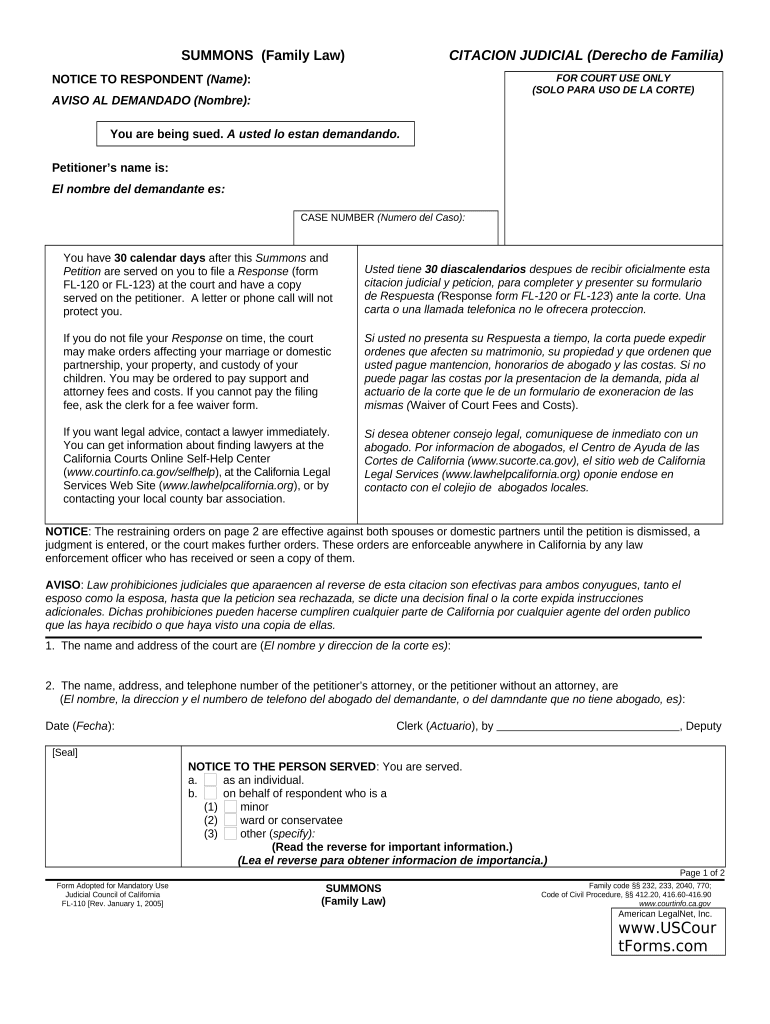
What the California Summons (Family Law) Is
Why the Summons Matters in Family Law Cases
A properly completed Summons creates official notice, starts the case timeline, establishes jurisdiction, and preserves both parties’ procedural rights in California family court.

Who Typically Prepares or Receives This Form
Common users include petitioners, family law attorneys, court clerks, and self-represented parties preparing an initial filing.
- Petitioner or petitioner’s attorney prepares the Summons when starting a divorce, separation, parentage, or custody action.
- Self-represented litigants use the form to assert claims without counsel and must follow local court filing rules.
- Court clerks and process servers receive, file, and carry out service protocols to ensure valid notice.
Each role must follow California court rules for filing, service, and proof of service to avoid default or dismissal risks.
Step-by-step: Completing a California Family Law Summons
-
01Prepare Petition: Complete petition forms and supporting declarations before creating the Summons.
-
02Complete Summons: Fill court name, parties, and case type; include required notices and safety language.
-
03File With Court: Submit originals at the clerk’s office or via the court’s accepted e-filing provider.
-
04Serve Respondent: Have a qualified process server provide personal or authorized substituted service and file proof of service.
How to Configure an Online Workflow for This Summons
| Field | Configuration |
|---|---|
| E-filing Provider | Select a court-approved vendor or the county e-filing portal. |
| Signature Type | Choose email authentication or stronger methods as required by court rules. |
| Service Packet | Bundle Summons, petition, and notice forms into one exported PDF for service. |
| Proof of Service | Include a fillable Proof of Service form to complete after personal or substituted service. |
Where to File, Serve, and Submit Supporting Papers
-
File at Clerk: Submit the original Summons and petition to the county superior court clerk.
-
E-file Option: Use an approved e-filing vendor when the court accepts electronic submissions.
-
Serve Respondent: Use personal service by a process server or law enforcement, or authorized substituted service.
-
File Proof: Return the signed proof of service to the clerk to document valid notice.
Technical Requirements for Digital Completion and Delivery
Use platforms that export court-ready PDF/A or printable copies and preserve timestamps and audit trails.
- File Formats: PDF, PDF/A, and DOCX are commonly accepted for e-filing and archival.
- Integrations: Platforms commonly integrate with Google Workspace, Microsoft 365, NetSuite, and case management systems.
- Authentication: Email link, SMS code, or more advanced signer verification may be configured.
Ensure any chosen service supports secure export, preserves signer audit trails, and meets court e-filing requirements before relying on electronic submission.
Key Timeframes to Track
Response Deadline:
Respondent typically has 30 days after personal service to file an answer or response.
Proof of Service Filing:
File the proof of service with the court promptly after completing service to document notice.
Temporary Orders:
Requests for temporary orders are often heard within weeks but depend on court calendar availability.
Default Procedures:
If respondent fails to respond within the deadline, petitioner may request default and relief.
Case Management Dates:
Initial case management or review dates vary by county; check local court rules.
Milestone Timeline from Filing to Initial Response
File Petition and Summons
Clerk stamps filing date and assigns the case number; this begins the official case record.
Serve the Respondent
Personal or substituted service delivers copies and triggers the response clock.
Response Window
Respondent usually has 30 days from service to file a written response.
File Proof of Service
Petitioner or server files the signed proof of service to verify valid notice.
Common Pitfalls When Preparing a Family Law Summons
- Using an incorrect court name or county delays filing and can require refiling with additional fees and time.
- Failing to include all required notices or attachments can cause a clerk to reject the filing or delay service.
- Improper service method or server selection risks an invalid service and may mean the respondent was not properly notified.
- Neglecting to file the proof of service promptly can prevent the court from proceeding and complicate enforcement.
Consequences of Errors or Incomplete Summons
Comparing eSignature Providers for Completing and Sharing the Summons
| signNow | DocuSign | Adobe Sign | PandaDoc | HelloSign | |
|---|---|---|---|---|---|
| Starting Price | $8/user/mo | $15/user/mo | $14/user/mo | $19/user/mo | $15/user/mo |
| Free Trial | 7-day free trial available | Trial terms vary by vendor; check vendor site | Trial terms vary by vendor; check vendor site | Trial terms vary by vendor; check vendor site | Trial terms vary by vendor; check vendor site |
| Bulk Send | Yes (Business Premium) | Yes | Yes | Yes | No |
| Audit Trail | Yes | Yes | Yes | Yes | Yes |
| HIPAA Compliant | Yes | Yes | Yes | No | No |
Real-World Examples of How the Summons Is Used
Self-Represented Petitioner
A parent files a petition for custody using court forms and a Summons
- Served the other parent by professional process server
- The petitioner filed a proof of service and used the case number to request a temporary hearing and child support services through the court.
Attorney-Managed Filing
An attorney prepares dissolution paperwork, generates a perfected Summons, and e-files the package
- The respondent received personal service within days
- The law firm uploaded proof of service and scheduled an early case management conference per local rules.
Frequently Asked Questions About the California Family Law Summons
-
Can the Summons be electronically signed?
Yes in many contexts. Electronic signatures meet the ESIGN Act (15 U.S.C. ch. 96) and UETA where applicable, provided the court and local rules accept e-signed filings and required consent and retention conditions are met.
-
Who may serve the Summons?
Service must be performed by an adult who is not a party, typically a registered process server or law enforcement. Substituted service rules and service by mail have specific California requirements; improper service can invalidate notice.
-
What if the respondent does not respond?
If no timely response is filed, the petitioner may move for default. A default can allow entry of orders without the respondent’s input, but courts may set aside defaults under certain circumstances.
-
Is notarization required for the Summons?
Generally no. The Summons itself typically does not require notarization; however, supporting declarations or proof of service may involve sworn statements or notary acknowledgements depending on the method of service.
-
How do I correct an error after filing?
Minor clerical errors may be corrected by filing an amendment or request to correct with the clerk. Significant defects may require refiling; consult the court clerk or a family law attorney for specific remedies.
-
Where to file the proof of service?
File the signed proof of service with the superior court clerk in the county where the case is pending. Many courts accept the document via e-filing portals if the county participates.