Identifying Information
Declarant name, address, case or file number, and contact details. Accurate identification ensures the statement is matched to the correct proceeding or account and avoids administrative rejection.
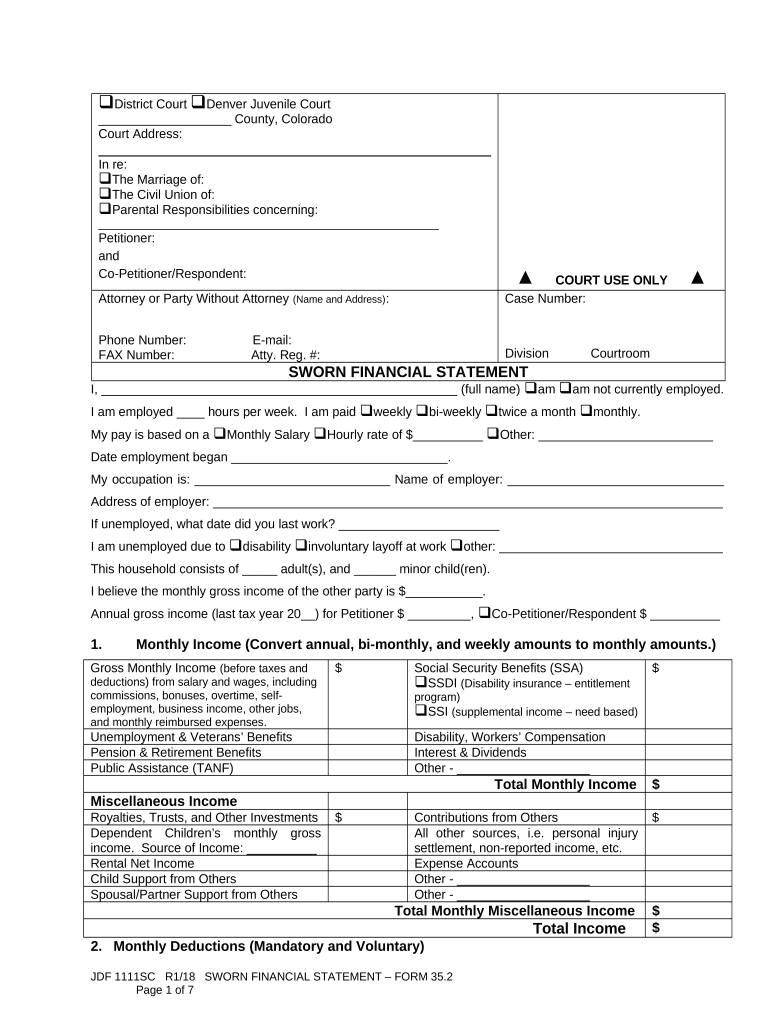
A Sworn Financial Statement creates a formal, verifiable record of financial facts used for judicial or administrative decisions; accuracy and completeness directly affect legal outcomes.

Typical users include practitioners, individuals who must disclose finances, lenders, and court personnel working on adjudication or verification.
Each audience expects verifiable numbers, supporting documentation, and clear attestation language to meet evidentiary and procedural requirements.
Represents the declarant, reviews underlying documents, and ensures the statement meets court formatting and jurisdictional requirements; may file the statement with the court and prepare accompanying declarations or exhibits.
The person attesting to their finances under oath. Responsible for entering accurate details, attaching supporting documents, and signing in the presence of a notary if required by the court or statute.
Declarant name, address, case or file number, and contact details. Accurate identification ensures the statement is matched to the correct proceeding or account and avoids administrative rejection.
Detailed listing of bank accounts, investments, real property, vehicles, retirement accounts, and other valuable property with current values and account identifiers where applicable.
Itemized debts, loans, mortgages, credit card balances, and other obligations, including creditor names, outstanding balances, monthly payments, and secured/unsecured status.
Monthly or annual income sources and regular expenses; itemize wages, self-employment receipts, benefits, taxes, child support, rent, utilities, and recurring payments for precise cash-flow analysis.
Bank statements, pay stubs, tax returns, loan statements and other records that corroborate declared figures; attach as exhibits or file per court instructions.
A sworn attestation clause followed by the declarant’s signature, date, and notary acknowledgment or certificate when required by jurisdiction or court rule.
| Field | Configuration |
|---|---|
| Document upload | Accept PDF, DOCX; convert to flattened PDF for final archive |
| Templates | Use reusable templates with pre-placed fields and logic |
| Conditional fields | Show/hide fields based on prior answers |
| Signer authentication | Choose email, SMS code, or stronger ID verification |
Confirm the platform captures a complete audit trail, stores tamper-evident copies, and can produce a court-ready certificate of completion.
Optica used mobile-friendly forms to collect investor financial statements quickly and securely.
A real estate operator shifted tenant financial disclosures to an online workflow for lease underwriting and compliance.
| Document Type | Notarization Required | Court Use |
|---|---|---|
| Sworn Financial Statement | often | family court |
| Income Statement | sometimes | lenders |
| Tax Return | irs use | |
| Affidavit of Assets | often | various tribunals |
Courts often set 14–30 day deadlines for producing statements
Observe local court calendar and hearing dates when submitting
Allow time for in-person or RON notarization session scheduling
Lenders and agencies may take 5–15 business days to process
Archive final signed copy immediately after filing
| signNow | DocuSign | Adobe Sign | PandaDoc | HelloSign | |
|---|---|---|---|---|---|
| Starting Price | $8/user/mo | $15/user/mo | $14/user/mo | $19/user/mo | $15/user/mo |
| Free Trial | 7-day free trial | Varies | Varies | Varies | Varies |
| Bulk Send | Yes | Yes | Yes | Yes | No |
| Audit Trail | Yes | Yes | Yes | Yes | Yes |
| HIPAA Compliant | Yes | Yes | Yes | No | No |
| Envelope Cap | No cap | 100 envelopes/user/year | Varies by plan | Varies by plan | Varies by plan |