Establishing secure connection…Loading editor…Preparing document…

Technology Transfer Agreement

This template is fully customizable. Edit the text, fill out the fields, and send it for signature. Give it a try!
Technology Transfer Agreement

What a Technology Transfer Agreement Is and when it applies

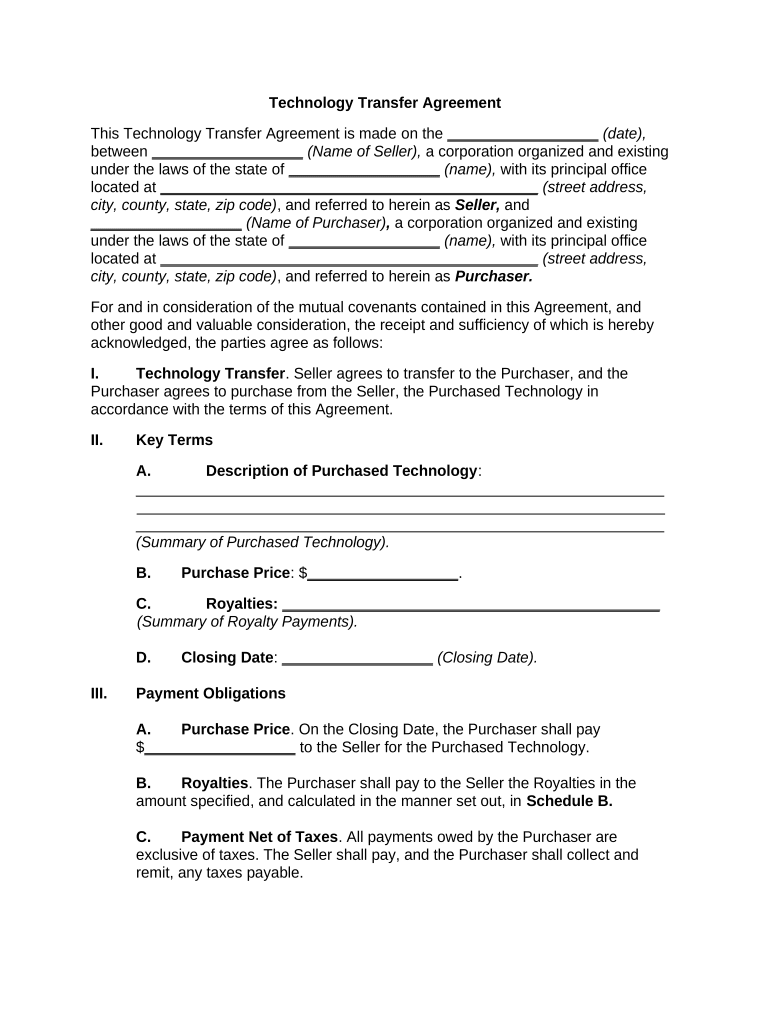
A Technology Transfer Agreement (TTA) is a legal contract that documents the transfer, license, or assignment of intellectual property, know-how, or technical materials between parties. It defines the scope of what is transferred, the rights retained or granted, payment or consideration, confidentiality obligations, and responsibilities for regulatory or patent filings. TTAs are used when research institutions, companies, or government entities move technology between organizations, spin out startups, or permit commercial use of proprietary processes or software.

Why a clear Technology Transfer Agreement matters

A well-drafted TTA reduces IP disputes, clarifies licensing scope, and preserves patent rights while protecting confidential information. It establishes measurable obligations, timelines, and remedies so both parties understand deliverables and payment terms, reducing downstream risk and cost.

Why a clear Technology Transfer Agreement matters

Who typically prepares and signs a Technology Transfer Agreement

Common parties involved in a TTA include the IP owner, the recipient/licensee, and their legal or technology transfer offices; third-party funders or sponsors may also be listed.

  • University technology transfer offices and research institutions managing patentable outcomes and commercialization.
  • Corporate R&D units or in-house counsel negotiating licenses, assignments, or sponsored research rights.
  • Startups and spinouts receiving IP or license rights as part of formation or funding rounds.

Each signer should have clear authority to bind their organization and be listed with role, title, and authority in the signature block to avoid later challenges.

Step-by-step: completing a Technology Transfer Agreement

Follow these steps to prepare, review, and execute a TTA in an auditable, legally consistent way.

  • 01
    Assemble materials: Gather invention disclosures, patent numbers, code repositories, and prior agreements.
  • 02
    Draft core terms: Define grant scope, exclusivity, payment, and milestone obligations in plain language.
  • 03
    Review legal issues: Have IP counsel verify assignment language, export controls, and third-party rights.
  • 04
    Execute and retain: Obtain authorized signatures, notarize if required, and preserve an auditable copy.

Typical workflow for managing a Technology Transfer Agreement

A predictable workflow helps ensure obligations are met and records are preserved for patent or regulatory timelines.

  • Prepare package: Collect IP documents, disclosures, and exhibits to attach to the agreement.
  • Internal approvals: Secure signoff from technology transfer office, finance, and compliance as needed.
  • External negotiation: Exchange drafts, track redlines, and record agreed changes in version control.
  • Execution and distribution: Sign, date, and distribute final executed copies to all parties and counsel.

Key e-signature and workflow settings for a Technology Transfer Agreement

Configure a digital workflow to preserve audit trails and meet authentication requirements for IP-sensitive transfers.

Field Configuration
Document source Upload PDF or DOCX with exhibits combined
Signer order Set sequential or parallel signing per roles
Authentication Use email + SMS or advanced auth for high-assurance
Retention Enable secure storage with audit trail and export

Technical considerations for eSigning and eSubmission

Verify platform capabilities and integrations before eSigning an IP-sensitive agreement.

  • Document formats: PDF and DOCX accepted; maintain original exhibits
  • Integrations: Supports Salesforce, NetSuite, Microsoft 365, Google Workspace
  • Security standards: TLS 1.2/1.3 and AES-256 encryption

Ensure the chosen platform preserves audit trails (timestamps, IP, signer identity) and can export signed files in standard formats for patent offices or legal records.

Typical timelines and deadlines in Technology Transfer Agreements

TTAs often include specific milestone dates and notice periods that affect patent filings, commercialization, and payment schedules.

Effective Date:

Date obligations commence; use MM/DD/YYYY.

Technology Delivery:

Dates for transfer of materials, code, or documentation.

Patent Prosecution Notice:

Deadline for informing parties of filings or claims.

Payment Milestones:

Dates tied to deliverables or commercialization stages.

Termination Notice:

Required advance notice period for termination events.

Key milestones for a Technology Transfer Agreement lifecycle

A milestone timeline helps parties track obligations from negotiation through post-termination obligations.

01

Negotiation and Drafting

Exchange and agree on draft terms, exhibits, and definitions.

02

Internal Approvals

Obtain board, sponsor, or technology transfer office signoff as required.

03

Execution and Delivery

Signed agreement executed; deliverables transferred per schedule.

04

Post-Execution Compliance

Monitor royalties, reporting, and patent prosecution responsibilities.

Essential clauses every Technology Transfer Agreement should include

A complete TTA balances transfer mechanics with legal protections for IP, confidentiality, and commercial terms.

Definitions

Clear definitions of 'technology', 'know-how', 'confidential information', and 'field of use' to avoid ambiguity in enforcement and scope.
Grant or Assignment

Precise language describing whether rights are licensed or assigned, with exclusivity, territory, and duration spelled out.

Consideration

Monetary payments, royalties, milestone fees, equity, or other compensation, plus invoicing and payment terms.

IP Prosecution

Responsibilities for patent filings, prosecution costs, inventorship, and cooperation during litigation or patent office actions.

Confidentiality

Non-disclosure obligations, permitted disclosures, duration of confidentiality, and carve-outs for independently developed information.

Warranties and Indemnities

Representations on ownership, non-infringement, and indemnity obligations for third-party claims and breaches.

Required data fields and record elements

Parties' Legal Names: Exact registered names
Technology Identifier: Patent numbers or code repo tags
Deliverables List: Files, source code, documentation
Consideration Terms: Payment amounts and royalties
Governing Law: Selected state law
Authorized Signatories: Name, title, date

Common legal and commercial risks in Technology Transfer Agreements

IP Ownership Dispute: Risk of competing claims
Patent Filing Delay: Loss of priority
Tax Consequences: Incorrect reporting of consideration
Confidentiality Breach: Loss of trade secret protection
Unenforceable Terms: Overbroad assignment or void clauses
Regulatory Noncompliance: Export control or data privacy issues

Common mistakes to avoid when preparing a Technology Transfer Agreement

  • Using vague technical descriptions that leave room for dispute over what was actually transferred or licensed.
  • Failing to specify whether the transfer is an assignment or a license, and omitting field-of-use and territorial limits.
  • Neglecting patent prosecution responsibilities and timelines, which can forfeit priority or exclusivity rights.
  • Omitting explicit retention and handling requirements for confidential materials and source code archives.

Real-world examples of technology transfers and practical outcomes

Two brief examples illustrate how organizations use TTAs to move technology into commercial use while managing risk.

Optica Ventures — COO

Optica Ventures documented a clear list of deliverables and an IP assignment schedule to support startup formation.

  • The TTA assigned necessary patents and provided post-closing cooperation.
  • As a result, the startup secured investor confidence, avoided title disputes, and accelerated commercialization with documented obligations for future patent filings and milestone payments.

Tech Data — CEO

A corporate transfer defined sublicensing rights and integration responsibilities for embedded software.

  • The agreement required detailed technical handover and testing deliverables.
  • This structure clarified maintenance responsibilities, protected the licensor's core IP, and enabled the licensee to integrate the technology into product offerings without ambiguity over support or update obligations.

eSignature vendor comparison for signing Technology Transfer Agreements

Pricing and core capabilities vary across vendors; signNow is listed first for comparison. Confirm specific plan features and HIPAA/BAA availability with each vendor before selection.

signNow DocuSign Adobe Sign PandaDoc HelloSign
Starting Price $8/user/mo $15/user/mo $14/user/mo $19/user/mo $15/user/mo
Free Trial 7-day free trial Varies by plan Varies by plan Varies by plan Varies by plan
Bulk Send Yes (Business Premium) Yes Yes Yes No
Audit Trail Yes Yes Yes Yes Yes
HIPAA Compliant Yes Yes Yes No No
Envelope Cap No cap 100 envelopes/user/year Varies Varies Varies

Practical tips for accurate and efficient Technology Transfer Agreement completion

Adopt consistent practices to reduce negotiation cycles and protect IP value when transferring technology.

Use clear definitions
Define 'technology' and 'know-how' precisely to avoid scope disputes.
Attach exhibits
Include technical specs, source code lists, and repository access instructions as exhibits.
Set milestones
Tie payments and obligations to objective deliverables and test criteria.
Preserve audit logs
Use eSignature platforms that retain timestamps, IP, and signer authentication records.

Typical authorized signatories for Technology Transfer Agreements

Licensor — VP of Research

The licensor's VP of Research or director of the technology transfer office typically signs for universities or R&D organizations and must be authorized to assign rights and accept consideration on behalf of the institution.

Licensee — General Counsel

The licensee's General Counsel or an authorized executive with signature authority signs to bind the company to license scope, payment obligations, and indemnities.

Frequently asked questions about Technology Transfer Agreements

Answers to common legal and execution questions for TTAs, focusing on enforceability, IP assignment, and digital execution.


Need help? Contact support

be ready to get more
Join over 28 million airSlate SignNow users