Establishing secure connection…Loading editor…Preparing document…

Renunciation and Disclaimer of Property

This template is fully customizable. Edit the text, fill out the fields, and send it for signature. Give it a try!
Renunciation and Disclaimer of Property

What a Renunciation and Disclaimer of Property Does

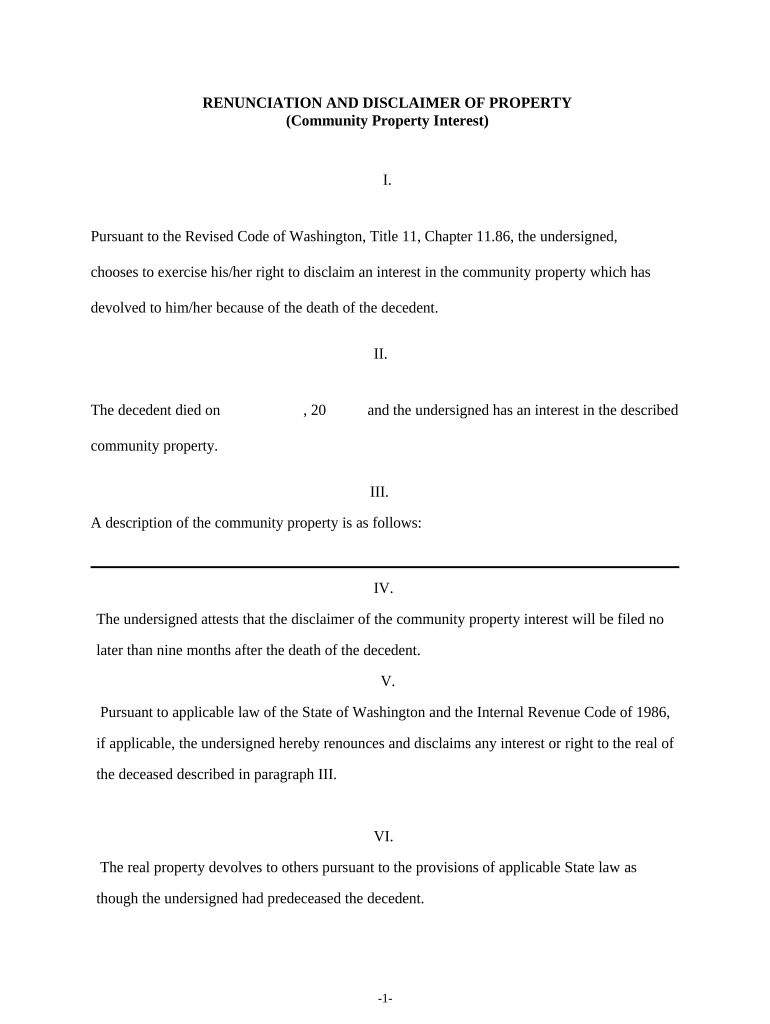
A Renunciation and Disclaimer of Property is a written instrument in which a person formally refuses or disclaims any present or future interest in specified property. Typically used in estate and probate contexts, it redirects the disclaimed interest to other beneficiaries or back to the estate under state law. The document identifies the disclaiming party, precisely describes the property or interest being disclaimed, and states whether the disclaimer is partial or total. Proper execution, timing, and delivery are essential to ensure the disclaimer achieves the intended property and tax effects.

Why use a Renunciation or Disclaimer

A disclaimer transfers or rejects an interest without the disclaimant accepting ownership first, which can simplify estate administration, avoid conflicts, and preserve intended distributions while minimizing formal transfers and probate steps.

Why use a Renunciation or Disclaimer

Who commonly completes this document

Typical users include estate beneficiaries, personal representatives, trustees, and attorneys handling probate or estate planning matters.

  • Individual beneficiaries who prefer distributions pass by operation of law rather than taking title.
  • Personal representatives or executors processing estate distributions and recording beneficiary actions.
  • Trustees or fiduciaries documenting that a potential beneficiary declines an allocated interest.

Timing, legal effect, and filing vary by jurisdiction; parties often consult counsel before signing to preserve tax and succession outcomes.

Essential elements to include in a professional disclaimer

A complete Renunciation and Disclaimer of Property contains specific sections that make the intent, scope, and effect clear to courts, fiduciaries, and taxing authorities.

Identifying Parties

Full legal name and capacity of the disclaimant, plus names and roles of the estate, trust, or other affected parties to ensure attribution and avoid ambiguity in succession.
Property Description

A precise description of the property, interest, or asset class being disclaimed, including identifiers like account numbers, parcel numbers, or instrument references to prevent disputes over scope.

Statement of Disclaimer

A clear, unconditional declaration that the disclaimant refuses, renounces, and releases any legal or equitable interest in the specified property without accepting benefits or control.

Effective Date and Delivery

A specified effective date plus language confirming delivery to the personal representative, trustee, or other designated recipient to satisfy timing and notice requirements.

Legal and Tax Acknowledgments

Where relevant, language noting awareness of potential tax or fiduciary consequences and a recommendation to seek counsel; do not provide tax advice within the form itself.

Execution Blocks

Signature, printed name, date, notary or witness lines where required by state law, and any acceptance or acknowledgement by the estate or trustee when applicable.

Step-by-step: completing the form

Follow these steps in order to avoid execution or timing problems that could affect probate or tax treatment.

  • 01
    1. Identify the interest: Describe the property precisely.
  • 02
    2. Confirm capacity: State your relationship and authority.
  • 03
    3. Choose effective date: Enter MM/DD/YYYY format.
  • 04
    4. Sign and notarize: Execute per state witness/notary rules.

How the disclaimer affects estate flow

Understand the practical effect: a valid disclaimer means the disclaimant is treated as if they predeceased or never took the interest, altering distribution paths.

  • No acceptance: Disclaimant must not accept benefits first.
  • Transfer by operation: Interest passes according to instrument or statute.
  • Estate accounting: Executor adjusts distribution schedules.
  • Tax reporting: Beneficiary and estate consider tax consequences.

Typical digital workflow settings for online completion

Configure an e-sign workflow to capture intent, attribution, and retention while meeting legal and notarial requirements.

Field Configuration
Signatures Require signature and date fields for each party
Authentication Use email link or SMS code; stronger ID if required
Notarization Enable remote online notarization where permitted
Audit Trail Capture IP, timestamp, and action log

Technical considerations for eSigning and notarization

Choose a platform that supports required authentication, audit trails, and RON where your state permits.

  • Authentication: Email, SMS, or KBA verification
  • Audit Trail: Timestamps, IP address, action history
  • Integrations: Connects with cloud storage and case systems

Ensure the selected service meets legal and state notary requirements; retain signed records in tamper-evident formats and maintain a complete audit trail for proof of execution.

Timing and filing considerations

A disclaimer is often time-sensitive; confirm any state-specific deadlines, probate timelines, and filing practices before execution.

Prompt Execution:

Sign and deliver as soon as interest is identified.

Delivery Notice:

Provide written notice to the personal representative or trustee.

Probate Deadlines:

Meet court filings or estate reporting schedules where applicable.

Tax Timing:

Confirm timing impacts with a tax advisor.

Record Retention:

Keep original for estate records and counsel.

Key milestones in processing a disclaimer

Track these sequential milestones from discovery to final accounting to ensure the disclaimer is effective and recorded correctly.

01

Identify Interest

Confirm the specific asset or right to be disclaimed.

02

Draft Document

Prepare clear language and property identifiers.

03

Execute Properly

Sign with required witnesses or notary.

04

Deliver and Record

Provide notice to fiduciary and file if required.

Common preparation mistakes to avoid

  • Ambiguous property descriptions that create disputes over scope and intent.
  • Signing without observing state witness or notarization rules invalidates execution in some jurisdictions.
  • Accepting benefits before disclaiming which may negate the disclaimer under governing law.
  • Failing to provide timely written notice to the personal representative or trustee.

Consequences of incorrect or untimely disclaimers

Tax consequences: Possible gift or estate tax effects
Probate delay: Increased administration time and costs
Invalid disclaimer: Court may treat interest as accepted
Creditor claims: Exposure to unexpected creditor rights
Title issues: Complications in property transfers
Correction costs: Need for affidavits or court proceedings

Information you must include and protect

Party Names: Full legal names
Property ID: Parcel/account/instrument number
Effective Date: MM/DD/YYYY format
Delivery Details: Recipient and delivery method
Execution Evidence: Notary or witness details
Retention Location: Where original is stored

Practical examples of how disclaimers are used

These real-world scenarios illustrate typical disclaimer outcomes and administrative steps taken after execution.

Optica Ventures

A beneficiary renounced a small partnership interest to streamline distributions

  • The partnership reallocated units per governing instrument
  • The disclaimer reduced accounting and allowed faster final distribution to remaining partners.

Martin Properties

An heir declined a partial interest in a rental parcel to avoid landlord responsibilities

  • The estate assigned the interest to co-heirs under the will
  • The executor recorded the disclaimer with the county recorder to clear title before sale.

Comparing eSignature vendors for executing disclaimers and notarizations

Cost and feature differences matter when choosing eSignature software for legal instruments; the table below summarizes starting prices and select capabilities from common providers.

signNow DocuSign Adobe Sign PandaDoc HelloSign
Starting Price $8/user/mo $15/user/mo $14/user/mo $19/user/mo $15/user/mo
Free Trial 7-day free trial Varies Varies Varies Varies
Bulk Send Yes Yes Yes Yes No
Audit Trail Yes Yes Yes Yes Yes
HIPAA Compliant Yes Yes Yes No No

Frequently asked questions and troubleshooting

Answers to common questions about execution, validity, notarization, and electronic signing of disclaimers to help prevent errors and delays.


Need help? Contact support

be ready to get more
Join over 28 million airSlate SignNow users