Original Reference
Cite the original easement by recording book/page or document number and recording county so the public record and title exam can identify which instrument is being released.
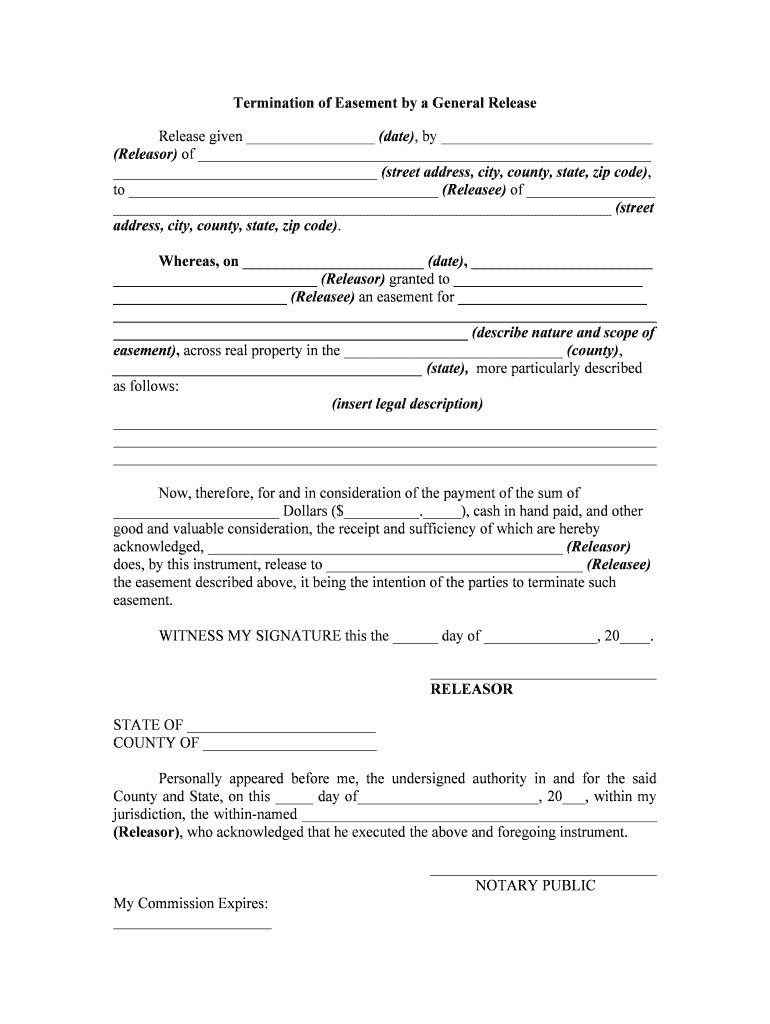
A precise termination instrument reduces title risks, avoids duplicate encumbrances, and uncovers potential conflicts before sale or refinancing. Recording the termination preserves marketable title and gives notice to future purchasers and lenders.

Real estate attorneys, title companies, grantors, and grantees commonly prepare or request terminations to clear title or finalize changed property use.
Each party should confirm the termination complies with the original easement terms, local recording requirements, and any lender conditions prior to execution and recording.
The grantor or holder of the easement is the party who relinquishes rights; their signature and any required acknowledgements confirm consent to terminate and are central to enforceability.
The grantee or benefited property owner may sign to acknowledge release terms or to accept conditions; lenders or title agents might also sign or provide lien releases where required.
Cite the original easement by recording book/page or document number and recording county so the public record and title exam can identify which instrument is being released.
Include full metes-and-bounds or lot-and-block descriptions for the properties affected to ensure the release applies only to the intended parcels.
A clear declarative clause stating the easement is terminated, describing the rights being released and any reservation that survives termination.
If termination is in exchange for payment or other consideration, state the amount or recite nominal consideration as required by local recording practices.
Signature blocks for parties, notary acknowledgements, and witness lines where required by state law to validate the instrument for recording.
Specify the recording county and clerk, and include a return-to clause for the recorded document to avoid misfiling and ensure notice is delivered post-recording.
| Upload Document | PDF or DOCX file; ensure legal descriptions are formatted clearly. |
|---|---|
| Place Signature Fields | Assign signature, date, and notary fields to the correct parties. |
| Signer Authentication | Use email plus SMS or ID verification for higher assurance. |
| Notary / RON Settings | Enable notary acknowledgement or RON session recording where permitted. |
| Return and Archive | Route recorded copy to title agent and store original in secure records. |
Use an eSignature platform that supports notarization workflows, audit trails, PDF/A export, and secure storage for recorded copies.
Verify that the chosen platform can produce a tamper-evident signed PDF, provide a complete audit trail, and support any state RON requirements if remote notarization is used.
| signNow | DocuSign | Adobe Sign | PandaDoc | HelloSign | |
|---|---|---|---|---|---|
| Starting Price | $8/user/mo | $15/user/mo | $14/user/mo | $19/user/mo | $15/user/mo |
| Free Trial | 7-day free trial | Yes | Yes | Yes | Yes |
| Bulk Send | Yes | Yes | Yes | Yes | No |
| Audit Trail | Yes | Yes | Yes | Yes | Yes |
| HIPAA Compliant | Yes | Yes | Yes | No | No |
| Envelope Cap | No envelope cap | 100 envelopes/user/year | Varies by plan | Varies by plan | Varies by plan |
Coordinate signing and notary availability; some parties require corporate sign-off that can add days
County recorder processing varies from same-day to several business days
Title companies typically update reports after receipt of recorded instrument within 1–10 business days
If lender approval is required, allow additional time for payoff or lien release verification
If using Remote Online Notarization, retain recording of session per state rules (often 5–10 years)
Title search locates the easement and identifies necessary parties and references
Draft termination and have counsel or title review for accuracy
Signatures obtained with required notarization or RON session
File with county recorder and obtain recorded document number
A developer needed to remove an access easement after new internal roads were built.
A utility abandoned a narrow corridor after relocating lines.