Establishing secure connection…Loading editor…Preparing document…

Assignment of Trademark and Trade Dress

This template is fully customizable. Edit the text, fill out the fields, and send it for signature. Give it a try!
Assignment of Trademark and Trade Dress

What the Assignment of Trademark and Trade Dress is

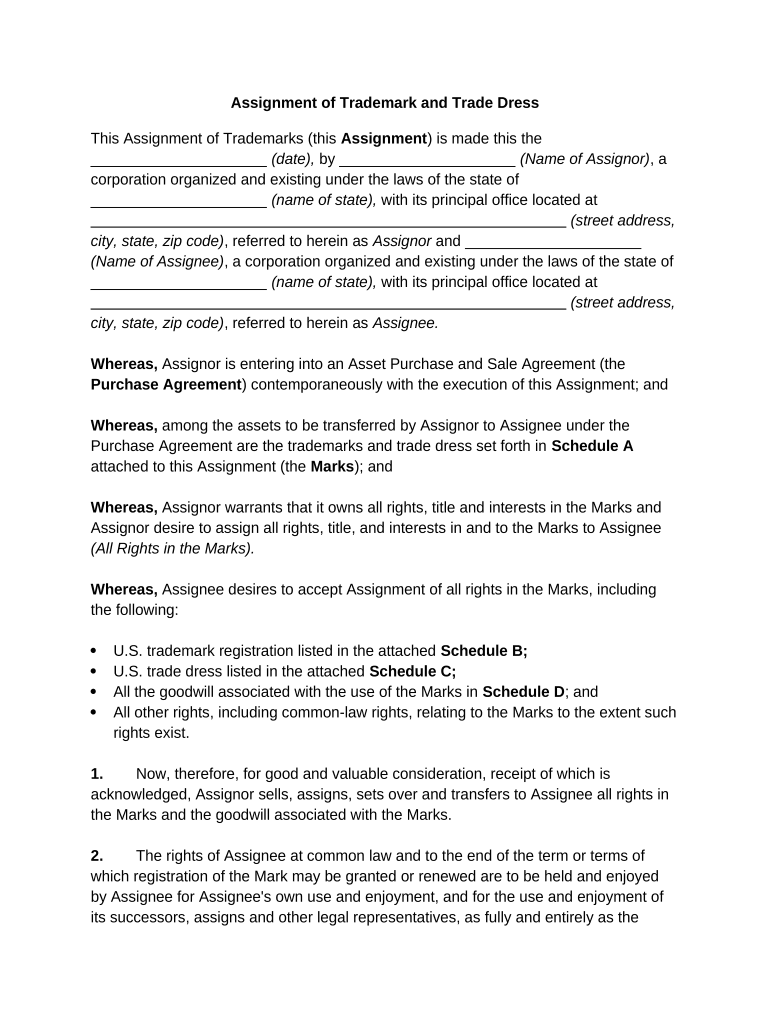
An Assignment of Trademark and Trade Dress is a written agreement that transfers ownership of registered or unregistered trademark rights and associated trade dress from one party (the assignor) to another (the assignee). The document identifies the marks and trade dress being transferred, states the effective date, describes consideration, and clarifies any retained rights or limitations. Proper execution and, where applicable, recording with the U.S. Patent and Trademark Office (USPTO) preserve the public chain of title and support future enforcement.

Why a formal assignment matters for IP clarity

A clear, written assignment establishes legal title, reduces disputes over ownership, and documents the scope of rights transferred, including goodwill and territorial limits. It also supports enforcement actions and licensing.

Why a formal assignment matters for IP clarity

Typical parties involved and their roles

Assignments are used by buyers, sellers, licensors, licensees, investors, and legal counsel to transfer or confirm trademark and trade dress ownership.

  • Brand owners selling a business or assets who must transfer trademarks and associated trade dress to a buyer.
  • Companies acquiring brands that need documented chain of title for due diligence and enforcement.
  • Attorneys and IP managers preparing documents to reflect retained rights, licensing carve-outs, or quality controls.

Who typically signs this assignment

Assignor — Representative

A corporate officer, authorized partner, or individual owner signs for the assignor. The signer should be authorized in board resolutions or an existing power of attorney to avoid challenges to authority during enforcement or recording.

Assignee — Authorized Officer

An authorized officer or in-house counsel signs for the assignee. The assignee’s signer should have authority to accept the transferred rights and confirm any ongoing obligations such as quality control for licensed marks.

Essential elements to include in a professional assignment

A complete assignment addresses identification of marks, statement of transfer, effective date, consideration, representations and warranties, and post-assignment obligations such as recordation and goodwill handling.

Identification of marks

List registrants, registration numbers (if any), filing dates, and a clear description of trade dress elements or specimens being transferred to avoid ambiguity.
Statement of transfer

An explicit conveyance clause transferring 'all right, title and interest' or a tailored scope, including any limits on goods, services or geographic territories.

Effective date

Specify the effective date of the transfer; this date controls priority, tax treatment, and the start of ownership for enforcement purposes.

Consideration

Describe monetary payment or other consideration clearly, or state a nominal amount if part of a corporate reorganization to support enforceability.

Representations and warranties

Include common warranties about ownership, absence of conflicting assignments, validity of the marks, and authority to assign to reduce future disputes.

Recordation and delivery

State responsibility for recording with USPTO, delivery of executed counterparts, and any obligations to transfer supporting documentation or specimens.

Step-by-step: completing and finalizing the assignment

Follow these sequential actions to prepare, execute, and preserve the assignment effectively.

  • 01
    Prepare draft: Assemble mark details, specimens, and consideration terms.
  • 02
    Review authority: Confirm signatory authority and board approvals if required.
  • 03
    Execute agreement: Obtain wet or electronic signatures from all parties.
  • 04
    Record and deliver: Record with USPTO and distribute executed copies to parties.

Customizing an online workflow for assignments

Configure fields and routing to match your approval and recordation steps when using an eSignature platform.

Field Configuration
Signers and order Set assignor then assignee signing order.
Required fields Make mark list, effective date, and consideration required.
Attachments Require specimen and assignment exhibit uploads.
Recording step Add task to record with USPTO after execution.

Digital signing and technical requirements

Use a platform that supports secure signatures, audit trails, and required file formats.

  • Integration ecosystem: Salesforce, NetSuite, Microsoft 365 support
  • Supported formats: PDF, DOCX, HTML, Excel
  • Authentication options: Email, SMS code, KBA, SSO

Where to file and how documents move after signing

After execution, route signed originals and electronic copies to internal records and the USPTO (if recording).

  • Deliver executed copies: Send signed PDFs to legal and business records.
  • Record with USPTO: Submit assignment for recordation against registrations.
  • Update contracts: Notify licensees and update related agreements.
  • Store originals: Retain originals in secure records management.

Common eSignature vendor comparison for assignments

Compare starting prices and core features relevant to executing and recording trademark and trade dress assignments. Check vendor plans for enterprise or recordation-specific features.

signNow DocuSign Adobe Sign PandaDoc HelloSign
Starting Price $8/user/mo $15/user/mo $14/user/mo $19/user/mo $15/user/mo
Free Trial 7-day free trial Trial available Trial available Trial available Trial available
Bulk Send Yes (Business Premium+) Yes (varies) Yes Yes Varies by plan
Audit Trail Yes Yes Yes Yes Yes
HIPAA Compliant Yes Yes Yes No No
Envelope Cap No cap 100 envelopes/user/year Varies by plan Varies by plan Varies by plan

Common mistakes to avoid when preparing an assignment

  • Vague mark descriptions that omit registration numbers, filing dates, or specimens, which can lead to uncertainty about what was transferred.
  • Failing to include specific language about transfer of goodwill or continuing quality controls, causing disputes with licensees or enforcement issues.
  • Neglecting to confirm signatory authority or corporate approval, which can render the assignment voidable or delay recordation with the USPTO.
  • Omitting instructions about who bears recordation costs or how executed originals will be delivered, causing administrative delays and disagreements.

Risks and potential consequences of improper assignments

Enforcement gaps: May impair ability to enforce mark rights
Title disputes: Creates chain-of-title challenges
Recording delays: Can interrupt licensing or sales closings
Tax consequences: Improper consideration may affect tax treatment
Contract risk: Unclear carve-outs cause litigation
Reputational harm: Brand confusion or consumer harm

Security and compliance considerations for electronic assignments

Encryption: TLS 1.2/1.3; AES-256 at rest
Certifications: SOC 2 Type II; ISO 27001
Regulatory: ESIGN and UETA compliant
Industry rules: 21 CFR Part 11 available
Health data: HIPAA support with BAA
Accessibility: WCAG 2.0 Level AA

Use-case illustrations from customers and legal workflows

These examples show how electronic execution and clear assignments support transactions across organizations.

Optica Ventures — Operational efficiency

The interface is simple and easy-to-use for our team; more importantly, it is just as easy for our customers.

  • Used standardized assignments to speed closings.
  • Resulted in fewer follow-up signatures and clearer chain-of-title documentation for acquisitions.

Tech Data — Enterprise workflows

Tech Data uses airSlate SignNow to improve our internal and external customer service while increasing our speed to revenue.

  • Centralized assignment templates and recording tasks.
  • Reduced manual steps during asset transfers and improved audit readiness for IP transactions.

Frequently asked questions about assignments and e-signing

Answers to common legal and practical questions when preparing or executing an Assignment of Trademark and Trade Dress.


Need help? Contact support

be ready to get more
Join over 28 million airSlate SignNow users