Establishing secure connection…Loading editor…Preparing document…

Transfer on Death Deed

This template is fully customizable. Edit the text, fill out the fields, and send it for signature. Give it a try!
Transfer on Death Deed

What a Transfer on Death Deed Is and when it matters

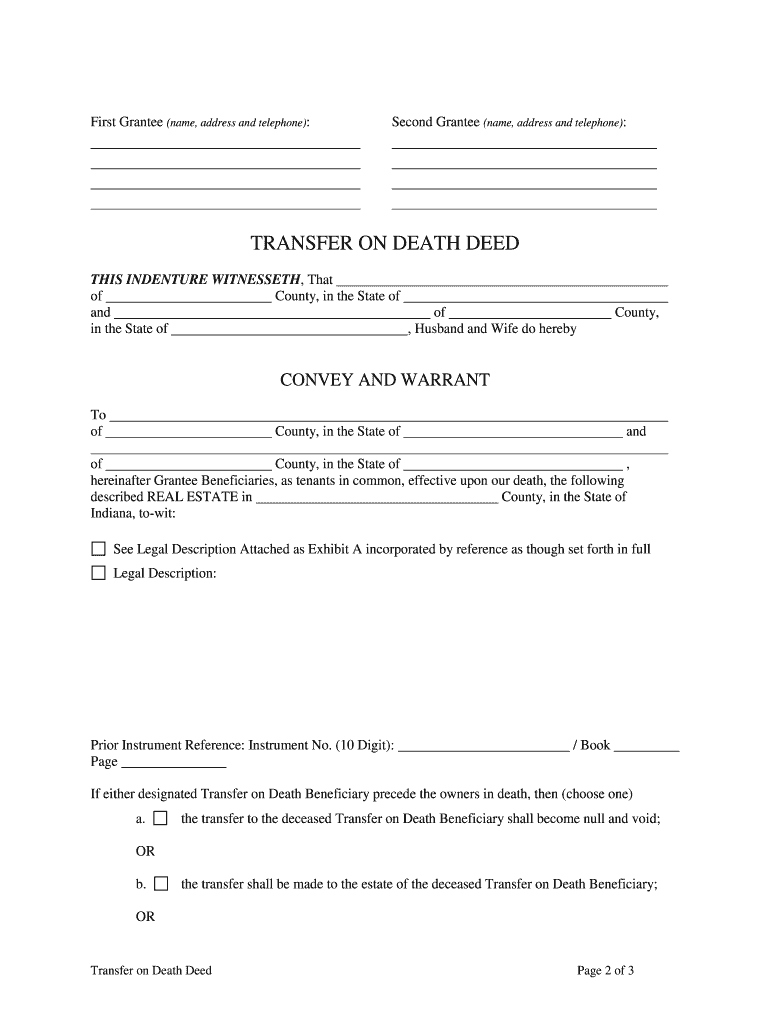
A Transfer on Death Deed (TODD) is a recorded real estate instrument that names one or more beneficiaries to receive title to real property automatically upon the owner’s death. The grantor retains full ownership and control while alive, including the right to sell, mortgage, or revoke the deed. Because the deed transfers title outside of probate when properly executed and recorded according to state rules, it can simplify succession for single parcels and reduce probate costs and delay for small estate transfers.

Why people choose a Transfer on Death Deed

A TODD lets an owner name successors directly while keeping property control during life. It can avoid probate for the specific parcel, preserve privacy, and speed transfer to beneficiaries. Legal recognition depends on state statute; ESIGN/UETA do not change the substantive recording requirements for real property, which still require a properly executed, notarized, and recorded paper or electronic deed in most jurisdictions.

Why people choose a Transfer on Death Deed

Core parts of a valid Transfer on Death Deed

A complete TODD contains defined elements that recording offices and future title examiners expect. Missing or ambiguous components are the most common reasons for rejection or title issues.

Grantor

Full legal name and capacity of the current property owner executing the deed; must match title records and ID.
Beneficiary

Name(s) of the person(s) or entity receiving title on death, with sufficient detail to identify each transferee.

Legal Description

Complete metes-and-bounds or lot-and-block description as shown on the current deed; parcel number if available.

Transfer Condition

Clear language stating transfer occurs on the grantor’s death and is revocable by the grantor during life.

Notary Acknowledgement

State-compliant notarial block evidencing grantor signature; may require witnesses depending on state law.

Recording Block

Space reserved for county recorder stamps and entry of recording information to complete the public record.

Essential data elements to include

Grantor Identity: Full legal name
Beneficiary Details: Full name and city/state
Property Description: Complete legal description
Recording County: County name
Execution Date: MM/DD/YYYY
Notary Block: State-compliant acknowledgement

Step-by-step: preparing and recording a Transfer on Death Deed

Follow these steps in order to prepare, execute, and record a TODD with minimal risk of rejection or future dispute.

  • 01
    1. Verify title: Confirm current deed names and legal description match your inputs.
  • 02
    2. Draft the deed: Include beneficiary, legal description, and 'transfer on death' language.
  • 03
    3. Sign before notary: Execute the deed in the presence of a notary and any required witnesses.
  • 04
    4. Record with county: Submit the original to the county recorder and obtain recording confirmation.

Where the deed goes and what happens after recording

Recording creates public notice and establishes the grantor’s intent to transfer on death; the recorder’s office retains the original instrument and issues a recorded copy.

  • Submit to Recorder: File the original signed and notarized deed in the county where the property sits.
  • Recorder Action: Clerk assigns a book/page or document number and stamps the instrument.
  • Title Impact: Recorded TODD appears in title searches and notifies successors and lienholders.
  • Post-Death Transfer: Beneficiary records death certificate and any beneficiary affidavit required by county.

Configuring an online workflow for a Transfer on Death Deed

When using an eSignature or document platform, configure authentication, notary options, and storage to match legal and recorder requirements.

Field Configuration
Authentication Method Email + SMS code or stronger KBA
Document Format PDF/A with original signature image
Notary Option In-person or RON where permitted
Storage Location Secure cloud with audit trail

Digital signing, notarization, and file formats

Use technology settings that preserve the signed original, provide an audit trail, and meet county recording or RON technical rules.

  • Accepted Formats: PDF, PDF/A, DOCX acceptable
  • Integrations: Works with Box, Google Drive, NetSuite
  • Notary Support: In-person or RON where allowed

How a Transfer on Death Deed compares to a last will

Compare core outcomes to decide whether a TODD or a will better suits your estate plan for real property.

Criteria Transfer on Death Deed Last Will
Takes effect on grantor’s death at probate
Probate required usually no usually yes
Recording required yes (county)
Revocable by owner

Timing and recording considerations

Timely recording and correct follow-up steps preserve the grantor’s intent and reduce risk that title issues will arise after death.

Record Immediately:

Record before any sale or refinance to avoid title conflicts

Retain Recorded Copy:

Keep recorder confirmation and document number for beneficiaries

Post-Death Filing:

Beneficiary typically records death certificate with recorded TODD

Tax Filings:

Estate tax filings follow federal/state rules when applicable

Title Insurance:

Notify insurer of recorded TODD during claims or transfer

Key milestones from drafting to beneficiary title

Sequence these milestones to track progress and confirm successful transfer when the grantor dies.

01

Draft Execution

Prepare and sign the deed with required witnesses and notary.

02

County Recording

Recorder stamps and assigns document number; obtain recorded copy.

03

Grantor Death

Death triggers beneficiary’s ability to claim title per deed terms.

04

Beneficiary Recording

Beneficiary records death certificate and any affidavit to perfect title.

Common mistakes to avoid when preparing a TODD

  • Using an incomplete legal description; mismatched descriptions lead to recorder rejection or title defects.
  • Failing to match grantor name to existing title records, which can cause the recorder to refuse filing.
  • Overlooking state witness or notary requirements; missing witness signatures can invalidate the transfer.
  • Not updating deeds after property changes such as subdivision, refinance, or partial conveyance.

Risks and consequences of an incorrect Transfer on Death Deed

Failed Recording: Clouded title risk
Wrong Beneficiary: Property passes incorrectly
Revocation Error: Unintended transfer upon death
Creditor Claims: Subject to liens against estate
Probate Litigation: Contests may lead to court involvement
Tax Exposure: Estate or transfer tax consequences

Real-world examples of digital workflows for property transfers

These brief cases show how secure e-signing and proper recording practices support property transfer tasks in practice.

Martin Properties

Tim Martin, Founder

  • Uses online execution for remote owners
  • I can process and execute all of these documents online with 100% compliance and built-in security. Whether on mobile or working offline, I can get forms back to their necessary parties efficiently.

Optica Ventures

Brian Fitzgibbons, COO

  • Streamlines signature collection for small-portfolio transfers
  • The interface is simple and easy-to-use for our team; more importantly, it is just as easy for our customers.

Who typically prepares or signs a Transfer on Death Deed

Each role has different responsibilities: grantors must ensure accurate execution, attorneys ensure legal sufficiency, and title professionals confirm marketability after recording.

  • Property owners and grantors preparing succession for a single parcel, often without a full probate plan
  • Estate attorneys and paralegals drafting deeds to align with broader estate plans and to advise on state requirements
  • Title companies and closing agents reviewing recorded instruments during transactions and underwriting

Typical signer roles and what they must provide

Grantor — Property Owner

The grantor signs and may revoke the TODD while alive. Provide government ID, current deed reference, and notarized signature; mismatches with title records delay recording.

Beneficiary — Named Transferee

A beneficiary gains title at death and should retain a copy of the recorded TODD and plan for recording death certificate and affidavit to perfect title after the grantor’s death.

eSignature vendor comparison for recording and notarization workflows

Platform pricing and core capabilities differ; signNow is listed first to show pricing tiers and typical feature availability across common vendors.

signNow DocuSign Adobe Sign PandaDoc HelloSign
Starting Price $8/user/mo $15/user/mo $14/user/mo $19/user/mo $15/user/mo
Free Trial 7-day trial Varies Varies Varies Varies
Bulk Send Yes Yes Yes Yes No
Audit Trail Yes Yes Yes Yes Yes
HIPAA Compliant Yes Yes Yes No No
Envelope Cap No cap 100 envelopes/user/year Varies Varies Varies

Frequently asked questions about Transfer on Death Deeds

Answers to common execution, recording, revocation, and enforceability questions for Transfer on Death Deeds in the United States.


Need help? Contact support

be ready to get more
Join over 28 million airSlate SignNow users