Establishing secure connection… Loading editor… Preparing document…
Navigation

Fill and Sign the Restriction Easement Form

Fill and Sign the Restriction Easement Form

How it works

Open the document and fill out all its fields.
Apply your legally-binding eSignature.
Save and invite other recipients to sign it.

Rate template

4.6
55 votes
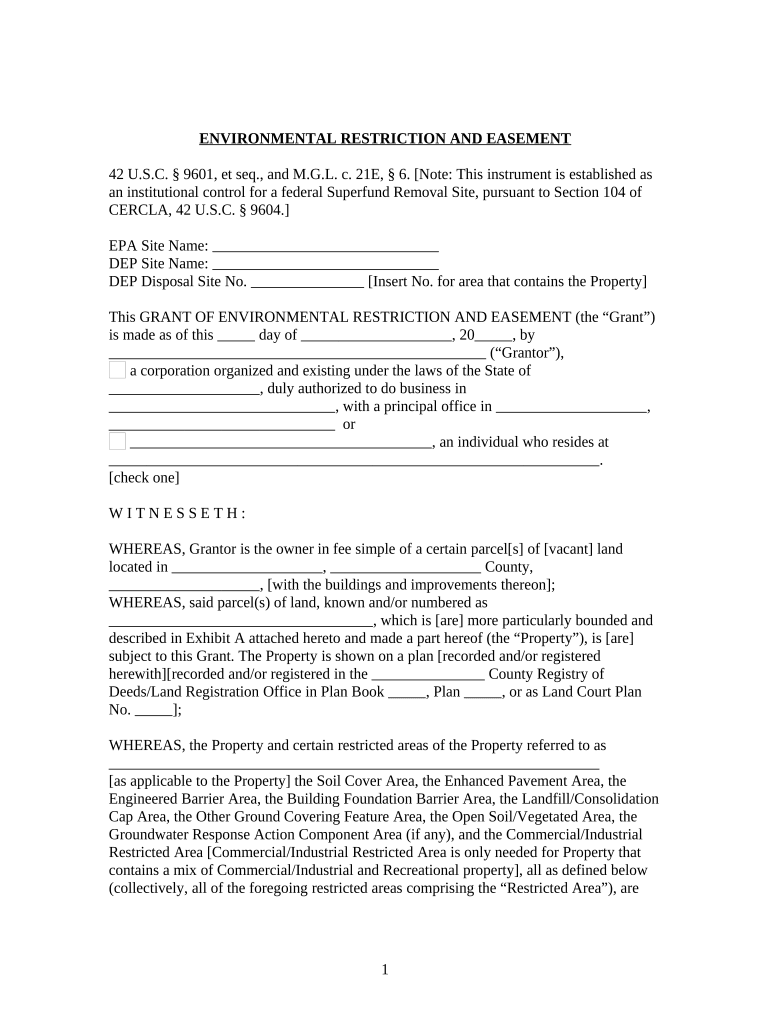
ENVIRONMENTAL RESTRICTION AND EASEMENT 42 U.S.C. § 9601, et seq., and M.G.L. c. 21E, § 6. [Note: This instrument is established as an institutional control for a federal Superfund Removal Site, pursuant to Section 104 of CERCLA, 42 U.S.C. § 9604.] EPA Site Name:                                     DEP Site Name:                                     DEP Disposal Site No.                   [Insert No. for area that contains the Property] This GRANT OF ENVIRONMENTAL RESTRICTION AND EASEMENT (the “Grant”) is made as of this       day of                         , 20       , by                                                             (“Grantor”), a corporation organized and existing under the laws of the State of                         , duly authorized to do business in                                     , with a principal office in                         ,                                     or                                                 , an individual who resides at                                                                               . [check one] W I T N E S S E T H : WHEREAS, Grantor is the owner in fee simple of a certain parcel[s] of [vacant] land located in                         ,                         County,                         , [with the buildings and improvements thereon]; WHEREAS, said parcel(s) of land, known and/or numbered as                                           , which is [are] more particularly bounded and described in Exhibit A attached hereto and made a part hereof (the “Property”), is [are] subject to this Grant. The Property is shown on a plan [recorded and/or registered herewith][recorded and/or registered in the                   County Registry of Deeds/Land Registration Office in Plan Book       , Plan       , or as Land Court Plan No.       ]; WHEREAS, the Property and certain restricted areas of the Property referred to as                                                                               [as applicable to the Property] the Soil Cover Area, the Enhanced Pavement Area, the Engineered Barrier Area, the Building Foundation Barrier Area, the Landfill/Consolidation Cap Area, the Other Ground Covering Feature Area, the Open Soil/Vegetated Area, the Groundwater Response Action Component Area (if any), and the Commercial/Industrial Restricted Area [Commercial/Industrial Restricted Area is only needed for Property that contains a mix of Commercial/Industrial and Recreational property], all as defined below (collectively, all of the foregoing restricted areas comprising the “Restricted Area”), are 1 subject to covenants, restrictions, easements and other rights and obligations under this Grant; the Restricted Area being shown on sheet number(s)       of a plan, [if unregistered land, add: consisting of             sheets, entitled “                                           ”, prepared by                               ,                                     ,                   , dated                                     , and recorded with the                   County Registry of Deeds on                         [insert date], in Plan Book       , Plan                         ;][if said land is registered land, add:             entitled “Sketch Plan,” and consisting of       sheets, which is attached hereto as Exhibit       and is made a part hereof;] as such plan may be revised by Grantor with the approval of Grantee and in accordance with the Consent Decree and the Statement of Work attached thereto (as defined below), to show the location of any Groundwater Response Action Component Area (to the extent that any such response action to address groundwater contamination at the Site has not been completed as of the date of this instrument); said plan, with any such revision, being collectively referred to herein as the “Plan of Restricted Area”; [Note: The Grant must include a legal description (by metes and bounds) of the Property that is subject to the Grant and a reference to a surveyed plan of the Property (upon which the legal description is based). This plan may be referenced in the Grant if already of record or may be recorded concurrently with the Grant. In some cases, while certain provisions of the Grant will affect the entire Property (such as the easements providing access and other rights), certain other provisions of the Grant (such as the restrictions on activities and uses) may affect only a portion of the Property. Such cases may include properties where EPA has determined (after a reasonable opportunity for review and comment by DEP) that a distinct portion of the Property meets the Performance Standards for residential use, as set forth in the Consent Decree and the SOW, or otherwise does not need to be subject to restrictions on activities and uses pursuant to the Consent Decree, and that such restrictions are necessary only for a discrete area within the Property (e.g., river or lake banks). In such cases, a reference to a recorded surveyed plan of the Property is insufficient, and (i) the Grant must also include a legal description (by metes and bounds) of the portion of the Property to be subject to the restrictions, and (ii) a separate surveyed plan must be prepared and Recorded and/or Registered (this plan should also show a perimeter survey of the Property, for purposes of locating the restricted portion, both within the larger parcel and relative to adjacent properties). In addition, regardless of whether the restrictions will apply to the entire Property or only a portion of the Property, if the Property will contain more than one type of restricted area (as defined below) or if different portions of the Property are to be subject to different restrictions or rights under the Grant (whether or not such areas or portions overlap), each such type of restricted or affected area must be described by metes and bounds and shown on the surveyed plan, as well. All restricted areas, collectively, are referred to as the “Restricted Area.” The plan showing the Restricted Area will be based upon                   ’s as-built plans for the Response Actions conducted at the Property. The surveyed plan must also show the location of the areas restricted as a result of the placement of any components of subsurface groundwater response actions such as slurry walls and sheet piling. It is anticipated that such components will have been installed for the                   at the time of the initial grants; but this requirement would 2 otherwise include revising and recording a revised surveyed plan, if the groundwater response action occurs after an ERE has been recorded on other affected properties. Such a revised plan must show the location of any new Groundwater Response Action Component Area and be accompanied by a notice, executed by                   and bearing the signed approval of Grantee, referencing such revised plan and noting that it is being recorded and/or registered in accordance with this Grant. In the event of any such revision, for unregistered land, a marginal note to the Plan Book and Page where the revised surveyed plan has been recorded must be made on the Grant, and a copy sent to the Grantor and Grantee.] WHEREAS, the UNITED STATES ENVIRONMENTAL PROTECTION AGENCY, a duly constituted agency organized under the laws of the United States of America and having a regional office at One Congress Street, Boston, Massachusetts 02114 (“EPA”), has identified a site, comprised of the             facility in Pittsfield, Massachusetts, the                   , and other areas, all as more particularly described in the Consent Decree (defined below), known as the “                   ” (the “Site”), as a result of the release of hazardous substances at or from the                   facility, as such terms are defined in the Comprehensive Environmental Response, Compensation, and Liability Act of 1980, as amended (“CERCLA”), 42 U.S.C. 9601 et seq.; WHEREAS, the                   DEPARTMENT OF ENVIRONMENTAL PROTECTION, a duly constituted agency organized under the laws of the Commonwealth of                   and having an office at                   (“DEP”), as a result of the release of oil and/or hazardous materials at the Site, as those terms are defined in the                                     , has placed the Site and/or portions of the Site on the                   List of Confirmed Disposal Sites and Locations To Be Investigated, pursuant to Chapter 21E, and has assigned to the portion of the Site containing the Property DEP Disposal Site Number(s)       , pursuant thereto; [use No. specific to area containing Property] WHEREAS, EPA regulates activities at hazardous substance disposal sites pursuant to CERCLA and the National Contingency Plan, 40 C.F.R. 300.400, et seq., as amended (the “NCP”), and DEP regulates activities at disposal sites pursuant to Chapter 21E respectively; WHEREAS, the Property is situated within the Site; WHEREAS,                   has entered into a Consent Decree in connection with the Site with the United States, the State of                   , and the Commonwealth of                   (the “Commonwealth”) in United States of America, State of                   , and Commonwealth of                   v.                   , Civil Action No.             , entered by the United States District Court for the District of                   on                         [date] (the “Consent Decree”); 3 WHEREAS, the Consent Decree and an accompanying Statement of Work (“SOW”) require the performance of certain Response Actions (as defined below) at the Site or portions thereof; WHEREAS, the Response Actions are ongoing at the Site and include work at the Property; WHEREAS, EPA has determined and the Consent Decree requires that certain easements, rights, obligations, covenants, and restrictions, as more particularly set forth below, are necessary at the Property and at a certain Restricted Area located within the Property, to conduct and ensure the protectiveness and integrity of the Response Actions; WHEREAS, DEP has provided EPA with review and comment on the Response Actions, and agrees with the need for easements, rights, obligations, covenants, and restrictions, as aforesaid; WHEREAS, because the Response Actions, as they affect the Property, are a Removal Action under CERCLA, EPA has requested that DEP accept a grant of such easements, rights, obligations, covenants, and restrictions, as aforesaid, pursuant to its authority under M.G.L. c. 21E, § 6; WHEREAS, Grantor has agreed to grant the aforesaid easements, rights, obligations, covenants and restrictions, as more particularly set forth below, to [DEP] and its assigns pursuant to the Consent Decree; NOW, THEREFORE, pursuant to the terms of the Consent Decree and in consideration of EPA’s and the Commonwealth’s agreement on behalf of DEP to settle certain of their claims against Grantor pursuant thereto, the receipt and sufficiency of which consideration is hereby acknowledged, GRANTOR does hereby COVENANT AND DECLARE that the Property shall be subject to the restrictions on activity and use set forth below, and does GIVE, GRANT AND CONVEY to                               (“Grantee”), with QUITCLAIM COVENANTS, (1) the perpetual right to enforce said activity and use restrictions, and (2) an environmental protection and access easement of the nature and character, and for the purposes hereinafter set forth, with respect to the Property (collectively, the “Environmental Restriction and Easement”). Said Environmental Restriction and Easement is subject to the following terms and conditions: 1. Purpose. It is the purpose of this instrument to establish covenants, restrictions and easements, all of which shall run with the land, to facilitate the cleanup of environmental contamination and to protect human health and the environment by reducing the risk of exposure to contaminants. 2. Definitions . For purposes of this instrument, the following terms shall have the following meanings: [A given grant will only list the relevant definitions.] 4 A. “Building Foundation Barrier Area” shall mean those areas of the Property designated as such on the Plan of Restricted Area; such areas are generally areas where building demolition debris has been placed into an existing building foundation and where a permanent barrier has been constructed and will be maintained to isolate and contain underlying building debris and other materials. B. “Commercial/Industrial Restricted Area” shall mean those areas of the Property designated as such on the Plan of Restricted Area, bounded and described in Exhibit B [legal description (by metes and bounds)], attached hereto and made a part hereof. [Commercial/Industrial Restricted Area is only needed for Property that contains a mix of Commercial/Industrial and Recreational property.] C. “Engineered Barrier Area” shall mean those areas of the Property designated as such on the Plan of Restricted Area; generally such areas contain permanent caps designed, constructed, and maintained to isolate and contain underlying soils and other materials. Such caps include either a vegetated cover or an asphalt cover, a drainage layer, and an impermeable membrane liner, as described in Attachment G of the SOW; D. “Enhanced Pavement Area” shall mean those areas of the Property designated as such on the Plan of Restricted Area; such areas generally are areas where the overall integrity of the pavement has been increased in order to minimize the potential for contact with the underlying soil, such that the pavement consists of a minimum four (4) inch thickness, and is constructed as described in Attachment G of the SOW; E. “                   Plastics Area” shall mean the area of the Property designated as such on the Plan of Restricted Area, bounded and described in Exhibit B’, attached hereto and made a part hereof; generally this is the area where the GE Plastics buildings and operations are situated. [This definition is only needed for an ERE Grant on Property that contains the GE Plastics Area] F. “Groundwater Response Action Component Area” shall mean those areas of the Property designated as such on the Plan of Restricted Area; generally such areas contain components of the response action for groundwater at the Property, if any. G. “Health and Safety Protocol” shall mean the Health and Safety Protocol attached hereto as Exhibit C and incorporated herein by reference. H. “Landfill/Consolidation Area Cap Area” shall mean those areas of the Property designated as such on the Plan of Restricted Area; generally such areas contain a capping system that includes several enhancements to the engineered barriers, as described in Attachment G of the SOW; I. “Licensed Site Professional” or “LSP” each shall mean a hazardous waste site cleanup professional, as defined in M.G.L. c. 21A, § 19, holding a valid license issued by the Board of Registration of Hazardous Waste Site Cleanup Professionals, pursuant to M.G.L. c. 21A, §§ 19 through 19J..6 J. “Open Soil/Vegetated Area” shall mean, collectively, those areas of the Property designated as such on the Plan of Restricted Area; such areas consist of any and all areas of the Restricted Area [use “Property” if Restricted Area boundary is coincident with Property boundary - see note after third “WHEREAS” Clause above] other than the Surface Cover Area and the Other Ground Covering Feature Area. K. “Other Ground Covering Feature Area” shall mean, collectively, those areas of the Property designated as such on the Plan of Restricted Area; such areas are where building foundations (other than those described in subparagraph 2.A above), interior slabs, exterior 5 slabs, paving and concrete (other than those.7 described in subparagraph 2.D above) are located. L. “Recorded and/or Registered” and its various conjugations shall mean, as to unregistered land, recorded with the appropriate registry of deeds; and as to registered land, filed with the appropriate land registration office; each conjugated as appropriate; M. “Response Actions” shall mean the environmental response actions required to be undertaken at the Site or portions thereof pursuant to the Consent Decree and SOW (designated as Removal Actions under CERCLA), including (but not limited to) source control measures, soil removal, capping of contaminated soil, groundwater monitoring and (if necessary) response actions to address groundwater contamination, other actions to address existing contamination, institutional controls in the nature of restrictive covenants to prevent certain activities and uses at various properties, and certain operation and maintenance activities necessary to maintain the effectiveness of the response actions. N. “Soil Cover Area” shall mean those areas of the Property designated as such on the Plan of Restricted Area; generally such areas are areas where the potential for contact with the underlying soil and other materials has been minimized, without restricting water from migrating into and through the soil cover, and contain a demarcation layer and at least one foot of clean soil placed over contaminated soil, as described in Attachment G of the SOW; O. “Soil Management Protocol” shall mean the Soil Management Protocol attached hereto as Exhibit D and incorporated herein by reference. P. “Statement of Work” or “SOW” shall mean the Statement of Work for Removal Actions Outside the River, which is Appendix E of the Consent Decree; Q. “Surface Cover Area” shall mean, collectively, the Soil Cover Area, the Enhanced Pavement Area, the Engineered Barrier Area, the Building Foundation Barrier Area, and the Landfill/Consolidation Area Cap Area. R. “Utility Work” shall mean the maintenance and repair of pipes, lines and other such conveyances for water, sewer, storm-water, steam, gas, fuel oil, electricity, and communications, but not the installation of new pipes, lines, or other such conveyances..8 [The following version of Paragraph 3 applies to property that is entirely Commercial/Industrial or entirely Recreational.] 3. Restricted Activities and Uses. Except as provided in Paragraph 4 (“Permitted Activities and Uses”), Paragraph 6 (“Conditional Exceptions From Restricted Activities and Uses”) and/or Paragraph 8 (“Emergency Excavation”), Grantor shall not perform, suffer, allow or cause any person to perform any of the following activities or uses in, on, upon, through, over or under the Restricted Area [use “Property” if Restricted Area boundary is coincident with Property boundary - see note after third “WHEREAS” Clause above] or portions thereof: A. residential activity or use; B. day care and educational (for children under eighteen (18) years of age) activity or use; C. community center (for children under eighteen (18) years of age) activity or use; [Note: omit this restriction for Recreational property.] D. recreational activity or use; [Note: omit this restriction for Recreational property.] E. agricultural activity or use; 6 F. extraction, consumption, or utilization of groundwater underlying the Property, including without limitation, extraction for potable, industrial, irrigation, or agricultural use; G. excavation, digging, drilling, or other intrusive activity into or disturbance of the surface of the ground and/or the underlying soil; [In appropriate cases, this restriction can be made applicable to a smaller area than the other restrictions, provided that any revisions to this Model ERE necessary to effect such change shall be subject to the approval process set forth in the Consent Decree; further provided that                   may voluntarily consult with EPA and DEP regarding any such revision prior to submitting the executed ERE for approval.] H. constructing or placing buildings or structures; and [Note: This restriction is only for the                   -owned properties at                   . Also, this restriction does not apply if                   chooses either of the first two options for designating averaging areas as set forth in Section 2.1, first bulleted paragraph, subparagraphs a. and b. of Attachment E (Protocols for Spatial Averaging) to the SOW. Further, in appropriate cases (where this restriction applies), this restriction can be made applicable to a smaller area than the other restrictions, provided that any revisions to this Model ERE necessary to effect such change shall be subject to the approval process set forth in the Consent Decree; further provided that                   may voluntarily consult with EPA and DEP regarding any such revision prior to submitting the executed ERE for approval.] I. any activity or use that would interfere with, or would be reasonably likely to interfere with, the implementation, operation, or maintenance of any aspect or component of the Response Actions already constructed or under construction, or of which Grantor has notice, including without limitation, interference with any component of the Response Actions situated within the Surface Cover Area, any groundwater contaminant containment measures or barriers situated within the Groundwater Response Action Component Area (if any), or any groundwater monitoring wells[; or exceeding the bearing load or piercing any barrier or membrane situated within the Engineered Barrier Area, the Building Foundation Barrier Area, or the Landfill/Consolidation Area Cap Area]. [Last clause to be included only where such areas are present.] [The following version of Paragraph 3 applies to any Property that contains a mix of Commercial/Industrial and Recreational areas.] 3. Restricted Activities and Uses. Except as provided in Paragraph 4 (“Permitted Activities and Uses”), Paragraph 6 (“Conditional Exceptions From Restricted Activities and Uses”) and/or Paragraph 8 (“Emergency Excavation”), Grantor shall not perform, suffer, allow or cause any person to perform any of the following activities or uses in, on, upon, through, over or under the following parcels and portions thereof, as such parcels and portions thereof are shown on the aforementioned Plan of Restricted Areas: A. The Restricted Area: [Use “Property” if Restricted Area boundary is coincident with Property boundary] i. residential activity or use; ii. day care and educational (for children under eighteen (18) years of age) activity or use; and iii. agricultural activity or use; 7 iv. extraction, consumption, or utilization of groundwater underlying the Property, including without limitation, extraction for potable, industrial, irrigation, or agricultural use; v. excavation, digging, drilling, or other intrusive activity into or disturbance of the surface of the ground and/or the underlying soil; [In appropriate cases, this restriction can be made applicable to a smaller area than the other restrictions, provided that any revisions to this Model ERE necessary to effect such change shall be subject to the approval process set forth in the Consent Decree; further provided that GE may voluntarily consult with EPA and DEP regarding any such revision prior to submitting the executed ERE for approval.]. vi. constructing or placing buildings or structures; and [Note: This restriction is only for the GE-owned properties at GE Plant Area. Also, this restriction does not apply if GE chooses either of the first two options for designating averaging areas as set forth Section 2.1, first bulleted paragraph, subparagraphs a. and b. of Attachment E (Protocols for Spatial Averaging) to the SOW. Further, in appropriate cases (where this restriction applies), this restriction can be made applicable to a smaller area than the other restrictions, provided that any revisions to this Model ERE necessary to effect such change shall be subject to the approval process set forth in the Consent Decree; further provided that GE may voluntarily consult with EPA and DEP regarding any such revision prior to submitting the executed ERE for approval.] viii. any activity or use that would interfere with, or would be reasonably likely to interfere with, the implementation, operation, or maintenance of any aspect or component of the Response Actions already constructed or under construction, or of which Grantor has notice, including without limitation, interference with any component of the Response Actions situated within the Surface Cover Area, any groundwater contaminant containment measures or barriers, or groundwater monitoring wells[; or exceeding the bearing load or piercing any barrier or membrane situated within the Engineered Barrier Area, the Building Foundation Barrier Area, or the Landfill/Consolidation Area Cap Area]. [Last clause to be included only where such areas are present.] B. The Commercial/Industrial Restricted Area: i. recreational activity or use; and ii. community center (for children under eighteen (18) years of age) activity or use. 4. Permitted Activities and Uses. Grantor reserves the right to perform, suffer, allow or to cause any person to perform any activity in, on, upon, through, over or under the Property, or make any use of the Property, that is not restricted by the provisions of this Environmental Restriction and Easement. In addition, Grantor may perform, suffer, allow or cause any person to perform the uses and activities set forth below in, on, upon, through, over or under the Property and the Restricted Area, set forth below, or portions of either. Except for the permitted activities and uses allowed pursuant to subparagraphs 4.A. and 4.B below, and except as otherwise provided in subparagraph 4.F below, all such activities and uses shall only be conducted in accordance with the Soil Management Protocol and the Health and Safety Protocol, as applicable, as set forth below. Grantor shall restore the Property, or any portion thereof, affected by any activity or use permitted under subparagraphs 4.A through 4.D and 4.F to its prior condition immediately upon completion of such activity or use, also in accordance with the Soil Management Protocol and the 8 Health and Safety Protocol (except for permitted activities and uses allowed pursuant to subparagraph 4.A. and 4.B and except as otherwise provided in subparagraph 4.F below). [Note the cross-references, below, are based on the first version, above, of Paragraph 3.] A. Surface Excavation of Ten (10) Cubic Yards or Less. Notwithstanding the restrictions set forth in subparagraph 3.G., excavation, digging, drilling, or other intrusive activity into or disturbance of the surface of the ground and/or the underlying soil in the Open Soil/Vegetated Area and the Soil Cover Area, solely within the top one (1) foot of the surface of the ground, of no more than ten (10) cubic yards of such materials, in the aggregate, on a per project basis, shall be permitted. Grantor shall not segment a project to avoid the ten (10) cubic yard limitation established by this subparagraph 4.A. In conducting activities and uses pursuant to this subparagraph, Grantor shall comply with the following requirements: i. Such surface excavation shall be conducted in a timely fashion so as to minimize the time when excavated areas are open and/or excavated materials are stored in the Soil Cover Area or the Open Soil/Vegetated Area to the minimum time practicable for such activity or use; provided, however, that the duration of such excavation or storage shall not exceed fourteen (14)days. ii. Grantor shall take appropriate measures to secure stored soil and to control erosion, dust, and runoff. iii. Grantor shall (a) backfill excavations to the original surface grade with clean soil or soil excavated from the Soil Cover Area or the Open Soil/Vegetated Area solely from the top one (1) foot of the surface of the ground; (b) replace and repair any aspect or component of the Response Actions situated within the Soil Cover Area; and reestablish any disturbed vegetation. iv. Grantor shall provide Grantee with written notice of each such surface excavation project no later than thirty (30) days after completion, and shall use the form attached hereto as Exhibit E for such notice, as such form may be modified in writing from time to time by Grantee; provided, however, that any such project where the total amount of soil that has been or will be excavated is less than five (5) cubic feet shall not be subject to the foregoing notification requirement. v. Grantor shall not store or dispose of any excavated material outside of the Soil Cover Area or the Open Soil/Vegetated Area. B. Surface Excavation of any Volume. Notwithstanding the restrictions set forth in subparagraph 3.G., excavation, digging, drilling, or other intrusive activity into or disturbance of the surface of the ground and/or the underlying soil in the Open Soil/Vegetated Area and the Soil Cover Area, solely within the top one (1) foot of the surface of the ground, of any volume of such materials shall be permitted. In conducting work pursuant to this subparagraph, Grantor shall comply with the requirements listed above in subparagraphs 4.A.i through 4.A.iv, and the following additional requirements: i. Grantor shall utilize an LSP to oversee the surface excavation permitted pursuant to this subparagraph. ii. Disposal of excavated materials off of the Property shall be permitted provided that an LSP oversees such disposal and that the Grantor complies with the provisions of 9 Paragraph 9 of the Soil Management Protocol regarding off-Property disposal of soil and other materials. C. Surface and/or Subsurface Excavation of Ten (10) Cubic Yards or Less. Notwithstanding the restrictions set forth in subparagraph 3.G., excavation, digging, drilling, or other intrusive activity into or disturbance of the surface of the ground and/or the underlying soil in the Open Soil/Vegetated Area, the Soil Cover Area, the Enhanced Pavement Area and the Other Ground Covering Feature Area, of no more than ten (10) cubic yards of such materials, in the aggregate, on a per project basis, shall be permitted. Grantor shall not segment a project to avoid the ten (10) cubic yard limitation established by this subparagraph 4.C. In conducting work pursuant to this subparagraph, Grantor shall comply with the following requirements: i. Grantor shall utilize an LSP to oversee the excavation permitted pursuant to this subparagraph, including without limitation, the disposal of soil and other material. All activities and uses permitted pursuant to this subparagraph shall be conducted in accordance with the Soil Management Protocol and the Health and Safety Protocol. ii. Such excavation shall be conducted in a timely fashion so as to minimize the time when excavated areas are open and/or excavated materials are stored on the Property to the minimum time practicable for such activity or use; provided, however, that the duration of such excavation shall not exceed fourteen (14) days. Any materials (e.g., soils, sediments, and personal protective equipment) excavated, collected, placed, used and/or stored on the Property or elsewhere, in connection with such excavation, shall be properly disposed of within ninety (90) days from the date of such initial storage or within such longer time as is permitted under any applicable state or federal law or regulation. iii. Grantor shall provide Grantee with written notice of each such project no later than thirty (30) days after completion. Grantor shall use the form attached hereto as Exhibit E for such notice, as such form may be modified in writing from time to time by Grantee. D. Surface and/or Subsurface Excavation for Utility Work. Notwithstanding the restrictions set forth in subparagraph 3.G., excavation, digging, drilling, or other intrusive activity into or disturbance of surface of the ground and/or the underlying soil in the Open Soil/Vegetated Area, the Soil Cover Area, the Enhanced Pavement Area, and the Other Ground Covering Feature Area, for the purpose of Utility Work, shall be permitted. In conducting Utility Work pursuant to this subparagraph, Grantor shall comply with the following requirements: i. All such Utility Work shall be conducted in accordance with the Soil Management Protocol and the Health and Safety Protocol. Grantor shall utilize an LSP to oversee all such activities and uses, including without limitation, the disposal of soil and other materials. ii. Such Utility Work shall be conducted in a timely fashion so as to minimize the time when excavated areas are open and/or excavated materials are stored on the Property to the minimum time practicable for such activity or use; provided, however, that the duration of such excavation shall not exceed fourteen (14) days. Any materials (e.g., soils, sediments, and personal protective equipment) excavated, collected, placed, used and/or stored on the Property or elsewhere, in connection with such excavation, shall be properly disposed of 10 within ninety (90) days from the date of such initial storage or within such longer time as is permitted under any applicable state or federal law or regulation. iii. Grantor shall give Grantee fifteen (15) days’ advance written notice prior to conducting any activities and uses pursuant to this subparagraph 4.D. E. Construction or Placement of Buildings or Structures. Notwithstanding the restrictions set forth in subparagraph 3.H., the construction or placement of buildings or structures in the Open Soil/Vegetated Area, the Soil Cover Area, the Enhanced Pavement Area, and the Other Ground Covering Feature Area shall be permitted, unless (i) the construction or placement of the building or structure creates a distinct area of exposure to contaminants, pollutants, hazardous materials, or hazardous substances that is different from the spatial averaging area shown on Exhibit F [Exhibit F shall be Figure E-1 of the SOW] containing the proposed building or structure; and (ii) such different exposure area created by the building or structure does not meet the applicable Performance Standards for such area as set forth in the Consent Decree. As provided below in subparagraph 4.H, all other restrictions set forth in Paragraph 3 (“Restricted Activities and Uses”) and activities and uses permitted pursuant to Paragraph 4 (“Permitted Activities and Uses”) shall apply the construction or placement of buildings or structures permitted under this subparagraph 4.E. [Note: This permitted use is only for the                   -owned properties at                   . Also, this permitted use does not apply if                   chooses either of the first two options for designating averaging areas as set forth Section 2.1., first bulleted paragraph, subparagraphs a. and b. of Attachment E (Protocols for Spatial Averaging) to the SOW.] F. Sampling. Notwithstanding the restrictions set forth in subparagraphs 3.F and 3.G., soil and groundwater sampling activities shall be permitted in the Open Soil/Vegetated Area, the Soil Cover Area, the Enhanced Pavement Area and the Other Ground Covering Feature Area; provided that Grantor shall utilize an LSP to oversee such sampling; and further provided that all such activities and uses shall be conducted in accordance with the Soil Management Protocol and the Health and Safety Protocol. While                   continues to own and control the Property, the foregoing requirements to utilize an LSP and to comply with the Soil Management Protocol shall not apply to soil or groundwater sampling activities conducted by or under the oversight of                   personnel or contractors familiar with the terms of this Grant and pursuant to a plan for sampling that takes into account contaminated media at the Property and has been approved by EPA or DEP, with notice to Grantee. The foregoing sentence shall run to the benefit of                   alone, not to any successors or assigns, and shall not run with the land. G. Groundwater Extraction Pursuant to Permit. Notwithstanding the restrictions set forth in subparagraph 3.F, extraction of groundwater in accordance with the provisions of Water Withdrawal Permit (Permit Number 9P-1-02-236.01) issued pursuant to the                   Water Management Act and attached hereto as Exhibit G, at wells number 3, 4, 5, and 6, at the locations described in said Permit, shall be permitted. 11 H. All other restrictions set forth in Paragraph 3 (“Restricted Activities and Uses”) shall apply to the activities and uses permitted to this Paragraph 4 ( “Permitted Activities and Uses”). 5. Obligations and Conditions. Grantor affirmatively agrees to perform the following activities at the Property and/or Restricted Area: A. If Grantor observes or otherwise becomes aware of evidence of any failure or other significant alteration of any Surface Cover, including without limitation (i) exposure of or damage to any drainage layer, synthetic barrier, or liner; (ii) uneven settlement relative to surrounding areas; or (iii) damage to Enhanced Pavement or the pavement cover of an Engineered Barrier or other Surface Cover components such as fissures, large cracks, or potholes; then Grantor shall notify Grantee and EPA [,and DEP, if DEP is not the Grantee] thereof in writing within five (5) business days thereafter, with a copy to                   , if                   is not the Grantor. B. Any utility repair, maintenance or installation conducted in confined spaces shall comply with the Health and Safety Protocol. 6. Conditional Exceptions from Restricted Activities and Uses. Grantor may requestfrom Grantee a conditional exception from one or more of the restricted activities or uses set forth in Paragraph 3 (“Restricted Activities and Uses”) for a particular proposed activity or use and any related work, which would otherwise temporarily violate such restriction(s). Such request shall be submitted to Grantee in accordance with and shall be subject to all of the following: A. Submittal Requirements. All requests for conditional exceptions shall, at a minimum: i. include a written description and/or plans of the proposed activity or use and other relevant information; ii. identify the Restricted Area or types of restricted areas for which the conditional exception is requested; iii. identify the specific restriction(s) from which the conditional exception is requested, and explain the need for the exception; iv. state the duration of the activity or use and any related work for which the conditional exception is requested, including a proposed termination date for the conditional exception; and v. if required pursuant to subparagraph 6.B, below, include (a) a determination by an appropriately trained and licensed professional, such as an LSP, that the proposed activity and use and any related work for which the conditional exception is requested would satisfy the human health and environmental risk standard set forth in subparagraph 6.C., and (b) supporting technical analysis upon which such determination is based. B. Requirement to Use an Appropriately Trained and Licensed Professional; Request for Waiver. An appropriately trained and licensed professional, such as an LSP, shall make the risk determination required in subparagraph 6.A.v., unless waived by Grantee pursuant to this subparagraph 6.B. Grantor may request Grantee to waive such requirement, if appropriate under the circumstances, for example, if a particular proposed activity and use and any related work is de minimis. In the event of such a request or on its own initiative, 12 Grantee, in its sole discretion, may waive such requirement taking into consideration the nature and scope of a particular proposed conditional exception request. Any such waiver must be in writing. A waiver for one conditional exception request shall not be deemed to be a waiver for any future conditional exception request. C. Human Health and Environmental Risk Standard. Grantor shall demonstrate, in accordance with the procedures set forth in subparagraphs 6.A. and 6.B., that the activity or use and any related work for which a particular conditional exception is requested would not result in an unacceptable risk to human health or the environment, pursuant to the criteria set forth at 40 C.F.R. § 300.430(e)(2)(i), as amended, or interfere with the integrity or effectiveness of the Response Actions. Such demonstration shall include, but not be limited to, consideration of the following factors, as applicable: i. potential exposure to or release of hazardous substances; ii. potential adverse impacts of the proposed activity or use on any Surface Cover or on surface water runoff pathways; iii. potential creation of pathways of contaminant migration; iv. potential impact on groundwater and any non-aqueous-phase liquids (NAPL); v. management plans for excavated contaminated materials, including handling and disposal; vi. appropriate worker health and safety plans; and vii. whether the proposed activity or use and any related work would interfere with the implementation, operation and/or maintenance of the Response Actions and if so, whether the proposed activity or use is necessary to reduce a threat to human health or the environment. D. Other Relevant Considerations. In reviewing a proposed conditional exception request, Grantee may consider Grantor’s financial and/or technical ability to perform the necessary response work in connection with such request. Grantee may also consider any other relevant matters related to the human health and environmental risk standard set forth in subparagraph 6.C., above. E. Completeness Determination, Review and Response. i. If Grantee determines that Grantor’s conditional exception request is sufficient and complete for purposes of review, Grantee shall review such request. If necessary, Grantee may notify Grantor of any deficiencies in Grantor’s request, and may provide Grantor with an opportunity to submit supplemental information. ii. Except as provided for in subparagraph 6.G., Grantee, upon completion of its review of any conditional exception request, based upon whether the human health and environmental risk standard set forth in subparagraph 6.C. would be satisfied, and upon the other relevant considerations set forth in subparagraph 6.D., shall determine whether the requested conditional exception is appropriate and, if so, shall issue the conditional exception. If Grantee determines that the requested conditional exception is not appropriate, then Grantee shall issue a written explanation. Grantee may condition its issuance of a conditional exception as appropriate, including without limitation, upon the results of future sampling and/or testing. iii. All conditional exceptions must be in writing and signed by Grantee. 13 F. Interim and Closeout Report Requirements. During and/or upon completion of the activity or use and any related work for which the conditional exception was obtained, upon request by Grantee, Grantor shall submit a written report confirming that such activity or use and related work was or is being implemented in accordance with the conditional exception, including in accordance with the representations in Grantor’s conditional exception request submittal regarding the requirements set forth in subparagraphs 6.C. and 6.D. Such report shall be prepared and signed by an appropriately trained and licensed professional, such as an LSP, unless pursuant to subparagraph 6.B. Grantee previously waived the requirement to include a risk determination and supporting technical analysis by such professional. G. Applicability of Amendment Provision to Conditional Exception Requests. Any conditional exception request for an activity or use and any related work which, in the judgment of Grantee, would result in a permanent modification to an activity or use restriction established in Paragraph 3 (“Restricted Activities and Uses”), including without limitation, to the boundary of the Restricted Area or any particular type of restricted area, shall require an amendment to this instrument in lieu of a conditional exception, in accordance with Paragraph 15 (“Amendment and Release”). 7. Applicability. The restrictions set forth in Paragraph 3 (“Restricted Activities and Uses”) shall not apply to any response action undertaken by EPA or DEP, or their respective agents, representatives, contractors, subcontractors or employees, pursuant to CERCLA or Chapter 21E, and their respective implementing regulations. In addition, the restrictions set forth in subparagraphs 3.F through 3.I [based upon the first version of Paragraph 3] shall not apply to any of the following activities conducted by GE, or its employees, contractors, or subcontractors, pursuant to the Consent Decree and/or the SOW, as approved by EPA (which approval shall be after a reasonable opportunity for review and comment by DEP), for purposes of implementing or monitoring the Response Actions, provided that such activities do not permanently modify the boundary of the Restricted Area or of any particular type of restricted areas: soil or groundwater sampling; excavation, digging, drilling, or other intrusive activity into or disturbance of the surface of the ground and/or the underlying soil; and/or groundwater extraction. 8. Emergency Excavation. If it becomes necessary to excavate a portion of the Property, as part of a response to an emergency (e.g., repair of utility lines or responding to fire or flood), any activity and use restriction provisions of Paragraph 3 (“Restricted Activities and Uses”) above, which would otherwise restrict such excavation, shall be suspended with respect to such excavation for the duration of such emergency response, provided that Grantor: A. Limits the actual disturbance involved in such excavation to the minimum reasonably necessary to adequately respond to the emergency; B. Implements all measures necessary to limit actual or potential risk to the public health and environment arising from the emergency and the response thereto; C. Undertakes precautions to minimize exposure of workers and neighbors of the Property to the hazardous substance or material; and 14 D. Utilizes an LSP (except as provided in the last sub-paragraph of this Paragraph 8) to oversee the implementation of the terms of this Paragraph 8 (“Emergency Excavation”), and to prepare and oversee the implementation of a written plan which, in said professional’s opinion, will restore the Property to a condition consistent with its condition before the emergency excavation took place, with minimal disturbance of the contaminated soils; said plan to be subject to the Soil Management and the Health and Safety Protocols, as applicable; said plan to be promptly prepared and implemented; a copy of said plan to be submitted to EPA and DEP within ten (10) days of its performance, together with a completed Post-Work Notification Form, attached hereto as Exhibit E, with a statement from said LSP that the Property has been restored to said condition; provided, however, that in cases where only minimal excavation has occurred such that there has been no significant impact on the protectiveness of the Response Actions, Grantor may request Grantee to allow the Grantor to prepare and submit the plan and statement, without utilizing the services of the otherwise required LSP. In addition, Grantor shall notify the EPA Emergency Response Unit and the DEP                   Regional Office Emergency Response Section, or such other party as EPA or DEP may identify in writing to Grantor, of such emergency as soon as possible but no more than two (2) hours after having learned of such emergency. The following provisions shall run to the benefit of GE alone, but not to any successor or assign, and shall not run with the land: i. While                   continues to own and control the Property, to the extent that                   is unable practicably to utilize an LSP to oversee the implementation of this Paragraph 8 (as required by subparagraph 8.D, above) due to the time-critical nature of the emergency, GE may instead utilize a similarly trained and experienced                   employee during the emergency to satisfy said requirement, provided that such employee: (a) is experienced in overseeing excavation and management of contaminated media; (b) is familiar with health and safety considerations, including proper use of personal protective equipment; (c) is familiar with regulatory requirements for sampling and management of hazardous material; (d) is familiar with the relevant requirements of this Grant, the Consent Decree and the SOW; and (e) has appropriate environmental science or engineering training and experience and other appropriate educational background ii. While                   continues to own and control the Property,                   may, at its option, utilize a consultant, under the supervision of an LSP, to prepare the above-described written plan (as required by subparagraph 8.D., above). 9. Grant of Easements. In establishing this Environmental Restriction and Easement, Grantor hereby grants the following easements for the term of this Grant to Grantee, its agents, representatives, contractors, subcontractors and employees: A. An easement to pass and repass over the Property for the purpose of inspecting the Property to ensure compliance with and fulfillment of the terms of this Environmental Restriction and Easement; and 15 B. An easement in, on, upon, through, over and under the Property, except for the                   , [only necessary for ERE Grant on                   Property where the                   is located] for the following purposes: i. constructing, implementing, monitoring, and performing the Response Actions and operation and maintenance for the Response Actions; ii. assessing the need for, planning, or implementing other response actions at the Site; iii. verifying any data or information submitted to EPA or DEP; iv. surveying and obtaining samples; v. installing groundwater monitoring wells and extraction wells; vi. conducting investigations relating to contamination at or near the Site; and vii. determining whether additional activity or use restrictions are necessary. [subparagraph C, following, is only necessary for ERE Grant on                   Property where                   factory is located] C. An easement in, on, upon, through, over and under all locations within the GE Plastics Area where Work (as defined in the Consent Decree) is being performed or as necessary to conduct any activity pursuant to the Consent Decree, at all reasonable times and upon reasonable notice, for the following purposes: i. constructing, implementing, monitoring, and performing the Response Actions and operation and maintenance for the Response Actions; ii. assessing the need for, planning, or implementing other response actions at the Site; iii. verifying any data or information submitted to EPA or DEP; iv. surveying and obtaining samples; v. installing groundwater monitoring wells and extraction wells; vi. conducting investigations relating to contamination at or near the Site; and vii. determining whether additional activity or use restrictions are necessary. 10. Severability. Grantor agrees, in the event that a court or other tribunal determines that any provision of this instrument is invalid or unenforceable: A. That any such provision shall be deemed to have been modified automatically to conform to the requirements for validity and enforceability as determined by such court or tribunal; or B. That any such provision that, by its nature, cannot be so modified, shall be deemed deleted from this instrument as though it had never been included. Such modifications and deletions shall be deemed effective as of the date of the determination of the court or other tribunal. In either case, the remaining provisions of this instrument shall remain in full force and effect. 11. Enforcement. Grantor expressly acknowledges that a violation of the terms of this instrument could result in the following: A. The assessment of penalties and other action by DEP to enforce the terms of this Environmental Restriction and Easement, pursuant to Chapter 21E and the MCP; and/or B. Upon a determination by a court of competent jurisdiction, the issuance of criminal and civil penalties, and/or equitable remedies, which could include the issuance of an order to (i) modify or remove any improvements constructed in violation of the terms of this 16 Environmental Restriction and Easement at Grantor’s sole cost and expense or (ii) to reimburse the Commonwealth and the United States for any costs incurred in modifying or removing any improvement constructed in violation of the terms of this Environmental Restriction and Easement. [This language in Paragraph 11 assumes that DEP will be the Grantee.] 12. Provisions to Run With the Land. The land use restrictions, obligations, and access rights provided herein establish certain rights, liabilities, agreements and obligations upon and subject to which the Property or any portion thereof, shall be improved, held, used, occupied, leased, sold, hypothecated, encumbered, or conveyed. The rights, liabilities, agreements and obligations herein set forth shall run with the Property for the term of this instrument, as applicable thereto, and any portion thereof, and shall inure to the benefit of Grantee and its assigns and be binding upon Grantor and all parties claiming by, through or under Grantor. Grantor hereby covenants for himself and his executors, administrators, heirs, successors and assigns, to stand seized and hold title to the Property, or any portion thereof, subject to these land use restrictions, access rights, and other provisions of this Grant; provided, however, that a violation of these land use restrictions, access rights, and other provisions shall not result in a forfeiture or reversion of Grantor’s title to the Property. 13. Concurrence Presumed. It is agreed that: A. Grantor and all parties claiming by, through or under Grantor shall be deemed to be in accord with the provisions herein set forth; and B. Grantor and all such parties agree for and among themselves and any party claiming by, through or under them, and their respective agents, contractors, sub- contractors and employees, that the land use restrictions and access rights herein established shall be adhered to and not violated and that their respective interests in the Property shall be subject to the provisions herein set forth. 14. Incorporation into Deeds, Mortgages, Leases and Instruments of Transfer. Grantor hereby agrees to incorporate this instrument, in full or by reference, into all deeds, easements, mortgages, leases, licenses, occupancy agreements or any other instrument of transfer by which an interest in and/or a right to use the Property, or any portion thereof, is conveyed; provided, however, that any failure of Grantor to do so shall not affect the validity or applicability of the provisions of Paragraph 12. 15. Amendment and Release. A. Amendment at Grantee’s Request. i. Grantee may request Grantor to amend this instrument. Grantor hereby further agrees to execute any such amendment which Grantee reasonably deems necessary for the effective administration of this instrument; provided, however, that such amendment shall be limited to procedural matters hereunder. Accordingly, the foregoing obligation shall not obligate Grantor to impose additional substantive restrictions on the Property, beyond those listed in Paragraph 3 (“Restricted Activities and Uses”); nor to impose additional substantive limitations on the permitted activities and uses set forth in Paragraph 4 (“Permitted Activities and Uses”); nor to impose additional substantive obligations and 17 conditions upon Grantor, beyond those set forth in Paragraph 5 (“Obligations and Conditions”). All amendments shall include Grantee’s signed approval and shall become effective upon Recordation and/or Registration. ii. Notwithstanding the foregoing, if Grantor is not                   , Grantor expressly acknowledges and agrees that the within Grant includes the right of                   , in accordance with the Consent Decree, with notice to Grantor and written approval of Grantee, to Record and/or Register a revised Plan of Restricted Area indicating the location of any Groundwater Response Action Component Area and associated notice thereof. The Recordation and/or Registration of any such revised Plan of Restricted Area and associated notice thereof shall not be deemed an amendment to this Grant, but rather the exercise of rights established by, and effective upon the Recording and/or Registration of, this Grant. B. Amendment at Grantor’s Request. Grantor may amend this instrument only with the prior, written approval of the Grantee. Grantor may propose to Grantee an amendment of an activity or use restriction set forth in Paragraph 3 (“Restricted Activities and Uses”) or of a permitted use set forth in Paragraph 4 (“Permitted Activities and Uses”), based upon changed circumstances, including, without limitation, new analytic and engineering data or a Grantor proposal to perform additional remediation at the Property. In the event that Grantor requests such an amendment, Grantor shall provide such information as Grantee may require for review of such a request, including without limitation, information that addresses the considerations set forth in Paragraph 6 (“Conditional Exceptions from Restricted Activities and Uses”), as applicable, and an explanation of the changed circumstances. If Grantee determines that any amendment to this Grant proposed by Grantor is not appropriate, then Grantee shall issue a written explanation. C. Release. This instrument may be released, in whole or in part, by Grantee in Grantee’s sole discretion, and in accordance with CERCLA, the NCP, Chapter 21E and the                   , to the extent applicable. This instrument shall not be deemed released unless and until Grantee, its successors and assigns, and/or any other party claiming under Grantee, have released their respective interests. Said release shall become effective upon its Recordation and/or Registration. D. Recordation and/or Registration. Grantor hereby agrees to Record and/or Register any amendment to and/or release of this instrument, and/or other document created pursuant to this instrument for which Recording and/or Registration is required, within thirty (30) days of the date of having received from Grantee any such amendment, release, and/or other document. No more than thirty (30) days from the date of Recording and/or Registration, Grantor shall provide to Grantee a certified Registry/Land Registration Office copy of the amendment, release, and/or other such document. At that time, or as soon thereafter as it becomes available, Grantor shall provide Grantee with the final recording information for the amendment, release, and/or other such document, certified by said Registry/Land Registration Office. Grantor shall pay any and all recording fees, land transfer taxes and other such transaction costs associated with any such amendment, release, and/or other document. Grantor, if not                   , further agrees to cooperate with                   in the Recording and/or Registration of a revised Plan of Restricted Area, as described above, and any associated notice thereof. 18 E. Notice to Local Officials. Grantor further agrees to notify local officials and the public of the amendment or release in accordance with the requirements set forth in 310 C.M.R. 40.1403(7), as amended. A copy of said regulation is attached hereto as Exhibit H. 16. No Dedication Intended. Nothing herein set forth shall be construed to be a gift or dedication of the Property to Grantee, its assigns or to the general public for any purpose whatsoever. 17. Term. This instrument shall run with the land in perpetuity. 18. Rights Reserved. It is expressly agreed that acceptance of this instrument by Grantee or its assignment shall not operate to bar, diminish, or in any way affect any legal or equitable right that Grantee or its assigns may otherwise have to issue any future order or take response action with respect to the Property or in any way affect any other claim, action, suit, cause o

Useful suggestions for preparing your ‘Restriction Easement’ online

Are you fed up with the annoyance of managing paperwork? Look no further than airSlate SignNow, the premier electronic signature solution for individuals and enterprises. Bid farewell to the time-draining process of printing and scanning documents. With airSlate SignNow, you can effortlessly finalize and approve paperwork online. Take advantage of the powerful features bundled into this intuitive and economical platform and transform your method of paperwork administration. Whether you need to approve forms or gather eSignatures, airSlate SignNow manages it all seamlessly, with just a few clicks.

Adhere to this detailed guide:

  1. Log into your account or register for a free trial with our service.
  2. Click +Create to upload a document from your device, cloud, or our template collection.
  3. Open your ‘Restriction Easement’ in the editor.
  4. Click Me (Fill Out Now) to finalize the form on your end.
  5. Add and designate fillable fields for other participants (if needed).
  6. Proceed with the Send Invite settings to solicit eSignatures from others.
  7. Save, print your copy, or convert it into a multi-use template.

No need to worry if you need to collaborate with others on your Restriction Easement or send it for notarization—our solution offers everything you require to complete such tasks. Establish an account with airSlate SignNow today and elevate your document management to new levels!

Here is a list of the most common customer questions. If you can’t find an answer to your question, please don’t hesitate to reach out to us.

Need help? Contact Support

The best way to complete and sign your restriction easement form

Save time on document management with airSlate SignNow and get your restriction easement form eSigned quickly from anywhere with our fully compliant eSignature tool.

How to Sign a PDF Online How to Sign a PDF Online

How to fill out and sign paperwork online

In the past, coping with paperwork took pretty much time and effort. But with airSlate SignNow, document management is quick and simple. Our powerful and easy-to-use eSignature solution allows you to easily complete and eSign your restriction easement form online from any internet-connected device.

Follow the step-by-step guide to eSign your restriction easement form template online:

  • 1.Register for a free trial with airSlate SignNow or log in to your account with password credentials or SSO authorization option.
  • 2.Click Upload or Create and add a file for eSigning from your device, the cloud, or our form collection.
  • 3.Click on the document name to open it in the editor and use the left-side toolbar to complete all the empty fields properly.
  • 4.Place the My Signature field where you need to eSign your sample. Type your name, draw, or upload a photo of your handwritten signature.
  • 5.Click Save and Close to accomplish editing your completed form.

As soon as your restriction easement form template is ready, download it to your device, export it to the cloud, or invite other people to eSign it. With airSlate SignNow, the eSigning process only takes several clicks. Use our powerful eSignature tool wherever you are to handle your paperwork productively!

How to Sign a PDF Using Google Chrome How to Sign a PDF Using Google Chrome

How to complete and sign forms in Google Chrome

Completing and signing paperwork is simple with the airSlate SignNow extension for Google Chrome. Adding it to your browser is a fast and productive way to deal with your forms online. Sign your restriction easement form template with a legally-binding electronic signature in just a few clicks without switching between programs and tabs.

Follow the step-by-step guidelines to eSign your restriction easement form template in Google Chrome:

  • 1.Go to the Chrome Web Store, search for the airSlate SignNow extension for Chrome, and install it to your browser.
  • 2.Right-click on the link to a form you need to eSign and choose Open in airSlate SignNow.
  • 3.Log in to your account with your password or Google/Facebook sign-in buttons. If you don’t have one, you can start a free trial.
  • 4.Use the Edit & Sign toolbar on the left to complete your template, then drag and drop the My Signature field.
  • 5.Add a picture of your handwritten signature, draw it, or simply enter your full name to eSign.
  • 6.Make sure all data is correct and click Save and Close to finish modifying your paperwork.

Now, you can save your restriction easement form template to your device or cloud storage, send the copy to other people, or invite them to electronically sign your form with an email request or a protected Signing Link. The airSlate SignNow extension for Google Chrome improves your document workflows with minimum time and effort. Start using airSlate SignNow today!

How to Sign a PDF in Gmail How to Sign a PDF in Gmail How to Sign a PDF in Gmail

How to fill out and sign documents in Gmail

When you receive an email with the restriction easement form for signing, there’s no need to print and scan a file or download and re-upload it to a different program. There’s a much better solution if you use Gmail. Try the airSlate SignNow add-on to rapidly eSign any paperwork right from your inbox.

Follow the step-by-step guidelines to eSign your restriction easement form in Gmail:

  • 1.Go to the Google Workplace Marketplace and find a airSlate SignNow add-on for Gmail.
  • 2.Set up the tool with a related button and grant the tool access to your Google account.
  • 3.Open an email with an attachment that needs approval and utilize the S sign on the right sidebar to launch the add-on.
  • 4.Log in to your airSlate SignNow account. Choose Send to Sign to forward the file to other people for approval or click Upload to open it in the editor.
  • 5.Put the My Signature option where you need to eSign: type, draw, or import your signature.

This eSigning process saves time and only takes a couple of clicks. Take advantage of the airSlate SignNow add-on for Gmail to update your restriction easement form with fillable fields, sign paperwork legally, and invite other individuals to eSign them al without leaving your inbox. Improve your signature workflows now!

How to Sign a PDF on a Mobile Device How to Sign a PDF on a Mobile Device How to Sign a PDF on a Mobile Device

How to complete and sign documents in a mobile browser

Need to quickly submit and sign your restriction easement form on a mobile phone while doing your work on the go? airSlate SignNow can help without needing to install additional software applications. Open our airSlate SignNow tool from any browser on your mobile device and add legally-binding electronic signatures on the go, 24/7.

Follow the step-by-step guidelines to eSign your restriction easement form in a browser:

  • 1.Open any browser on your device and go to the www.signnow.com
  • 2.Register for an account with a free trial or log in with your password credentials or SSO option.
  • 3.Click Upload or Create and import a file that needs to be completed from a cloud, your device, or our form library with ready-made templates.
  • 4.Open the form and fill out the blank fields with tools from Edit & Sign menu on the left.
  • 5.Place the My Signature area to the sample, then enter your name, draw, or upload your signature.

In a few easy clicks, your restriction easement form is completed from wherever you are. When you're done with editing, you can save the file on your device, create a reusable template for it, email it to other individuals, or invite them electronically sign it. Make your documents on the go speedy and efficient with airSlate SignNow!

How to Sign a PDF on iPhone How to Sign a PDF on iPhone

How to fill out and sign forms on iOS

In today’s corporate environment, tasks must be completed quickly even when you’re away from your computer. With the airSlate SignNow app, you can organize your paperwork and sign your restriction easement form with a legally-binding eSignature right on your iPhone or iPad. Set it up on your device to close deals and manage documents from just about anywhere 24/7.

Follow the step-by-step guidelines to eSign your restriction easement form on iOS devices:

  • 1.Open the App Store, find the airSlate SignNow app by airSlate, and install it on your device.
  • 2.Launch the application, tap Create to upload a template, and select Myself.
  • 3.Choose Signature at the bottom toolbar and simply draw your signature with a finger or stylus to eSign the sample.
  • 4.Tap Done -> Save after signing the sample.
  • 5.Tap Save or utilize the Make Template option to re-use this paperwork later on.

This process is so straightforward your restriction easement form is completed and signed in just a couple of taps. The airSlate SignNow application works in the cloud so all the forms on your mobile device are kept in your account and are available any time you need them. Use airSlate SignNow for iOS to enhance your document management and eSignature workflows!

How to Sign a PDF on Android How to Sign a PDF on Android

How to complete and sign paperwork on Android

With airSlate SignNow, it’s simple to sign your restriction easement form on the go. Set up its mobile app for Android OS on your device and start boosting eSignature workflows right on your smartphone or tablet.

Follow the step-by-step guidelines to eSign your restriction easement form on Android:

  • 1.Navigate to Google Play, find the airSlate SignNow app from airSlate, and install it on your device.
  • 2.Sign in to your account or create it with a free trial, then add a file with a ➕ option on the bottom of you screen.
  • 3.Tap on the uploaded document and select Open in Editor from the dropdown menu.
  • 4.Tap on Tools tab -> Signature, then draw or type your name to electronically sign the sample. Complete blank fields with other tools on the bottom if necessary.
  • 5.Use the ✔ key, then tap on the Save option to end up with editing.

With an intuitive interface and total compliance with primary eSignature standards, the airSlate SignNow app is the best tool for signing your restriction easement form. It even operates without internet and updates all form adjustments when your internet connection is restored and the tool is synced. Fill out and eSign forms, send them for eSigning, and create re-usable templates anytime and from anyplace with airSlate SignNow.

Sign up and try Restriction easement form
  • Close deals faster
  • Improve productivity
  • Delight customers
  • Increase revenue
  • Save time & money
  • Reduce payment cycles