Establishing secure connection…Loading editor…Preparing document…

Uniform Transfers to Minors Act

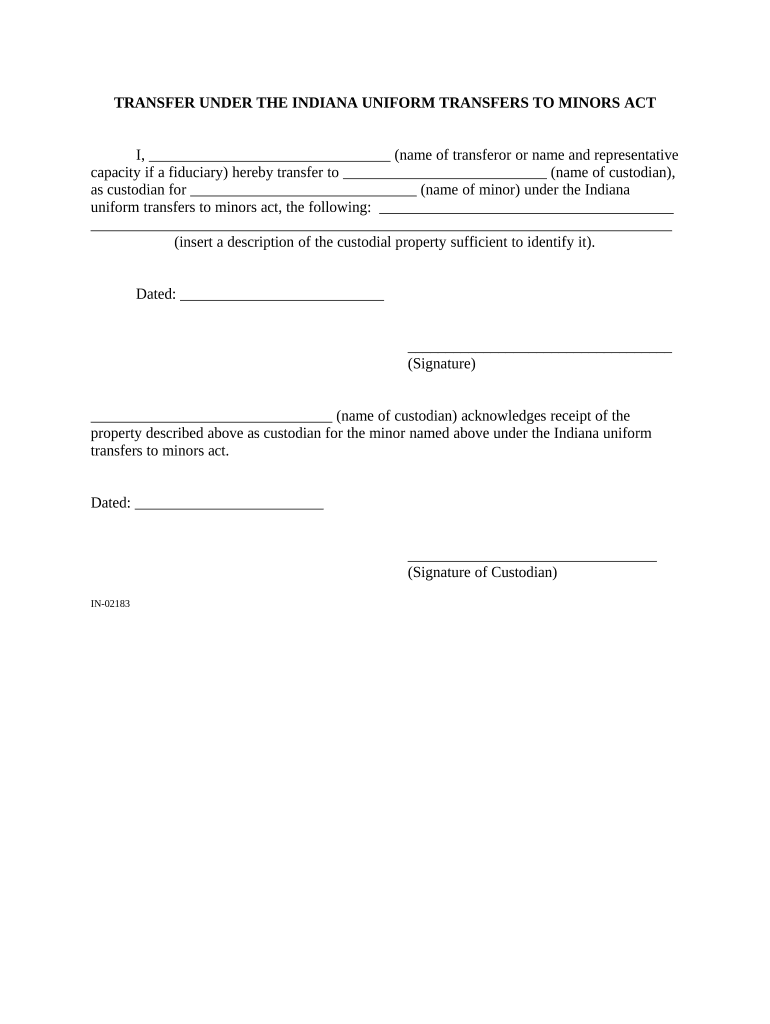
This template is fully customizable. Edit the text, fill out the fields, and send it for signature. Give it a try!
Uniform Transfers to Minors Act

What the Uniform Transfers to Minors Act covers

The Uniform Transfers to Minors Act (UTMA) creates a statutory custodial framework that lets a donor transfer assets to a minor through a custodian without creating a trust. The custodian manages the property for the minor's benefit until the statutory termination age, at which point legal title vests in the former minor. UTMA replaces earlier Uniform Gifts to Minors Act (UGMA) rules in many jurisdictions and extends custodial coverage to additional property types such as real estate and certain intangible assets.

Why UTMA matters for transfers to minors

UTMA simplifies gifting and custodial ownership by avoiding probate and formal trust administration while providing a clear legal mechanism for one person to hold property on behalf of a minor until statutory age. It is commonly used for savings, securities, and small real estate transfers where formal trust management is unnecessary.

Why UTMA matters for transfers to minors

Typical parties and professionals involved

Common parties include donors, custodians, financial institutions, and minor beneficiaries; each has distinct responsibilities under UTMA.

  • Donors and parents often set up custodial transfers when gifting cash, securities, or small assets for a child’s benefit.
  • Financial institutions use custodial agreements to hold accounts, enforce withdrawal limits, and file required tax forms for custodial accounts.
  • Legal and tax advisors review transfer terms, assess gift tax consequences, and confirm compliance with state UTMA provisions.

Professional involvement reduces recording or tax errors and helps ensure the transfer follows the chosen state's UTMA provisions and any related recording or deed requirements.

Core elements to include in a professional UTMA transfer

A complete UTMA transfer document should clearly identify the donor, custodian, minor, transferred property, powers of the custodian, and termination conditions to avoid ambiguity and future disputes.

Donor identification

Full legal name, address, and taxpayer identification for the person making the gift; essential for gift tax reporting and for tracing the transfer back to the donor.
Custodian details

Full legal name and contact information of the custodian, plus any successor custodians and an explicit statement of custody powers and limitations.

Beneficiary info

Minor's full legal name, birthdate, and identifying details so the custodial account and tax records uniquely reference the intended beneficiary.

Property description

Clear description of assets transferred (cash, securities, real property) including account numbers or legal description for real estate to avoid recording errors.

Custodial powers

Express authority the custodian has to invest, sell, reinvest, and spend for the minor's health, education, support, or maintenance, including any restricted powers.

Termination terms

State the age of termination or earlier conditions for distribution, and whether distributions may be made earlier for specific needs or emergencies.

Step-by-step: completing a UTMA transfer

Follow these steps in order to create, document, and effect a valid custodial transfer under the Uniform Transfers to Minors Act.

  • 01
    Identify parties: Confirm donor, custodian, and minor legal names and IDs.
  • 02
    Describe assets: Provide precise descriptions or account numbers.
  • 03
    Sign and date: Obtain signatures per state requirements.
  • 04
    Record if needed: Record deeds for real property transfers where required.

How a custodial transfer takes effect

A UTMA transfer moves legal title to the custodian while vesting beneficial ownership in the minor immediately; the custodian manages assets until termination.

  • Transfer executed: Donor signs transfer document and conveys assets to custodian.
  • Custodian controls: Custodian holds and manages assets for minor's benefit.
  • Record obligations: Record deeds for real property when required by state law.
  • Distribution at age: On reaching statutory age, custodian must transfer assets to the former minor.

Typical digital workflow settings for UTMA documents

Configure electronic fields and recipient roles to reflect donor, custodian, and minor, and to capture signatures and dates in the correct order.

Field Configuration
Signature order Donor signs before custodian
Date field Auto-populate MM/DD/YYYY format
Identity verification Email + SMS code or stronger as required
Attachment Include ID or deed as supporting file

Digital signing and submission considerations

Ensure the eSignature platform supports audit trails, identity verification, and secure storage to meet legal and recordkeeping needs.

  • Audit Trail: Timestamp and IP address captured
  • Authentication: Email or SMS code options
  • File formats: PDF and DOCX supported

Maintain exportable, tamper-evident signed copies and configure document retention consistent with federal and state rules; platforms with API or cloud integrations simplify long-term recordkeeping.

Security and compliance features to verify

Encryption: TLS 1.2/1.3; AES-256 at rest
Regulatory compliance: ESIGN, UETA support
HIPAA readiness: HIPAA-compliant with BAA
Audit logs: Detailed event history retained
Access control: SSO and role-based permissions
Standards: SOC 2 Type II and ISO 27001

Common legal and tax risks to watch for

Unclear property description: May void transfer or create title disputes
Mismatched names: Creates tax reporting and account reconciliation problems
Failure to record: Real property transfers can lose priority without recording
Gift tax oversight: Large gifts may require IRS reporting
Custodian misconduct: Improper distributions create liability for custodian
Incorrect signatures: Improper execution can invalidate the transfer

Pitfalls people commonly encounter when preparing UTMA transfers

  • Using informal language or vague descriptions for transferred property leads to ambiguity and potential later litigation over ownership rights.
  • Failing to name a successor custodian creates administrative gaps if the original custodian dies or becomes incapacitated.
  • Not checking whether state law requires recording or notarization for certain asset types increases the risk of defective title.
  • Omitting clear termination age language causes confusion on when the minor must receive the custodial property.

Time-sensitive requirements and typical timelines

Certain actions related to UTMA transfers are time-sensitive; ensure timely recording, tax reporting, and signature authentication to avoid penalties or invalidation.

Effective date of transfer:

Transfer takes effect on the date signed unless a later effective date is specified.

Recording real property:

Record deeds promptly per county rules to preserve priority of title.

Gift tax reporting:

Report gifts when required under federal tax rules to the IRS (consult IRS guidance).

Custodian documentation:

Retain ID and account records for audit and tax purposes.

Termination age notice:

Provide notice and finalize distribution when the minor reaches statutory age.

Key milestones from transfer to final distribution

Track milestones to ensure custody duties are fulfilled from execution through final transfer to the former minor.

01

Execution of Transfer

Document signed and asset ownership conveyed to custodian.

02

Custodial management

Custodian invests and spends for beneficiary's benefit.

03

Statutory notification

Prepare distribution notice as minor approaches termination age.

04

Final distribution

Transfer legal title and provide accounting to beneficiary.

Practical examples of UTMA transfers

Two concise scenarios show how UTMA transfers operate in common situations and the operational steps custodians follow.

College Savings Transfer

Donor opens custodial account for a minor to hold securities

  • Custodian invests dividends and documents tuition disbursements
  • On reaching the statutory age, custodian transfers remaining assets and provides final accounting to the beneficiary.

Real Property Gift

Parent conveys a small residential lot to a minor via UTMA deed

  • Title is recorded and the custodian manages the property and tax obligations
  • At termination age the custodian conveys clear title and records the distribution.

Practical tips to reduce errors and disputes

Use consistent names, clear property descriptions, and documented successor provisions; confirm whether recording or notarization is required before execution.

Verify identity and tax IDs
Confirm donor, custodian, and minor identities and taxpayer identification numbers to avoid backup withholding and reconcile account tax reporting.
Describe assets precisely
Provide account numbers, CUSIPs, or full legal real estate descriptions to ensure the transferred asset is unambiguously identified and can be recorded.
Name successor custodians
Specify successor custodian(s) and the conditions for succession to prevent administrative gaps if the primary custodian becomes unable to serve.
Keep clear accounting
Maintain transaction records, distributions, and investment activity to support tax reporting and to provide the beneficiary with an accurate final accounting.

eSignature vendor pricing and feature comparison for executing UTMA forms

Compare common eSignature vendors on starting price, trial availability, bulk send, audit trails, HIPAA compliance, and envelope limits to select a platform that meets execution and recordkeeping needs.

signNow DocuSign Adobe Sign PandaDoc HelloSign
Starting Price $8/user/mo $15/user/mo $14/user/mo $19/user/mo $15/user/mo
Free Trial 7-day free trial Varies by plan Varies by plan Varies by plan Varies by plan
Bulk Send Yes Yes Yes Yes No
Audit Trail Yes Yes Yes Yes Yes
HIPAA Compliant Yes Yes Yes No No
Envelope Cap No cap 100 envelopes/user/year Varies by plan Varies by plan Varies by plan

Frequently asked questions about UTMA transfers

Answers to common issues cover execution, tax, notarization, revocation, and electronic signature validity under U.S. law.


Need help? Contact support

be ready to get more
Join over 28 million airSlate SignNow users