Establishing secure connection…Loading editor…Preparing document…

Amended Uniform Commercial Code Security Agreement

This template is fully customizable. Edit the text, fill out the fields, and send it for signature. Give it a try!
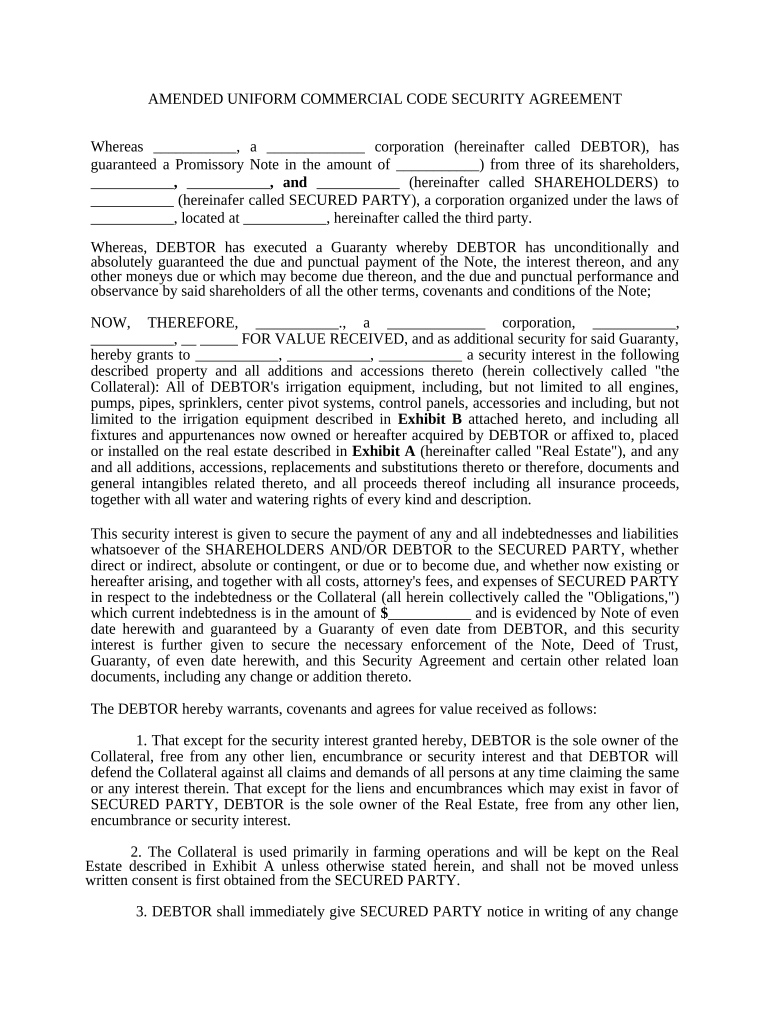
Amended Uniform Commercial Code Security Agreement

What the Amended Uniform Commercial Code Security Agreement Is

An Amended Uniform Commercial Code Security Agreement modifies a previously filed UCC security agreement to change terms such as the collateral description, secured parties, debtor name, or effective date. It documents the parties’ intent to preserve or adjust a security interest under Article 9 of the UCC and is paired with a UCC-3 (amendment) filing to update public records and lien priority.

Why You May Need an Amended UCC Security Agreement

Amendments keep public records accurate, protect lien priority, and reduce disputes. They are commonly used when collateral is added or released, parties change, or clerical errors require correction to maintain enforceability and notice to third parties.

Why You May Need an Amended UCC Security Agreement

Who Typically Prepares and Signs These Amendments

Coordination among counsel, the debtor, and the secured party is essential to ensure the amendment achieves its intended legal and public-record effect.

  • Secured lenders and banks preparing amendments to preserve or change collateral descriptions and priority.
  • Borrowers or debtor companies updating asset lists, addresses, or successor information after a corporate change.
  • Commercial law attorneys and compliance teams who draft precise amendment language and supervise filing.

Core Elements Found in a Professional Amendment

A clear, well-structured amendment should identify the original instrument, specify each change, and confirm continuing or modified security interests.

Amendment Recitals

Identify the original security agreement and UCC filing number, state parties, and summarize why the amendment is needed to provide context for record keepers and courts.
Collateral Description

Provide an exact, unambiguous description of added, omitted, or revised collateral using specific identifiers (serial numbers, account numbers, real property references) to avoid ambiguity.

Continuation Statement

State whether the security interest continues unchanged, is modified in part, or is partially released, and specify the legal effect of each change on secured obligations.

Representations

Include short representations about authority, absence of conflicting liens, and accuracy of debtor identification to reduce future disputes over priority.

Governing Law

Specify which state law will govern interpretation and enforcement, typically the applicable UCC jurisdiction or the state of the debtor’s location.

Execution Block

Provide signature blocks for debtor and secured party, printed names and titles, dates, and notary acknowledgment if required for underlying recordation or collateral type.

Required Data Elements for Filing

Debtor Name: Exact legal name
Secured Party: Official financing name
Original Filing Number: UCC file reference
Collateral: Specific asset details
Effective Date: MM/DD/YYYY
Signatures: Authorized party signatures

Step-by-Step: Completing an Amended UCC Security Agreement

Follow these sequential steps to prepare, execute, and file an amendment correctly.

  • 01
    Draft Amendment: Reference original filing and describe each change clearly.
  • 02
    Review Authority: Confirm signatory authority and any board or lender approvals.
  • 03
    Execute Document: Obtain signatures and dates; notarize if required by state or collateral.
  • 04
    File Amendment: Submit the UCC-3 or equivalent to the state filing office with fee.

Digital Workflow Settings for Electronic Amendment Processing

Configure your e-sign and filing workflow to capture identity, timestamps, and a durable audit trail before submitting a filing.

Field Configuration
Authentication Method Email link, SMS code, or stronger KBA for higher assurance
eSignature Provider Platform that supports audit trail and records retention
Notary Option Enable RON or schedule in-person notary if required
Retention Settings Store executed PDF and certificate of completion securely

Typical Execution and Filing Flow

A standard online workflow reduces errors and preserves evidence needed for lien priority and enforcement.

  • Prepare Amendment: Draft or upload the amendment template.
  • Place Fields: Add signature, date, and initial fields where needed.
  • Sign and Authenticate: Parties sign electronically with chosen authentication.
  • File and Store: Submit UCC-3 and archive executed documents with audit trail.

Platform and File Requirements for eSigning and Archiving

Verify the platform meets your organization’s compliance needs and that exported files include the signing certificate for future evidence.

  • File Formats: PDF or PDF/A preferred for long-term retention
  • Security Controls: TLS in transit and AES-256 at rest
  • Integrations: Support for cloud storage and SoS filing portals

Common Filing and Processing Deadlines

Be mindful of execution and filing timing to protect lien priority and meet contractual deadlines.

Execution Date:

Date on which parties sign the amendment.

File Promptly:

File UCC amendment immediately to preserve priority.

Creditor Notice:

Provide updated notice to relevant lien search parties as required.

Retention Start:

Start retention from execution date for evidence purposes.

Review Cycle:

Schedule periodic review after amendment for accuracy and compliance.

Key Milestones from Draft to Recorded Amendment

Track these numbered milestones to ensure the amendment becomes effective and public-record accurate.

01

Draft Completion

Finalize amendment language and confirm original filing reference.

02

Internal Approvals

Obtain corporate or lender approvals and counsel sign-off.

03

Execution and Notarization

Sign, date, and notarize where required by jurisdiction or collateral type.

04

State Filing

Submit the UCC-3 amendment to the filing office and retain confirmation.

Common Preparation Errors to Avoid

  • Using an incorrect debtor name or trade name that does not match formation documents leads to rejected filings or loss of priority.
  • Vague collateral descriptions such as 'all assets' can create ambiguity and undermine lien enforcement against specific property.
  • Failing to reference the original financing statement or filing number can cause the amendment to be unlinked in public records.
  • Omitting authorized signatory details, notary blocks, or required witness lines results in execution defects and refiling needs.

Potential Consequences of an Incorrect Amendment

Loss of Priority: Competes with other liens
Filing Rejection: Records office may refuse filing
Enforcement Delay: Court actions may be postponed
Additional Costs: Refiling and counsel fees
Creditor Disputes: Challenges to secured rights
Regulatory Exposure: Possible administrative penalties

Typical eSignature Vendor Comparison for UCC Amendments

Compare vendor capabilities and cost structure when selecting an eSignature provider for executing and archiving amended UCC security agreements.

signNow DocuSign Adobe Sign PandaDoc HelloSign
Starting Price $8/user/mo $15/user/mo $14/user/mo $19/user/mo $15/user/mo
Bulk Send Yes (Business Premium) Yes Yes Yes Varies by plan
Audit Trail Yes Yes Yes Yes Yes
HIPAA Compliant Yes Yes Yes No No
Envelope Cap No cap 100 envelopes/user/year Varies by plan Varies by plan Varies by plan

Frequently Asked Questions About Amended UCC Security Agreements

Answers to common legal and practical questions about preparing, executing, and filing amended UCC security agreements.


Need help? Contact support

be ready to get more
Join over 28 million airSlate SignNow users