Establishing secure connection…Loading editor…Preparing document…

Terms of Use and Service Agreement

This template is fully customizable. Edit the text, fill out the fields, and send it for signature. Give it a try!
Terms of Use and Service Agreement

What a Terms of Use and Service Agreement Covers

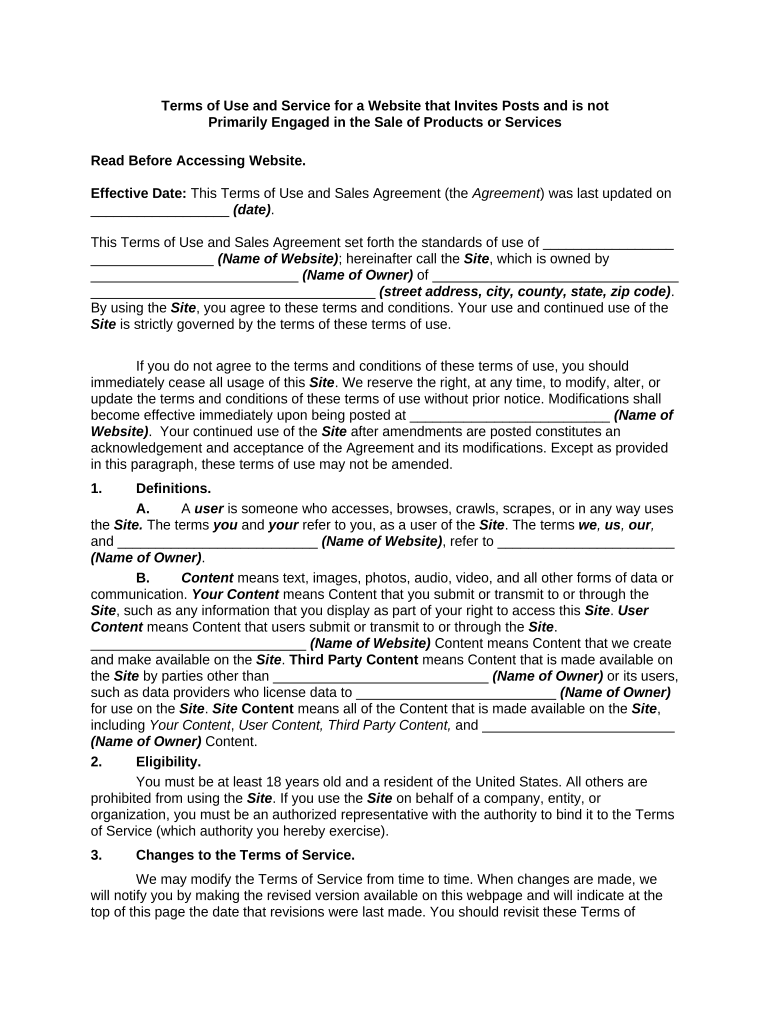
A Terms of Use and Service Agreement is a legal contract that sets the rules and conditions between a service provider and users of a website, application, or digital platform. It defines permitted use, account requirements, intellectual property rights, limitations of liability, disclaimers, dispute resolution procedures, termination rights, and data-handling practices. The agreement should also address consumer disclosures required under federal law when offering electronic records or signatures, and identify governing law and contact information for legal notices. Properly drafted terms help clarify expectations and reduce litigation risk.
Why clear Terms of Use matter for legal certainty

Well-drafted Terms of Use and Service Agreement protect both parties by setting clear rights, responsibilities, and limits on liability. They provide a legal basis for enforcement, reduce ambiguity in disputes, and ensure compliance with electronic signature and consumer disclosure requirements.

Why clear Terms of Use matter for legal certainty

Who typically issues and relies on Terms of Use

Organizations and individuals who publish online services, SaaS providers, marketplaces, and content platforms routinely issue Terms of Use and Service Agreement to govern user interactions.

  • Small and mid-size SaaS companies managing subscriptions and user accounts
  • Enterprises publishing platform policies and integrating them into customer contracts
  • Legal teams and compliance officers reviewing enforceability and regulatory alignment

Core clauses to include in a professional Terms of Use

Essential clauses define user obligations, intellectual property rights, permitted use, disclaimers and limitations of liability, dispute resolution, and procedures for amendments and termination.

User Obligations

Define account eligibility, acceptable conduct, prohibited activities, and consequences for violations. Include account suspension and termination procedures and any fees or penalties tied to breaches to support consistent enforcement.

Intellectual Property

Specify ownership of content, user-generated content licensing, trademark protections, and any license the platform grants to use user submissions, including scope, duration, and revocation rights.

Limitation of Liability

Include disclaimers for indirect, incidental, and consequential damages, cap monetary liability where permitted, and state any warranty disclaimers to limit exposure under applicable state law.

Data Handling

Describe data collection, processing purposes, retention periods, third-party sharing, security measures, and user rights; reference privacy policy and compliance commitments such as HIPAA or PCI where applicable.

Dispute Resolution

Specify governing law, forum selection, arbitration clauses if used, notice requirements for disputes, and how injunctive relief or class-action waivers are handled to support enforcement.

Amendments

Outline how terms are amended, notice to users, effective date of changes, and the user's right to accept or terminate service if they do not agree with updates.

Required information and standard fields

Effective Date: Use MM/DD/YYYY format
Parties' Legal Names: Enter full legal entity names
Contact Information: Include street, city, state, ZIP
Scope of Services: Clear description of services
Payment Terms: Amount, due dates, late fees
Termination Rights: Notice period and effective date

Step-by-step: completing and issuing Terms of Use

Follow these steps to complete, sign, and distribute a Terms of Use and Service Agreement accurately and in compliance with U.S. e-signature laws.

  • 01
    Prepare Document: Draft clauses, define scope, and insert variable fields.
  • 02
    Review Legal: Have counsel check enforceability and consumer disclosures.
  • 03
    Add Signature Fields: Place signature, initials, and date fields for each party.
  • 04
    Distribute and Record: Send via eSignature platform; retain audit trail and copy.

How to configure an online signing workflow

Configure your e-signature workflow to capture consent, authenticate signers, and preserve an audit trail that meets ESIGN and UETA requirements.

Workflow settings and recommended configuration Field | Configuration
Signing order and recipient roles Sequential or parallel; assign roles and responsibilities
Signer authentication options and strength Email link, SMS code, or two-factor for higher assurance
Conditional fields and templates setup Use conditional visibility and templates for consistent execution
Document retention and export configuration Set PDF/A export, storage location, and retention duration

Where to file, send, and store signed terms

Routing a Terms of Use and Service Agreement typically involves upload, field placement, recipient assignment, signer authentication, signing, and automated distribution of the completed record.

  • Upload Document: Import final PDF or DOCX into the platform.
  • Place Fields: Drag signature, date, and checkbox fields into position.
  • Assign Signers: Enter email addresses and set signing order if required.
  • Send and Track: Send invites; monitor completion and download signed package.

Technical considerations for e-submission and distribution

Ensure the e-signature platform supports required formats, authentication levels, and audit logging before finalizing your Terms of Use and Service Agreement workflow.

  • File Formats: PDF, DOCX, and HTML supported
  • Authentication Options: Email, SMS code, KBA, or SAML
  • Security Standards: TLS in transit; AES-256 at rest

Key timing and notice expectations

Key timing expectations for Terms of Use and Service Agreement include effective date, notice periods for changes, signature deadlines, and archival retention triggers.

Effective date and commencement of obligations:

Enter as MM/DD/YYYY; obligations begin unless otherwise stated.

Advance notice period for material changes:

Commonly 30 days; check governing law requirements.

Signature deadline to accept terms:

Specify number of days to sign after notice is sent.

Periodic review, renewal, and version control:

Review annually or after major product changes to maintain accuracy.

Triggers that start retention and archiving periods:

Retention begins at execution and continues per regulatory requirements.

Common preparation mistakes to avoid

  • Using a generic template without tailoring to your service, governing law, or consumer disclosure obligations can render key clauses unenforceable or ineffective in litigation.
  • Failing to include a clear acceptance mechanism and e-consent record undermines ESIGN compliance and may invalidate electronic acceptance by consumers.
  • Omitting dispute resolution details, such as arbitration or venue, leads to uncertainty and increases litigation costs and discovery disputes.
  • Neglecting data-handling clauses or HIPAA references when processing health data exposes the organization to regulatory penalties and contractual liability.

Penalties and legal risks from incorrect or incomplete terms

Unenforceable Terms: Court may refuse enforcement
Regulatory Fines: HIPAA or FTC penalties possible
Consumer Claims: Statutory damages or class actions
Backup Withholding: Tax issues from incorrect TINs
Reputational Harm: User trust and brand damage
Contractual Liability: Indemnity and damages exposure

eSignature vendor comparison relevant to Terms of Use workflows

Comparison of common eSignature vendor features and pricing relevant to executing and managing Terms of Use and Service Agreement.

signNow DocuSign Adobe Sign PandaDoc HelloSign
Starting Price $8/user/mo $15/user/mo $14/user/mo $19/user/mo $15/user/mo
Free Trial 7-day free trial Varies by vendor Varies by vendor Varies by vendor Varies by vendor
Bulk Send Yes (Business Premium) Varies by plan Varies by plan Varies by plan Varies by plan
Audit Trail Yes Yes Yes Yes Yes
HIPAA Compliant Yes (BAA available) Yes Yes No No

Frequently asked questions about enforceability and execution

Answers to frequent questions about drafting, executing, and enforcing a Terms of Use and Service Agreement in the U.S. legal context.


Need help? Contact support

be ready to get more
Join over 28 million airSlate SignNow users