Trust name
A distinct legal name for the trust including the settlor's name and creation date; used in banking and title documents to identify trust-owned assets.
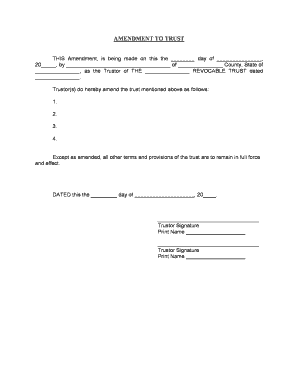
A Utah Trust centralizes asset management, often reduces probate exposure, preserves family privacy, and specifies successor decision-makers. It clarifies distribution timing and trustee duties, which can lower administration time and dispute risk compared with intestate succession or sole reliance on a will.

Professionals and individuals who prepare or sign Utah trusts vary by purpose and asset type.
For many clients, lawyers draft the trust language and trustees or settlors execute the document according to Utah signing practices; digital workflows are frequently used to streamline signatures and recordkeeping.
The person who creates the trust and transfers assets into it. The settlor must use consistent legal name formatting and clearly identify initial trust property; mismatches can complicate funding and title transfers.
The individual or entity accepting fiduciary responsibility. Trustees must acknowledge duties and powers, sign acceptance where required, and follow distribution terms to avoid personal liability.
A distinct legal name for the trust including the settlor's name and creation date; used in banking and title documents to identify trust-owned assets.
Full legal name, address, and declaration of intent to create the trust; accurate information avoids future challenges about capacity or identity.
Enumerated authorities for investment, distribution, and administration; specific powers reduce need for court intervention or later amendments.
Names, distribution percentages, ages, and contingencies; precise language prevents disputes and clarifies when discretionary distributions are permitted.
Steps and examples for transferring real property, accounts, and titles into the trust, plus required deeds and beneficiary designations.
Conditions for trust termination, successor trustee actions, and final distribution mechanics to ensure orderly wind-up.
Use secure eSignature and storage methods that meet Utah legal and industry-specific standards when executing trust documents online.
Ensure any eSign vendor used supports ESIGN/UETA compliance, audit trails, secure storage, and the specific export formats required by title companies and financial institutions.
Document effective as of the signed date.
Record transfers promptly; county recording delays vary widely.
Update financial account registration within weeks of execution.
File trust returns as required; timing depends on fiscal year and transactions.
Review trust terms every 3–5 years or on major life events.
Optica used a simple signing workflow to collect client approvals quickly.
A small real estate firm processed trust transfers and title updates online.
| Document Type | Utah Trust | Last Will | Transfer-on-Death Deed |
|---|---|---|---|
| Avoids probate | often | often for specific property | |
| Privacy level | high | low (public probate) | medium |
| Typical notarization | recommended | not required for validity | required for recording |
| Amendable | usually (revocable) | yes until death | yes until conveyance |
| signNow | DocuSign | Adobe Sign | PandaDoc | HelloSign | |
|---|---|---|---|---|---|
| Starting Price | $8/user/mo | $15/user/mo | $14/user/mo | $19/user/mo | $15/user/mo |
| Free Trial | Yes (7-day trial) | No | No | Yes, limited | Yes, limited |
| Bulk Send | Yes | Yes | Yes | Yes | No |
| Audit Trail | Yes | Yes | Yes | Yes | Yes |
| HIPAA Compliant | Yes | Yes | Yes | No | No |