Parties
Identify landlord or owner, designated agent, and tenant(s) by full legal name and provide the full property address including unit number to avoid misidentification and ensure valid service and later enforcement.
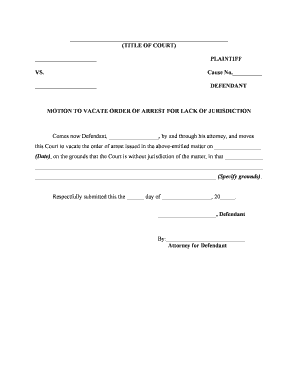
A properly drafted Vacate Order documents statutory and contractual bases for removal, informs the occupant of required actions and deadlines, preserves proof for enforcement, and reduces the risk of procedural dismissals or later liability.

Landlords, property managers, tenant attorneys, housing authorities, and court clerks commonly prepare, serve, or respond to Vacate Orders in eviction and compliance matters.
Identify landlord or owner, designated agent, and tenant(s) by full legal name and provide the full property address including unit number to avoid misidentification and ensure valid service and later enforcement.
State precise legal grounds for the notice: nonpayment, lease breach, holdover, or other statutory cause and cite the relevant lease clause or statutory provision when possible to show the basis for action.
Specify an exact vacate date in MM/DD/YYYY format where applicable, or a statutorily defined period (for example 'within 3 days'); include time of day if required by law or lease.
When a cure opportunity is required, describe the exact actions needed, acceptable payment methods, the final cure deadline, and how the tenant may demonstrate compliance.
Detail how the notice will be served—personal delivery, posting on the premises, certified mail, or statutory alternatives—and record the date, recipient, and proof of service.
Explain consequences for failing to vacate, such as filing for eviction, seeking a writ of possession, charging court costs, or reporting defaults, and reference applicable statutory remedies.
| Field | Configuration |
|---|---|
| Template | Pre-fill owner, property, and lease data |
| Signer Roles | Designate landlord or agent signature |
| Service Logging | Capture method, timestamp, and proof |
| Archive | Store signed copy + audit trail |
Use an eSignature platform that produces tamper-evident signed PDFs, stores audit trails, and integrates with your case or property management systems.
Often short (commonly 3–5 days) depending on state.
May allow cure periods typically 10–30 days.
Often require 30 days' notice or as statute provides.
Filing for eviction typically permitted after notice period expires.
Keep service receipts, return receipts, or affidavit of service.
Landlord prepares and signs the Vacate Order with explicit date and grounds.
Tenant receives notice via permitted method and service is documented.
Deadline passes; tenant may have cured or remained in possession.
Landlord may file eviction action or seek writ of possession if needed.
A landlord documents three months of unpaid rent and serves a 3-day pay-or-quit notice with certified mail
A public housing authority issues a 30-day vacate notice for lease violation after documented warnings
| signNow | DocuSign | Adobe Sign | PandaDoc | HelloSign | |
|---|---|---|---|---|---|
| Starting Price | $8/user/mo | $15/user/mo | $14/user/mo | $19/user/mo | $15/user/mo |
| Free Trial | 7-day free trial | Varies by vendor | Varies by vendor | Varies by vendor | Varies by vendor |
| Bulk Send | Yes | Yes | Yes | Yes | No |
| Audit Trail | Yes | Yes | Yes | Yes | Yes |
| HIPAA Compliant | Yes | Yes | Yes | No | No |