Caption
Court name, county, case number and party names at the top; ensures the filing is routed to the correct court division and clerk.
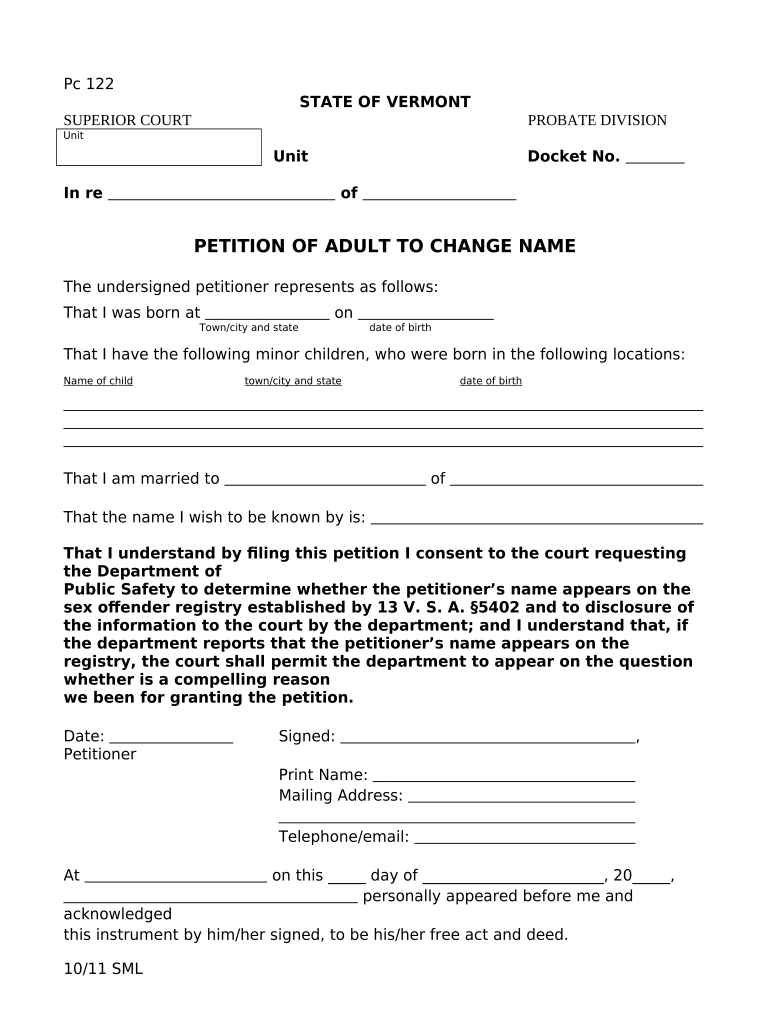
A court-ordered name change creates a single, verifiable legal record that enables consistent identity updates across public and private records and reduces later disputes.

People and professionals file petitions for several routine reasons.
Attorneys and court clerks also work with these petitions to verify identity, manage service, and prepare the final decree for record updates.
| Field | Configuration |
|---|---|
| E-sign Enabled | Verify the county court accepts electronic signatures before e-filing. |
| Authentication | Use email or SMS code; choose stronger ID when court requires it. |
| Document Format | Submit PDFs; use PDF/A or flattened PDFs for stability. |
| Service Method | Configure certified mail or personal service per local rules. |
Ensure chosen platforms meet court standards and local acceptance for electronic records.
Confirm with the county clerk whether e-submission, remote notarization, or certified electronic records are acceptable before relying on purely digital workflows.
Court name, county, case number and party names at the top; ensures the filing is routed to the correct court division and clerk.
Full legal name, current address, DOB, and contact details; used for identity verification and service of process.
A concise factual statement explaining why the name change is sought, without extraneous or defamatory material.
Certified birth certificate, photo ID, and any adoption or divorce decree copies that support and validate identity claims.
Information on required service or publication and proof that notice was given to interested parties when applicable.
A draft order for the judge to sign if the petition is granted; including language for record updates and certificate issuance.
A certified copy from the vital records office establishes birth identity; courts often require an original or certified copy rather than a photocopy.
Driver's license or passport confirms identity and supports the petition. Expired IDs may be rejected depending on clerk discretion.
Recent utility bill, lease, or tax document showing current address; helps establish jurisdiction for filing the petition.
Save completed documents as flattened PDF or PDF/A for stable archiving and submission to e-filing systems when accepted.
A petitioner files to adopt a spouse's surname after marriage to align identity documents.
A petitioner seeks to correct a misspelled name on official records to match true identity.
The date you submit the petition; starts court processing and any publication clock.
If required, publish notice per local rule before the hearing; duration varies by county.
Court schedules a hearing or grants by review; scheduling depends on clerk workload.
Judge signs decree at hearing or on review; obtain certified copies from clerk.
Use certified decree to update Social Security, DMV, banks, and other records promptly.
Submit petition and supporting documents to the county court clerk; pay filing fee.
Complete any required public notice or proof of service as directed by court rules.
Judge reviews petition; attend hearing if scheduled or provide additional evidence if requested.
Receive certified decree and distribute copies to agencies to effect legal name changes.
| signNow | DocuSign | Adobe Sign | PandaDoc | HelloSign | |
|---|---|---|---|---|---|
| Starting Price | $8/user/mo | $15/user/mo | $14/user/mo | $19/user/mo | $15/user/mo |
| Free Trial | 7-day free trial | Varies by plan | Varies by plan | Limited trial | Limited trial |
| Bulk Send | Yes (Business Premium) | Yes | Yes | Yes | Limited |
| Audit Trail | Yes | Yes | Yes | Yes | Yes |
| HIPAA Compliant | Yes | Yes | Yes | No | No |