Establishing secure connection…Loading editor…Preparing document…

Virginia Affidavit for Service by Publication

This template is fully customizable. Edit the text, fill out the fields, and send it for signature. Give it a try!
Virginia Affidavit for Service by Publication

What the Virginia Affidavit for Service by Publication Is

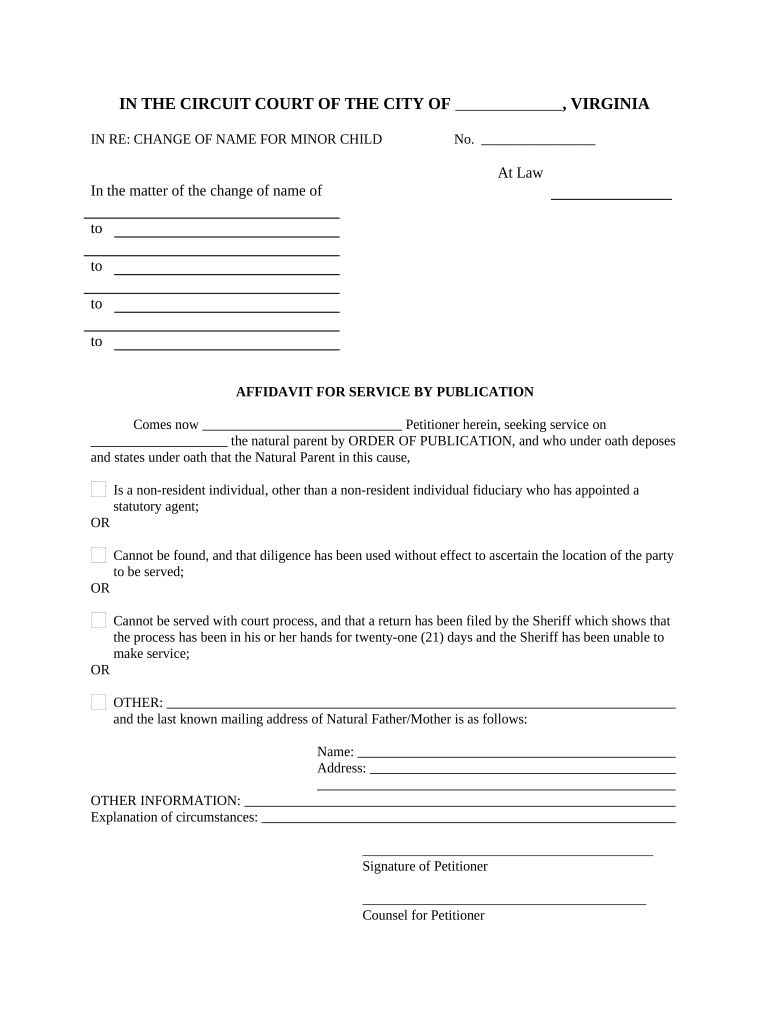
The Virginia Affidavit for Service by Publication is a sworn statement filed with a Virginia court describing the efforts made to locate and serve a defendant who cannot be found by ordinary means. It documents due diligence — attempts at personal service, mail, and other reasonable methods — and requests permission to serve process by publishing notice in an approved newspaper or other court-ordered medium. Courts use the affidavit to determine whether statutory and procedural prerequisites for publication-based service have been met before authorizing notice by publication.

When this affidavit matters

Use the affidavit when a party cannot be located after reasonable, documented efforts; it provides the court the factual basis to allow alternative service by publication in place of personal service.

When this affidavit matters

Who prepares and relies on this affidavit

This affidavit is typically prepared by the plaintiff, the plaintiff's counsel, or a process server who attests to attempts at locating the defendant.

  • Plaintiffs and counsel who must effect service when a defendant’s location is unknown
  • Professional process servers who document attempts and sign under oath
  • Court clerks and judges who evaluate compliance with procedural rules

Typical signatory profiles

Process Server

A licensed process server or sheriff who personally attempted service and documents each attempt, including dates, locations, contacts, and any returned mail. The server signs the affidavit under oath before a notary or other authorized official.

Attorney / Plaintiff

The plaintiff or the plaintiff’s attorney who certifies efforts to locate the defendant based on client information, public records searches, and contact attempts. Their sworn statement supports the motion for service by publication.

Core parts of a proper Virginia Affidavit for Service by Publication

A complete affidavit combines case identifiers, an account of diligent search efforts, the inability to find the defendant, identification of the newspaper or medium proposed for publication, a proposed publication schedule, and a sworn signature before a notary.

Case information

Court name, case number, plaintiff and defendant names, and the division or county where the case is filed to ensure correct docketing.
Search chronology

A dated, step-by-step account of all attempts to locate and serve the defendant, including addresses checked, phone calls, certified mail attempts, online searches, and contact with known associates.

Legal basis

A short statement referencing the court rule or statutory authority permitting service by publication when proper service cannot be effected.

Proposed publication

Name of the newspaper or publication, circulation basis, proposed frequency and duration of publication, and why the chosen medium is likely to give notice to the defendant.

Sworn statement

Affiant’s oath language confirming truthfulness, followed by the affiant’s printed name, signature, and the date of signing.

Notarial block

Notary acknowledgment or jurat showing the affiant appeared before an authorized official and swore or affirmed the contents; include notary name, commission number, and expiration.

Step-by-step: preparing and filing the affidavit

Follow these sequential steps to assemble a defensible affidavit and submit it for court approval.

  • 01
    Gather case facts: Collect complaint, docket number, and contact details for all parties.
  • 02
    Document searches: Perform address, DMV, and database searches; record each result with a date.
  • 03
    Draft affidavit: Write a clear chronology of attempts and the basis for publication.
  • 04
    Notarize and file: Sign before a notary if required and file or e-file with the clerk.

How courts evaluate a service-by-publication request

Understanding the courthouse workflow helps you provide precisely the evidence judges expect when considering a publication request.

  • Clerk review: Clerk checks case details and filing compliance before judge review.
  • Judge evaluation: Judge assesses the affidavit’s detail and reasonableness of search efforts.
  • Order issued: Court issues an order authorizing publication if satisfied with efforts.
  • Publication executed: Plaintiff publishes notice per the court order and files proof of publication.

Digital workflow configuration for online completion

Set up an e-filing or digital-signing workflow that preserves evidence of filing, signatures, and notarization for court review.

Field Configuration
Document Upload Accept PDF or DOCX; preserve original timestamps.
Signature Field Require signer name, signature, and date field.
Notary Block Include jurat or acknowledgment and a notary signature field.
Proof of Publication Attach publisher’s affidavit or certificate after publication.

Technical considerations for e-completion and filing

Ensure your chosen platform supports secure signature capture, notarization workflows, and archival of completed records.

  • File formats: PDF, PDF/A, Word DOCX accepted by most e-filing systems
  • Authentication: Email + SMS or stronger methods for signer attribution
  • Notarization: Support for in-person jurat or RON where permitted

Essential data and security items to include

Affiant Contact: Phone/email for verification
Document Hash: Digital fingerprint for integrity
Audit Trail: Timestamped signing events
Notary Info: Commission number and expiration
Publication Proof: Publisher’s affidavit or certificate
Retention Tag: Record retention metadata

Common pitfalls to avoid

  • Vague search descriptions with no dates or locations that fail judicial review
  • Using only a P.O. box or outdated contact information as the basis for service efforts
  • Failing to include a proper notarial jurat or incorrect notary information
  • Not filing proof of publication promptly after the notices run

Consequences of an inadequate affidavit

Motion Denied: Court may refuse authorization for publication
Default Relief Invalid: Judgments based on defective service can be vacated
Delay: Case timelines may extend substantially
Increased Costs: Additional notices, refilings, or hearings
Sanctions: Possible court sanctions for false statements
Evidence Risk: Weak affidavit undermines enforcement efforts

Timing and procedural deadlines to track

Adhere to court-ordered publication schedules and file proof promptly; missed dates can invalidate service or delay relief.

Request to Court:

File affidavit and motion before publication begins

Publication Window:

Run notices for the period ordered by the court (commonly weekly for several weeks)

Proof of Publication:

File publisher’s affidavit immediately after final issue

Response Period:

Count statutory response time from the date of last publication per the order

Appeals/Challenges:

Opposition can challenge sufficiency after service is completed

Key milestones from affidavit to proof of publication

Track these sequential milestones to ensure full compliance from filing to court recognition of service.

01

Prepare Affidavit

Assemble evidence of search efforts and draft sworn statement.

02

File Motion

Submit affidavit with a motion asking the court to permit publication.

03

Court Order

Receive the court’s written authorization specifying publication terms.

04

Publish and File Proof

Run notices per order, obtain publisher affidavit, and file proof with the clerk.

Practical examples of affidavit use

Two concise, real-world scenarios show how the affidavit supports court authorization for publication.

Foreclosure Action

A lender documented multiple certified mail attempts and county property searches

  • Affiant attached returned mail receipts and title searches
  • The court granted publication and the lender filed proof of publication, allowing the sale to proceed.

Debt Collection

A collection attorney ran skip traces and contacted known relatives

  • Affiant listed dates and outcomes of each contact attempt
  • After the court authorized publication, the defendant later appeared and the matter proceeded on the merits.

Comparing eSignature providers for affidavit completion and notarization workflows

Choose a provider that supports notarization workflows, audit trails, and secure storage; signNow is listed first for comparative pricing and feature context.

signNow DocuSign Adobe Sign PandaDoc HelloSign
Starting Price $8/user/mo $15/user/mo $14/user/mo $19/user/mo $15/user/mo
Free Trial 7-day free trial, no credit card Varies by vendor Varies by vendor Varies by vendor Varies by vendor
Bulk Send Yes Yes Yes Yes No
Audit Trail Yes Yes Yes Yes Yes
HIPAA Compliant Yes Yes Yes No No

Frequently asked questions about the Virginia Affidavit for Service by Publication

Answers to common questions focus on procedural sufficiency, notarization, and how to file proof of publication in Virginia courts.


Need help? Contact support

be ready to get more
Join over 28 million airSlate SignNow users