Establishing secure connection…Loading editor…Preparing document…

Washington Motion

This template is fully customizable. Edit the text, fill out the fields, and send it for signature. Give it a try!
Washington Motion

Overview: The Washington Motion explained

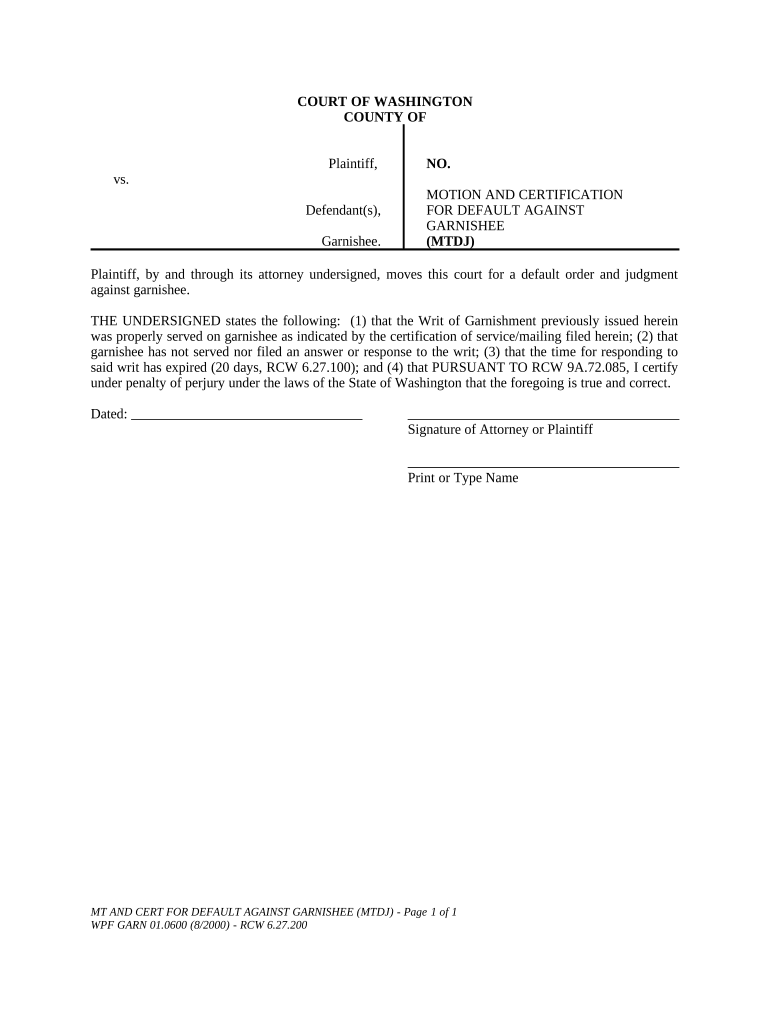
A Washington Motion is a formal written request submitted to a court in the state of Washington asking the judge to issue a specified order or ruling. Motions can seek temporary relief, clarification of procedure, dismissal, summary judgment, continuances, or other case-specific remedies. A properly prepared motion includes a caption, concise statement of facts, legal argument supported by authority, a clear request for relief, and proof of service. Local court rules and state civil procedure govern format, timing, filing method, and hearing procedures, so practitioners must confirm the applicable rule set before filing.

Why a well-prepared Washington Motion matters

A clear, rule-compliant motion improves the chance the court considers your legal arguments promptly and avoids procedural rejection. Proper form, supporting evidence, and timely service preserve rights and reduce the risk of sanctions or delay.

Why a well-prepared Washington Motion matters

Who typically prepares and files a Washington Motion

The Washington Motion is used by attorneys, self-represented litigants, government attorneys, and authorized agents to request court action in civil and family proceedings.

  • Private attorneys representing plaintiffs or defendants in civil litigation and family law matters.
  • Pro se litigants who prepare and file motions on their own behalf under court rules.
  • Government counsel and prosecutors when requesting judicial orders in administrative or enforcement matters.

Confirm who may sign and file in your matter (attorney of record, party, or authorized agent), and follow the court’s electronic filing and service requirements.

Step-by-step: Preparing a Washington Motion

Follow these sequential steps to draft, review, and file a compliant Washington Motion.

  • 01
    Draft the caption: Include court name, case number, party names, and title of the motion.
  • 02
    State facts: Summarize relevant, admissible facts concisely with supporting citations or exhibits.
  • 03
    Set out legal argument: Cite statutes, rules, and case law that support your requested relief.
  • 04
    Proof of service: Attach proof that opposing parties were properly served per local rules.

Filing flow: From draft to hearing

This simplified workflow shows the common operational steps from preparing a motion to a court ruling.

  • Draft and attach exhibits: Create the motion document and gather all supporting exhibits and declarations.
  • Internal review: Proofread, verify citations, confirm meet-and-confer obligations where required.
  • File and serve: E-file with the court and serve opposing counsel per local rules.
  • Hearing or ruling: Attend scheduled hearing or await the court’s written ruling on the motion.

Digital filing and e-submission essentials

Many Washington courts accept e-filed motions through state-supported e-filing portals or approved third-party vendors; confirm court-specific requirements before submitting.

  • File format: PDF documents with searchable text.
  • Authentication: User account and two-factor authentication commonly required.
  • Integrations: Supports cloud storage and case management integrations.

Ensure your chosen platform supports required formats, produces a timestamped audit trail, and can generate the proof-of-service or filing receipt the court requires.

Typical e-filing configuration for a motion

Configure these settings when preparing an electronic motion to match court and practice needs.

Field Configuration
Document type Motion | Attach exhibits as separate PDFs
Signer settings Attorney account signs electronically; include firm contact block
Service method Electronic service per court rule or email where permitted
Notification Enable filing receipts and calendar notifications

eSignature platform pricing and compliance snapshot

A concise feature and pricing comparison of common eSignature vendors relevant when preparing and executing court-related documents.

signNow DocuSign Adobe Sign PandaDoc HelloSign
Starting Price $8/user/mo $15/user/mo $14/user/mo $19/user/mo $15/user/mo
Free Trial 7-day free trial Varies by vendor Varies by vendor Varies by vendor Varies by vendor
Bulk Send Yes (Business Premium+) Yes Yes Yes No
Audit Trail Yes Yes Yes Yes Yes
HIPAA Compliant Yes Yes Yes No No
Envelope Cap No cap 100 envelopes/user/year Varies Varies Varies

Essential elements to include in a professional Washington Motion

A motion should present facts and legal authority clearly while making the requested relief immediately identifiable to the court.

Caption

Court name, case number, party names, and title of the motion so the filing is associated with the correct matter and calendar.
Statement of Facts

Concise recital of relevant facts supported by citations to record evidence or attached declarations and exhibits.

Points and Authorities

Legal argument with direct citations to statutes, case law, and rules that authorize the relief requested.

Relief Requested

Plain statement of the specific order sought, including any proposed order language the court may adopt.

Supporting Declaration

Affidavit or declaration under penalty of perjury verifying factual statements and authenticating exhibits.

Proof of Service

Document showing how, when, and to whom the motion and exhibits were served in compliance with local rules.

Common timeline items to verify before filing

Key timing elements vary by court; confirm the local rules and scheduling orders that apply to your case.

Filing Date:

Date you submit the motion to the court; determines subsequent response deadlines.

Service Date:

Date opposing parties receive documents; many rules measure response time from this date.

Opposition Deadline:

Often 7–21 days after service depending on local rule or judge’s order; check the applicable rule.

Reply Deadline:

Often a shorter window, typically several days after opposition—confirm the court schedule.

Hearing Date:

Set by the court or clerk; may be several weeks after filing or on an expedited calendar.

Penalties and risks of filing an improper motion

Motion Denial: Court may deny for procedural noncompliance.
Sanctions: Judge may impose monetary or evidentiary sanctions for frivolous filings.
Case Delay: Improper service or missing exhibits can delay proceedings.
Waiver of Issues: Failure to timely raise an issue can result in waiver.
Evidence Exclusion: Unsupported factual assertions may be excluded at hearing.
Costs Awarded: Court may award opposing party costs for improper motions.

Common mistakes to avoid when preparing a Washington Motion

  • Using an incorrect caption or case number, which can cause the clerk to misfile or reject the submission and delay the matter.
  • Failing to attach or properly label exhibits and declarations, leading the court to disregard critical evidence or continue the hearing.
  • Not following local page, font, or formatting rules; nonconforming briefs are often rejected or returned for correction.
  • Neglecting to confirm service method and deadlines; defective service can void the motion or result in additional filings.

Real-world scenarios where a Washington Motion is used

Practical examples illustrate typical contexts and the accompanying documentation commonly required.

Civil Discovery Dispute

A party files a motion to compel discovery to obtain withheld documents.

  • The motion includes specific discovery requests and privilege logs.
  • The filing attaches meet-and-confer correspondence and the disputed discovery responses, and requests an order compelling production and awarding reasonable expenses under the applicable rule.

Emergency Relief

A litigant seeks emergency injunctive relief to prevent imminent harm.

  • The motion requests immediate temporary restraining order.
  • The submission provides sworn declarations, evidence of irreparable harm, and a proposed order, and follows expedited service and notice procedures required by the court.

FAQs: Common questions about the Washington Motion

Answers to frequently asked questions about form, filing, e-signing, and common procedural issues when preparing a Washington Motion.


Need help? Contact support

be ready to get more
Join over 28 million airSlate SignNow users